
Tuesday, October 7, 2014
MoSAIC
The pair of interlocking sliced tori that went to the Bridges 2012 conference are now part of the permanent collection of the Bridges Organization and are traveling with a series of weekend math-art conferences called MoSAIC (Mathematics of Science, Art, Industry, Culture; what a math-artful acronym!). MoSAIC landed at Berkeley College in Berkeley CA this past weekend; it's next stop will be Columbia University in New York City, followed by my fist Alma Mater, the University of Illinois in Urbana IL, next month. The complete schedule for this year is here; check out a conference if it comes your way!

Tuesday, September 16, 2014
Porcelain and a spider
One of the joys of culling together three part-time jobs doing three different things I (fortunately) really enjoy and that require reporting largely only to myself, is that when things pile up, they really pile up. At some point, I will take photos of the new glazes I've been using. Initial results have ranged from truly spectacular to good-for-under-plants to not-even-its-mother-could-love.

I'm experiencing some impressive, unpredictable bloating in my dark clay (Standard 266). This was something a friend had warned me a while ago to expect with this clay but that I've never had problems with until recently. For some reason, only bowls bloat; chickens, zigzags, salt rocks, and mugs have been fine. Meanwhile, my favorite white clay, Li'l Loafers, is leaving annoying little bubbles in the new glazes (unless the clay is super thin). From what I've read, I suspect there are impurities in the clay that can't quite burn out through the glaze. Slower bisquing hasn't seemed to help, so I'm trying a switch to Helios porcelain.
Porcelain and I haven't gotten a long so well in the past; it's finicky, while I'm generally an impatient kludger. Having avoided porcelain for a few years, I'm currently pretending we're just meeting each other for the first time, and I plan to try to get to know porcelain for what it is, as opposed to what it isn't. All I shall observe at present is that, astonishingly, I can throw a bowl out of two pounds of porcelain that's about twice as big as what I can throw with two pounds of Li'l Loafers or 266. Also, porcelain doesn't rinse off as well as the other clays. (I'm shedding clay dust on my computer as I type; new studio cleaning habits will commence shortly.)
Since I don't have a photo of pots, I'll post this photo of a hard-working spider that was hanging out near the porch studio last night.
Thursday, August 28, 2014
The Clay's Lament
Sometimes folks in the communal pottery studio leave their clay on the plaster part of the wedging table to dry for a bit, and then they forget about it. Tonight, an accumulation of dried out clay lumps inspired this:
The Clay's Lament
~ in tragic verse ~
High atop a mountain born,
Across millennia, ground and worn,
'Til rested I in a riverbed,
For thy art then harvested.
My life, once formed, was all too brief:
My form, once lived, brought thee but grief.
Now on th'wedging table, I:
Abandoned here, out to dry.
Will no artist's hand or eye
Alter this cruel destiny?
Across millennia, ground and worn,
'Til rested I in a riverbed,
For thy art then harvested.
My life, once formed, was all too brief:
My form, once lived, brought thee but grief.
Now on th'wedging table, I:
Abandoned here, out to dry.
Will no artist's hand or eye
Alter this cruel destiny?
Friday, August 15, 2014
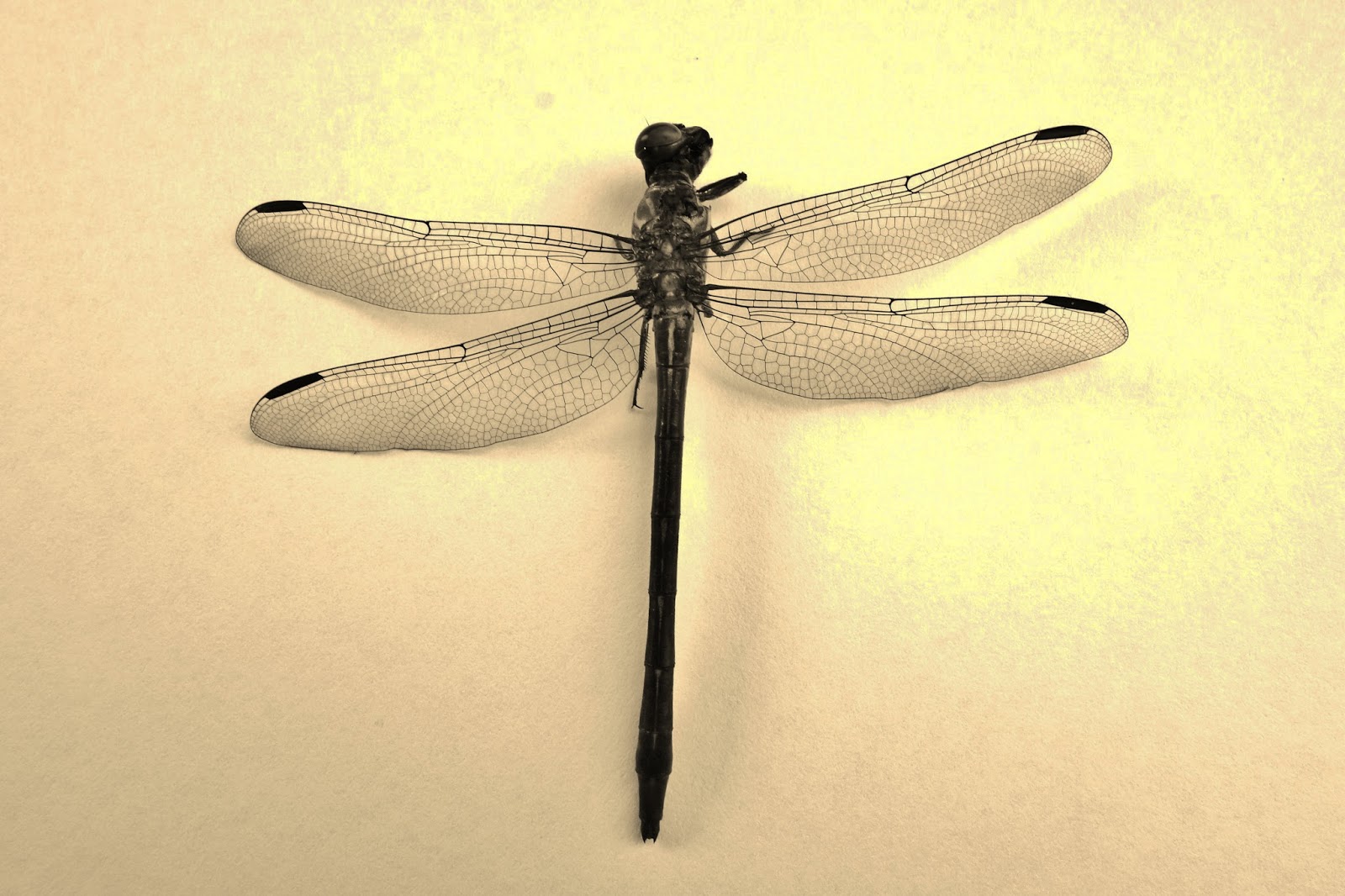
Dragonfly
I went for a jog this morning at West Point on the Eno, and found the remains of most of a dragonfly near the end of my route. I brought it home with me and photographed it on the porch. After downloading the images, I went back outside to try to get a better color shot at the angle I liked best, but in the meantime, ants had found the dragonfly. Perhaps I will continue to take photos all day long, to see how this ends up.

Wednesday, August 13, 2014
Lessons from the spray booth
Well folks, I've finally done it! Thanks to a grant from the Durham Arts Council, I have, in the past few months:
Finally, finally, I spent last weekend in the basement hanging out with the camel crickets and the mosquitoes, mixing up glazes.
And then, finally, finally, finally, today, I plugged in the compressor and the hood, hooked up the sprayer, and set to work.
Here is what I have learned so far:
Lesson 1: Before spraying, you're supposed to make sure your glazes are well sieved, lest they clog up the sprayer. Something clogged up my sprayer almost immediately, but it wasn't the newly mixed, freshly sieved glaze. I noticed little black threads accumulating in the sprayer nozzle. I took the nozzle apart and discovered the problem. Turns out, ants are not well sieved. They come through the nozzle in little shredded bits of abdomen, legs, and who knows what. There were about one and a half survivors; I'm not sure how many casualties there were. It has never been my practice with other spray booths to check for ants in the hosing first, but from here on out, it will be part of my plan.
Lesson 2: The compressor draws too much current and keeps tripping the circuit breaker. This is very annoying, and more than a little disappointing on Spray Booth Grand Opening day.
Lesson 3: Spiders loooove bisqueware. There is no better place to start a web than on a bisqued bowl that is about to be glazed. The more recently the bowl has been wiped down, the better: there's no time like the present!
(Since I'm sharing bug lessons, I should add that the dried up palmetto bug that fell off a greenware bowl into the bottom of the kiln on Sunday combusted 100% at cone 06/1824oF.)
Now I shall eat lunch.
- organized a space in the basement for storing glaze chemicals and mixing glazes (which involved removing a lot of junk, and nudging S to organize his hoard. Despite adding a few hundred pounds of raw glaze chemicals, the basement is now a far far safer place than it was previously);
- purchased or collected the necessary equipment for mixing glazes (buckets, jars, sieves, scale, scoops, cabinet, drill & mixing extension, table, etc. etc.);
- replaced the homemade spray booth that S designed for me from a 45-gallon chemical storage keg (a cool idea, and much appreciated, but tiny) with a much more spacious, easier-to-clean, affordable booth I nabbed from a potter who was closing up shop;
- and reorganized my porch studio to accommodate the spray booth, which was originally supposed to go in the basement, but--ha--it wouldn't fit through the hobbit door; so we decided to put it on the front porch, but it wouldn't fit through the human door either; so S took out a screen panel, and we lifted the booth over the railing into the porch studio and re-installed the screen. That was some unexpected fun.
Finally, finally, I spent last weekend in the basement hanging out with the camel crickets and the mosquitoes, mixing up glazes.
And then, finally, finally, finally, today, I plugged in the compressor and the hood, hooked up the sprayer, and set to work.
Here is what I have learned so far:
Lesson 1: Before spraying, you're supposed to make sure your glazes are well sieved, lest they clog up the sprayer. Something clogged up my sprayer almost immediately, but it wasn't the newly mixed, freshly sieved glaze. I noticed little black threads accumulating in the sprayer nozzle. I took the nozzle apart and discovered the problem. Turns out, ants are not well sieved. They come through the nozzle in little shredded bits of abdomen, legs, and who knows what. There were about one and a half survivors; I'm not sure how many casualties there were. It has never been my practice with other spray booths to check for ants in the hosing first, but from here on out, it will be part of my plan.
Lesson 2: The compressor draws too much current and keeps tripping the circuit breaker. This is very annoying, and more than a little disappointing on Spray Booth Grand Opening day.
Lesson 3: Spiders loooove bisqueware. There is no better place to start a web than on a bisqued bowl that is about to be glazed. The more recently the bowl has been wiped down, the better: there's no time like the present!
(Since I'm sharing bug lessons, I should add that the dried up palmetto bug that fell off a greenware bowl into the bottom of the kiln on Sunday combusted 100% at cone 06/1824oF.)
Now I shall eat lunch.
Sunday, July 20, 2014
Jamie Kirkpatrick workshop
Several years ago, I took two classes taught by Jamie Kirkpatrick at Claymakers: one on making larger pots and one on saggar firing. If I nudge my students now with the cheer, "you are the boss of the clay," it was in Jamie's classes that I started to be the boss of my own clay. So I was delighted that Jamie came back to Claymakers in early June to teach a saggar-firing workshop. The workshop (along with a workshop with Deborah Schwarzkopf last year) was a good reminder that, yes, you can make pretty much anything you want out of clay--you just have to figure out how. Jamie's pots are gorgeous, the cohort of students was a pleasure to spend a week with, and the results of the firing were dramatic and beautiful.


 |
| C.E.'s secret code soaked up the smoke |
 |
| My best result: copper wire mask with oxidation spot from hole in saggar |
 |
| Zigzag pot with oxidation spot from saggar hole (red slip on white clay) |
 |
| Totally reduced chickens and nested spheroid with one of Jamie's pots to the right and K.S.F.'s pots to the left |
 |
| Jamie pot with swirl |
 |
| Heavy metal stripes on a Jamie pot |
 |
| Jamie's carved pot |
 |
| Fresh fern oxidation shadow on a pot by K.S.F. |
 |
| S.S. dipped hexagon netting into copper wash and got this fascinating result |
Wednesday, June 18, 2014
Subscribe to:
Posts (Atom)

