Showing posts with label things you blow in. Show all posts

Saturday, June 15, 2013

The NC Maker Faire and the easiest fipple in the world

Today E, S, and I went to the NC Maker Faire--our first Maker Faire experience.


E's highpoint was learning to solder:


He made his very own blinky Make LED robot pin:


When he came home, he added a piece of paper to the back to interrupt the circuit; otherwise the LEDs would blink until the battery ran out.

S's highpoint was seeing the robotic bugs by the folks at www.sheekgeek.com, although I suspect he also enjoyed showing off his biking finesse by zipping his way through SPARKcon's stationary bike race. S handily won the first race; E came from behind to win the second.


My highpoint was learning how to make the least fickle fipple in the world from wood artist Hal Papan. I was drawn to his table of wood whistles when I looked up to see a hands-on wood-whistle-finishing demo in progress. Hal kindly talked to me about fipples and let me finish a whistle too. He had prepared a bunch of nearly-finished whistles, having already carved the bores and cut the bevels and fipple plugs; my task was simply to orient the plug properly and insert it far enough into the bore that it lined up with the vertex of the bevel cut. He had to help me force the plug in far enough, since it was a tight fit, but the nudge-check-nudge-check process was helpful since I could easily hear the difference between the not-quite-there-yet sound and the loud tweet of the aligned plug. It's a very pretty whistle, with lovely knots and curves.


Of course, when I got home, I tried making one out of clay. It was quick work to roll a coil, push a dowel in, and make a plug for the open end. I was too impatient to wait for the tube to stiffen up, so I went ahead and used a wire cheese slicer to cut the bevel. A little bevel tidying and voila--a sounding whistle, with a remarkably straightforward fipple.


My first attempt was a little too big to put my lips around (which I was doing with a conflicted mixture of enthusiasm for the sound and worry that my bag of clay scraps had been growing bacteria for three months on my porch and I really shouldn't be putting the clay anywhere near my mouth), so I smushed the first iteration and tried again with half as much clay--and voila again

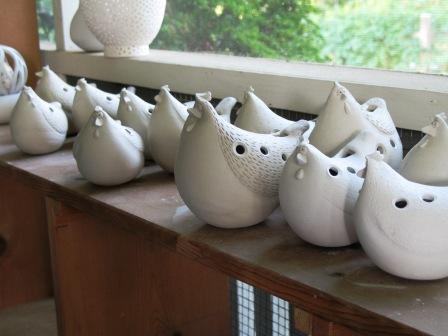
The result is a plain can-I-do-it experiment (yes! I can!), but there's clearly room for further experimenting to discover what kind of sound(s) I can get out of these sorts of whistles, to learn how they can be visually beautified (Joe is back at Penland making far more beautiful ones), and to find out whether there's any chicken potential. Tweet tweet.

Wednesday, April 10, 2013

A Claycophony of Instruments

Whan that Aprille, with hise shoures soote,
The droghte of March hath perced to the roote
And bathed every veyne in swich licour,
Of which vertu engendred is the flour;
Whan Zephirus eek with his swete breeth
Inspired hath in every holt and heeth
The tendre croppes, and the yonge sonne
Hath in the Ram his halfe cours yronne,
And smale foweles maken melodye,
That slepen al the nyght with open eye--
So priketh hem Nature in hir corages--
Thanne longen bloggers their blogges to update.

I'm thinking of Chaucer because yesterday, I was on a jog with my friend C, and something she said made me think of The Squire's Tale, in which the narrator claims he will not speak of something and then goes on for a while speaking of it. C said there's a name for that rhetorical flourish, and I've tracked it down on Wikipedia: Apophasis (more specifically, Paralipsis and Proslepsis).

Says the Squire:

This Cambinskan, of whom I have you told,
High in the palace, mounted on his throne
With crown and royal vestments sat alone,
And held his feast, so splendid and so rich
That in this world its like was not, of which,
If I should tell you all of the array,
Then would it occupy a summer's day.
Besides, it needs not here that I apprise
Of every course the order of service.
I will not tell you of their each strange sauce,
Nor of their swans, nor of their heronshaws.
Moreover, in that land, as tell knights old,
There are some foods which they for dainties hold.
Of which in this land the esteem is small;
There is no man that can report them all.
I will not so delay you, for it's prime,
And all the fruit of this were loss of time...

At the point in my education when I read The Canterbury Tales, it seemed that the narrator went on for pages and pages like this. As an adult, I see he didn't (maybe there are longer examples elsewhere in the text), but my memory of him inspires my blog today.

Thus, I will not tell you of the past year of running with C, training first for a 10K and now for a 10 mile race; of the weekly interwebs running assignments she signed up for and from which I mooched; nor will I tell you of our increasing endurance, nor how 5K, once strenuous, now feels brief.

Moreover, I will not so delay you by reporting on my renewed love affair with Robert Schumann, of my exploration of his Six Canonical Etudes (with which I was previously acquainted through Debussy's arrangement for two pianos), nor of their beauty on the organ, nor of my continued good but largely unrealized intentions to record and here upload my organ demos at Duke Chapel, so that I might learn from the listening thereof. Moreover, I will not mention the comment left by a YouTube listener regarding someone else's too-fast but otherwise accomplished performance of Bach's "Kyrie, Gott heiliger Geist," BWV 671 (a piece about which I erstwhile wrote)--no, I will not mention the five words that cut to the quick, dissuading me from ever being so bold as to post anything but cute cat videos on YouTube; nay, I will not here type the patronizing punch: "This is a laudable start."

Instead, I will get to my primary point of the day (about which I will actually say little; there's probably a rhetorical term for that too): musical instruments made out of clay. I've blogged before about making clay flutes and, of course, chickarinas. Thanks to a request by a student at Claymakers, this past session I taught a class entirely devoted to making clay instruments ("Bells and Whistles: A Claycophony of Instruments"). We made ocarinas, flutes, penny whistles, rain sticks, drums, horns, vuvuzelas, and tooters, with some bells and bowls on the side (not surprisingly, pretty much anything you whap will produce a tone).

Barry Hall's fabulous book From Mud to Music served as our inspiration. Barry Hall's even more fabulous CD Terra Cotta made me and E drop everything one evening after dinner and rush out to Home Depot to buy PVC parts for a didgeridoo. The student who requested the instruments class ended up building an impressive didgeridoo-horn hybrid that is way cooler than PVC tubing can ever be.

This was a great class to teach, since it involved problem solving and engineering, music theory and physics, and rawhide (sorry cows) and roofing nails and holes and a willingness to make noise on the way to making music. (Did you notice all the conjunctions in that last sentence? The rhetorical term for that is Polysyndeton.)

Naturally, we ended the class with a potluck and jam session. Alas, I did not have time to bake jam bars, but one student did bring caramel Bugles.


Note: video has been edited to protect the embarrassed; you know who you are. Also, S insists the flute lick is "House of the Rising Sun," but that would mean I actually absorbed something other than classical music during my early youth, which is unlikely.

Sunday, December 23, 2012

Summer recaps finished: Penland and flutes

Warm November flew away, and barely-cold December is also on its way out, so here's my last summer catch-up blog. I'm sure I'll never catch up with autumn blogging, so I'll spill the highlights right away: (1) our determined angel fish laid new eggs every 2-3 weeks and the young fry got eaten by their carnivorous tank-mates and parents every darned time; and (2) Schroeder lost his carrot, causing distress and consternation, but my mom knitted him a new one and everyone is content once more. Ooh, and (3) I worked towards coming to terms with glazes fired in oxidation, attempting to mimic the variation of reduction-fired surfaces by spraying layers of different Claymakers' studio glazes à le Steven Hill, and it's going well enough that I recently bought a used compressor and spray gun, with hopes of building (and, by extension, finding room for) a spray booth for my home studio; but that's a story that lacks photos and will have to wait until 2013 for blog development.

So back to the summer. I spent the last two weeks of August at the Penland School of Crafts, taking a class entitled "Shape Shift: The Pot," taught by Jim Lawton. I had been meaning to take a Penland class for almost a decade, and the stars had finally aligned between a class I was very interested in, two unencumbered weeks, and manageable kidcare. At Penland, I learned a lot about darting, making holes, and assembling well-proportioned altered pots, worked intensely from morning to night, met a lot of interesting and talented people, ate super duper well, and happily jogged almost daily along beautiful mountain roads (only getting lost once, when what I thought was a 180o-sum turn on curvy roads turned out to be only about 85o, and a 3-mile trip turned into 7 miles, so that I missed breakfast on the last day).

One of my Penland classmates, Joe, is a glass artist who was honing his clay skills. We had a shared interest in clay instruments; I showed him how to make ocarinas, and he showed me how to make a flute. It took until late this fall for me to finally attempt making a flute; the initial results are played below, with a chickarina for comparison (apologies to Beethoven for the flubs). Ocarinas are easier to play, although the tone quality and range aren't as good. Both flutes were tuned by ear; maybe next time I'll pull out my tuner. As with the chickarina, some pitches +/- can be replicated with multiple fingerings, which helps some with the tuning. It would probably help too if I actually knew how to play the flute. As it is, I feel disturbingly light-headed after playing these things. I'm sure good tone quality and hyperventilating don't always have to go hand-in-hand.

There are assorted online guides to making clay, wood, and PVC-tubing flutes. Handouts for assorted college-level acoustics labs tend to go into more precise detail than I was interested in, so I followed the suggested measurements in Barry Hall's book, From Mud to Music, which offers the same hole-positioning advice as this website by Mark Shepard. The detail that can't be stressed enough is that hole size hugely affects the tuning. After some trial and error, I abandoned the distance-of-finger-hole-from-mouthpiece measurements and relied on hole size to enable comfortable finger placements. But maybe that's part of why I have to hyperventilate when I play.

Another lesson I took away from Penland was to register for more workshops at Claymakers--way cheaper and way more convenient to get to than Penland (although the food and scenery, of course, can't compare). Thus I enjoyed a late-summer workshop with Susan Feagin (Penland's clay studio manager) and a mid-autumn brush-making workshop with Kent McLaughlin.

And now for some pastoral Beethoven...


Saturday, May 19, 2012

Chicklets

Earlier this week, E found a plain little whistle I had made for a public school workshop. He suggested it would be nice to have a similar whistle, but with a hole for a piece of string so he could hang it around his neck. Thus was born the mini-chickarina: four holes, major sixth span (do re mi fa fi sol si la), and so cute, they make their larger counterparts look downright classy by comparison. See http://cuteoverload.com/tag/the-rules-of-cuteness/, Rules of Cuteness #s 3, 6, 7, 9, 14, 21, 28, 37, and 38.


Family portrait

Contemplating the origins of life
The serious artist in me--the one who skillfully crafts forms of elegance and beauty--is a little concerned that all I want to make these days is chicken-shaped ocarinas; but the practical geek in me laughs and says this is the clear confluence of a PhD in music theory, years of practice on the pottery wheel, and a lifetime of cat ownership.

Thursday, May 17, 2012

Eurekarina

In 1987, I moved 1,600 miles from home to attend graduate school in Tucson. During a conversation about home towns, my friends there didn't believe me when I said that back in Urbana, we had experimental cows with windows in their stomachs. Home on a break, I rode my bike over to the South Farms and took this photograph to show everyone:


I was reminded of that picture recently in the geek lab, where I have apparently been industriously re-inventing the wheel.

Perhaps you recall me mentioning that the 7-hole chickarina produces a 12-note chromatic octave and then some, with several built-in pitch redundancies. I speculated then that with fewer holes, I could still get a diatonic octave scale. You might also recall that the number of holes in the ocarina is one of the variables that affects tone quality: increasing the number of holes usually necessitates fipple adjustments. Perhaps, I thought yesterday, I can attain better tone quality by building a diatonic scale using fewer holes.

How many holes would be necessary?

Two holes of different sizes yield four pitches total:
(1) 0 0 (both holes closed)
(2) 0 1 (H1 open)
(3) 1 0 (H2 open)
(4) 1 1 (both holes open)
Four notes out of eight, right there! Add a third hole:
(1) 0 0 0
(2) 0 0 1
(3) 0 1 0
(4) 0 1 1
(5) 1 0 0
(6) 1 0 1
(7) 1 1 0
(8) 1 1 1

"But what has this to do with reinventing wheels, or with cows with windows?," you ask. I'm getting there.

The fingering inventory above doesn't automatically produce a diatonic scale on a chickarina: I need holes of appropriately tuned sizes so that, e.g., 0 0 1 doesn't sound the same as 0 1 0 and 1 0 0. Moreover, according to that most honorable and meticulously edited of sources, Wikipedia, "the [pitch on an ocarina] is dependent on the ratio of the total surface area of opened holes to the total cubic volume enclosed by the instrument. This means that, unlike a flute or recorder, sound is created by resonance of the entire cavity and the placement of the holes on an ocarina is largely irrelevant." This suggests that two holes with a total area A would affect pitch and tone quality in the same way that a single larger hole with area A would, although in practice, as I've pointed out above, this isn't always the case--thus the motivation for fewer holes. But it does mean that if I want eight distinct pitches with three holes, 1 0 0 not only can't equal 0 0 1 or 0 1 0, it also can't equal 0 1 1. (Incidentally, I love that the Wiki author[s] wrote "cubic volume." I'll add that combo to the Redundancy List right after truly unique and labium lip. Perhaps if I want to learn about Helmholtz resonators, I should consult more rigorous texts than Wikipedia.)

Further complicating things, for any given resonating chicken-shaped cavity, the higher the pitch, the larger a newly opened hole has to be to produce a given interval. That is, if I want, say, a major second, I need a smaller hole at lower frequencies (e.g. do-re), and a larger hole at higher frequencies (e.g. la-ti). Consequently, with three holes, the bottom of a scale might be in tune, but as you approach the top of the scale, the pitches become woefully flat: you need a fourth hole. Adding a fourth hole adds eight new fingering combinations (1 0 0 0, 1 0 0 1, 1 0 1 0, etc.), making room for pitch redundancy.

So: four holes.

For my birds, I based hole-size decisions on the intervals produced between 0 0 0 0 and each singly open hole (0 0 0 1, 0 0 1 0, 0 1 0 0, and 1 0 0 0):
H1 = major second
H2 = major third
H3 = perfect fourth
H4 = perfect fourth. Yes, H3 and H4 are the same size. There's room for redundancy.

These holes yield a diatonic scale thus:
Do: 0 0 0 0 (no holes open)
Re: 0 0 0 1 (H1 open)
Mi: 0 0 1 0 (H2 open)
Fa: 0 1 0 0 (H3 open)
Sol: 0 1 1 0 (H3+H2 open. You'd think it should be H4+H1, but that tends to be a little flat: 0 1 0 1 isn't equivalent to a major second plus a perfect fourth--in theory a perfect fifth--because, remember, the higher you go up the scale, the larger the holes need to be to produce a given interval. H3+H2 is a little sharp, but under-blowing lowers the pitch just fine.)
La: 1 1 0 0 (H3+H4 open. On most instruments, a perfect fourth plus a perfect fourth yields a minor seventh. On an ocarina, the interval is flat--a major sixth.)
Ti: 1 1 1 0 (H3+H4+H2 open. A would-be octave is flat--a slightly flat major seventh)
Do': 1 1 1 1 (all holes open. A flat tenth becomes a perfect octave).

You can get a chromatic scale (and then some) out of this, although you have to half-cover H1 for Ra. Pitches can also be tweaked by changing wind speed. You can't really overblow an ocarina, but underblowing bends pitches quite well.

Thus did I reinvent the wheel: the internets tell me a British mathematician named John Taylor invented the four-hole chromatic octave ocarina in 1964. I suppose I could have started my ocarina adventures by looking up fingering charts online, but in exchange for taking the empirical route--thinking for months like the pianist that I am (7-hole ocarinas) before thinking like a mathematician (4 holes)--yours truly got to enjoy a pretty exciting oceureka moment.

As for the cows, the resonating cavities of my chickens vary in size and shape, so the acoustics of the individual ocarinas vary. Whistle wall thickness also affects pitch and tone quality. Thus, while most of the 4-hole birds I made looked just fine, a particularly thin-walled ocarina required humongous H3 and H4 holes and ended up looking like this:


So you can see why I was thinking about cows with windows in their stomachs.

In the midst of all this research, a friend dropped by and observed that my chickens were starting to look a little uniform. Personally, I think they all look wildly different, as far as these guys go, but I will concede that most of the current birds lean to the left. Given North Carolina's recent shameful vote to add a bigoted amendment to our state constitution, I'm not keen on having right-leaning chickens in my flock right now. Here, two lefties show a stunned right-winger that they haven't disappeared even though he voted their civil rights away.

Monday, April 30, 2012

Fickle fipples

The Durham spring Art Walk was this past weekend, and I spent a few hours on Saturday in front of Claymakers, providing wheel demos for passersby. I made chickens: they're quick and cute, and they offer great opportunities for one-liners. I used to demo chicken rattles, but of course this year I made chicken whistles, which facilitated pleasant cooing interactions with some morning doves in the awning above the door.


By the end of the afternoon, I had a bat full of chickens waiting to be transformed from single-note birds to full-octave gals, so on Sunday I spent a few hours on voicing.

The only annoying thing about making  full-octave ocarinas is that while an ocarina might start out with a lovely clear tone and might hold onto that tone through the addition of a few finger holes, at some point you cut one hole too many and the clear tone vaporizes: poof, gone. The quickest fix is to plug the last hole, but that's not an option if you need the hole for building a diatonic scale.

Ocarina fipples* are fickle, fickle, fickle, and predicting and diagnosing fipple problems is difficult because so many variables are involved: number of holes in the resonating cavity, hole sizes (a hole that is too small can muffle the tone), distance from windway exit to labium,** bevel angle, bevel thickness, windway channel shape/size, changes in the fipple due to condensation (when you blow through the mouthpiece to test the tone, water from your breath condenses onto the clay), stray clay goobers that obstruct the windway, etc. Once a chicken becomes breathy, it's often easiest to fix tone problems by hand-building a mouthpiece and attaching it to the bird butt, rather than trying to adjust a built-in windway (i.e. a windway that is one with the chicken), but attached mouthpieces sometimes shift during drying, and even a slight change in angle can obliterate the tone again.

Recently I've been having pretty good luck with built-in windways, but I still lose the tone around the sixth or seventh finger hole. Today it finally occurred to me how to fix the problem.

Several online ocarina-making instructions say the bevel angle should be 45o, which in practice isn't the case--certainly not when an ocarina produces just a single tone. However, because the bevel is the thinnest part of the fipple, it dries faster than the rest of the ocarina. I noticed that ocarinas that had been well tuned were turning breathy after drying a bit, and guessed that the drying bevels might be shifting upwards, changing whatever angle happened to be working when the chickarina was first voiced. Gently pushing the bevel down fixed the problem. I transferred that solution to the chickarinas that were losing tone quality with the addition of finger holes and discovered that pushing the bevel down usually repairs the sound. When that fix doesn't work, an added mouthpiece does.

I expect this is going to save me hours of mouthpiece futzing. Another trial-and-error breakthrough in the geek lab, where I continue to fill gaps the world never knew it had.

*Another bonus of making ocarinas is getting to use technical terminology like fipple and labium.
**Monday night update: According to the Wikipedia article on fipples, the bevel of a fipple is called the labium lip. The term labium lip is redundant, of course, since labium is Latin for lip, so I'm editing the term down to just labium. I suppose I could pare it down to lip instead, but labium and fipple sound intriguing together, while "lip and fipple" sounds like a '70s comedy team.

Wednesday, November 9, 2011

Introducing the Chickarina


E learned how to play this tune on his trumpet earlier this fall, and he struggled mightily with the syncopations. Attempting it on the chickarina gives me a new appreciation for its rhythmic challenges.

This is the first chickarina I've gotten around to glazing. Hey, it's been a busy fall. The instrument has seven finger holes. It has an octave range with a little wiggle room at the top and bottom if you over- or under-blow. I've been playing mostly diatonic pieces with occasional chromatic inflections; I'm pretty sure I could get a complete 12-tone (and then some) chromatic scale out of it, but I haven't figured out the fingering yet. This suggests that far fewer finger holes are necessary to produce a diatonic octave. A project for this winter, perhaps.

If you too would like to make an ocarina but don't have access to clay or kilns, try the handy method demonstrated in the video below. Once you have your materials assembled, you'll need only about 15 minutes to make your ocarina from start to finish. Yum!

Tuesday, September 20, 2011

Bailing

Hey y'all. It's been awhile. I could try to explain how, during my long absence, I've been wrangling with my convictions about the Greater Good and the Rightness of participating in the public education system, and about how putting kids in private schools doesn't do anything to improve public schools (indeed, probably makes them worse); and then about how, with much distress, we bailed at the last minute on our local public school system in order to see whether $10K can buy a more stimulating and well-rounded education for our child. I could write about the good (if not good enough) job his former school was doing, given the circumstances of a state legislature that has screwed children and teachers by slashing the education budget year after year, and of state and federally mandated testing that has made adequacy the new standard of excellence, and of the flawed philosophies of No Child Left Behind. I could try to unpack my expectations about what constitutes an "education" in the first place, and ask how the government expects children to get good ones when classrooms are ridiculously overcrowded. But goodness, I'm just all wrangled out.

So instead, I'll show you some photos of a bunch of greenware full-octave chickarinas waiting to be bisque fired. They seem a little trivial in the context of a school crisis, but life must go on, and nothing soothes the nerves quite like music and anthropomorphizing. This is a flock interrupted, as chicken whistles take waaaay more time to make than chicken rattles (have you ever tried tuning a chicken?), and lately every time I've gotten started on a subflock, some unrelated event has destroyed the momentum.

When these birds are done, I expect they will sound something like this green polka dot ocarina, but more in tune and without all the white noise.

Thursday, December 9, 2010

Condensation versus spit

In grad school, I had several friends who played French horn. As they drained the liquid contents of assorted valves onto the floors of assorted performance venues, they would insist, "it's not spit, it's condensation." As their accompanist, I learned to say it with them: "I know, it's not spit, it's condensation."

I was thus surprised to learn that there's a special valve on a trumpet called a "spit valve." When the instrument starts gurgling, the player presses the valve and blows a good gust of air into the mouthpiece, forcing a dribble of liquid out through the valve.

Now, it turns out you're supposed to give your trumpet a bath once a month or so. We finally learned this four months into E's trumpet education, so last weekend I set up my laptop on the bathroom scale (the horizontal surface farthest from water without also being the cover of a kitty-litter box) and carefully followed the step-by-step instructions offered in a well-reviewed youtube video on trumpet bathing. There's a whole genre of such videos. Some (like the ones that show you how to pry sticking parts apart with pliers, or that insist the idea that trumpets need cleaning is a conspiracy promulgated by trumpet cleaning supply manufacturers and music stores) are worse than others.

I carefully disassembled the instrument, placed the appropriate parts on a towel in the bathtub, soaked them in warm water, inserted the correct pipe cleaners and snakes into the tubes for which they were designed, rinsed and gently patted each piece dry, and finally lubed and oiled and reassembled the parts. Lo, E's trumpet looks and sounds significantly better post-bath.

In the process, I learned that trumpet players are happy to call a spade a spade. Judging by the four months worth of bacterial goo left behind in the water? It's not condensation. It's spit.

Friday, October 1, 2010

Embouchure

From modest beginnings...

come great things.