(Revisiting those old blog posts, I am disappointed to discover that the online presence of newspaper articles is apparently less than seven years. That should teach me to write in more detail rather than rely on links, but I'm a slow learner, as this post attests.)
Showing posts with label untapped potential. Show all posts
Showing posts with label untapped potential. Show all posts
Thursday, March 2, 2017
Because who has the time, right?
Back in 2010, I wrote about the News & Observer's coverage of Drive-thru Easter at two NC churches, and I proposed that the Chosen People keep pace with a Drive-thru Seder. That hasn't happened yet, as far as I know, but thanks to an N&O report on Drive-thru Ash Wednesday, I'm reminded that there are still 5.5 weeks for synagogues to prepare to keep up with the Joneses. "Next This year, within driving distance!"
(Revisiting those old blog posts, I am disappointed to discover that the online presence of newspaper articles is apparently less than seven years. That should teach me to write in more detail rather than rely on links, but I'm a slow learner, as this post attests.)
(Revisiting those old blog posts, I am disappointed to discover that the online presence of newspaper articles is apparently less than seven years. That should teach me to write in more detail rather than rely on links, but I'm a slow learner, as this post attests.)

Monday, September 10, 2012
Salt garden update
By day 5, our salt garden had started sending satellite crystals across the kitchen counter.

We could see evidence of the green, blue, and yellow food coloring, but no red.
 By day 7, there was as much crystal growth outside the bowl as in it. The blooms were turning dingy grey and starting to crumble, so we rinsed out the sponges and called it a wash (ba-da-bum).


We could see evidence of the green, blue, and yellow food coloring, but no red.


Tuesday, August 28, 2012
Liquid bluing
Yowza, this has been a busy, busy summer, and I'm way behind on blogging. I have much to write about, but will begin with the most current event: E and I are growing a salt garden.
When I was 12, I had a homework assignment to design and carry out my own science experiment. In browsing books for ideas, I came across instructions for a salt garden, with a recipe for a liquid concoction that, when spooned over cut-up sponges, would bloom into puffs of salt crystals. The recipe called specifically for non-iodized salt. Since most readily-available table salt by then was iodized, a person really had to go out of his or her way to find the non-iodized variety, so I assumed there was a reason the recipe called for it. My experiment involved growing two salt gardens--one iodized and one non-iodized--whereby I discovered that non-iodized salt made no difference except for the challenge of finding a supermarket that carried it.
The even bigger challenge of that experiment involved obtaining another vital ingredient: liquid bluing. Liquid bluing is a colloidal suspension of blue iron powder (ferric hexacyanoferrate) in water, and it was already a rarity in 1979. When I finally tracked some down at a tiny, dimly lit, locally-owned grocery store across town, I became a hoarder: I needed a mere four tablespoons, but I bought two 8-oz. bottles, figuring I might never again have access to this relic of olden-days laundry whitening.
Over the intervening 33 years, every time I moved, I took my two precious bottles of liquid bluing with me, from Urbana to Tucson to Corvallis to Madison to Lawrence and finally to Durham. In Durham, the bottles remained undisturbed for twelve years in a plastic bag in a storage cabinet, until, during a recent cleaning frenzy, I rediscovered them and decided I had guarded them carefully for long enough. It was time to play.
E and I accumulated the other ingredients and on Sunday afternoon, we mixed everything together and started our garden.
Here's what it looked like on Sunday:

And here's what it looked like this morning:

Notice the crystals hanging over the edge of the bowl. They completed their escape this afternoon, and I expect to find them making their way off the countertop later this week.
Happily, we still have nearly two bottles of bluing left, so E can share this experience with his own kid(s) 33 years from now (by which time he will also be conducting an experiment on the stability of ferric hexacyanoferrate suspensions).
Here's the recipe:
4 T salt
4 T liquid bluing
4 T H2O
1 T ammonia
Mix together and distribute over cut up pieces of sponge. For colored crystals, dribble drops of food coloring on the sponges before adding the salt solution.
When I was 12, I had a homework assignment to design and carry out my own science experiment. In browsing books for ideas, I came across instructions for a salt garden, with a recipe for a liquid concoction that, when spooned over cut-up sponges, would bloom into puffs of salt crystals. The recipe called specifically for non-iodized salt. Since most readily-available table salt by then was iodized, a person really had to go out of his or her way to find the non-iodized variety, so I assumed there was a reason the recipe called for it. My experiment involved growing two salt gardens--one iodized and one non-iodized--whereby I discovered that non-iodized salt made no difference except for the challenge of finding a supermarket that carried it.
The even bigger challenge of that experiment involved obtaining another vital ingredient: liquid bluing. Liquid bluing is a colloidal suspension of blue iron powder (ferric hexacyanoferrate) in water, and it was already a rarity in 1979. When I finally tracked some down at a tiny, dimly lit, locally-owned grocery store across town, I became a hoarder: I needed a mere four tablespoons, but I bought two 8-oz. bottles, figuring I might never again have access to this relic of olden-days laundry whitening.
Over the intervening 33 years, every time I moved, I took my two precious bottles of liquid bluing with me, from Urbana to Tucson to Corvallis to Madison to Lawrence and finally to Durham. In Durham, the bottles remained undisturbed for twelve years in a plastic bag in a storage cabinet, until, during a recent cleaning frenzy, I rediscovered them and decided I had guarded them carefully for long enough. It was time to play.
E and I accumulated the other ingredients and on Sunday afternoon, we mixed everything together and started our garden.
Here's what it looked like on Sunday:

And here's what it looked like this morning:

Notice the crystals hanging over the edge of the bowl. They completed their escape this afternoon, and I expect to find them making their way off the countertop later this week.
Happily, we still have nearly two bottles of bluing left, so E can share this experience with his own kid(s) 33 years from now (by which time he will also be conducting an experiment on the stability of ferric hexacyanoferrate suspensions).
Here's the recipe:
4 T salt
4 T liquid bluing
4 T H2O
1 T ammonia
Mix together and distribute over cut up pieces of sponge. For colored crystals, dribble drops of food coloring on the sponges before adding the salt solution.
Wednesday, November 9, 2011
Introducing the Chickarina
E learned how to play this tune on his trumpet earlier this fall, and he struggled mightily with the syncopations. Attempting it on the chickarina gives me a new appreciation for its rhythmic challenges.
This is the first chickarina I've gotten around to glazing. Hey, it's been a busy fall. The instrument has seven finger holes. It has an octave range with a little wiggle room at the top and bottom if you over- or under-blow. I've been playing mostly diatonic pieces with occasional chromatic inflections; I'm pretty sure I could get a complete 12-tone (and then some) chromatic scale out of it, but I haven't figured out the fingering yet. This suggests that far fewer finger holes are necessary to produce a diatonic octave. A project for this winter, perhaps.
If you too would like to make an ocarina but don't have access to clay or kilns, try the handy method demonstrated in the video below. Once you have your materials assembled, you'll need only about 15 minutes to make your ocarina from start to finish. Yum!
Thursday, April 7, 2011
Geek ball


 I thought about putting a chicken inside the outer ball, but decided it would be better to use something that wouldn't look anthropomorphically forlorn in a spherical cage. Enter the clay wiffle ball, form of 10,000 uses!
As I've already had to kluge one of the outer-ball spokes back together, I have serious doubts that this geek toy is going to survive intact into bisquehood. Ah, ethereal art!
Friday, April 1, 2011
Eureka!
 "Pottery for Geeks" is coming up in a few weeks at Claymakers, so I'm doing a little prototyping.* From the how-did-the-world-ever-manage-without-this department, I proudly introduce the clay wiffle ball. Imagine how these babies will fly when hit with a clay bat. No, not that kind of bat; this kind of bat. I just need to figure out how to throw one on the wheel.
Truthfully, the balls aren't meant for wiffle anything; they're merely a first step en route to a multiple sphere geek toy. I'll post photos eventually if everything works out as planned.
*Verbifying "prototype" reminds me that this morning, I heard a guest on the Diane Rehm show on NPR use "offshore" as a verb--as in "companies are offshoring labor." Way to turn an adjective/adverb into a verb, eh?
Monday, January 3, 2011
Prototype
Announcing another breakthrough from the Non-Orientable Manifold Lab!
I said I was going to call it a "Bagel Box," but that's so 2010. It's a new year, and "Möbius Diatom Box"* has a better ring to it (so to speak).
I took advantage of Saturday's warm weather to throw some tori.

Then it rained for two days, so I moved the tori inside to dry; and then winter returned, so after I trimmed the tori outside in the subfreezing night air (brrr), I moved production into the dining room.
I carefully marked and cut the first torus, going for an angular look.

Silly me. Those 90o angles locked the two rings together with impressive efficiency. I had to smoosh the clay to get the torus open, and both rings ripped a bit.

Oh well, back to the drawing board.
I carefully marked and cut the second torus. No sharp angles this time.
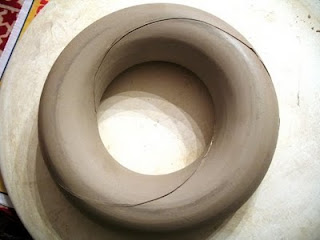
Incidentally, in preparation for this experiment, this weekend I tried (and failed) to slice four bagels into interlocked halves; the near-lack of bagel holes left no room to maneuver the knife. I can now say it's significantly easier to cut a clay torus this way than a bagel, but the rough edges stand out more in the clay than on the bagel, mainly because a linked-sliced bagel is almost entirely rough edges, whereas a hollow clay torus has the potential to be lovely and smooth all over.
Despite some jagged lines, the slicing achieved the desired outcome.

It turns out that this kind of box is a two-person job. My beloved engineer patiently held each ring in succession while I tidied up the other ring's rough edges.
Of course, no clay math toy is complete without holes.

 *George Hart calls the cut surfaces "two-twist Möbius strips." Although that second twist means the cut surface isn't really a Möbius strip, I'm sticking with the name "Möbius diatom box."
I said I was going to call it a "Bagel Box," but that's so 2010. It's a new year, and "Möbius Diatom Box"* has a better ring to it (so to speak).
I took advantage of Saturday's warm weather to throw some tori.

Then it rained for two days, so I moved the tori inside to dry; and then winter returned, so after I trimmed the tori outside in the subfreezing night air (brrr), I moved production into the dining room.
I carefully marked and cut the first torus, going for an angular look.

Silly me. Those 90o angles locked the two rings together with impressive efficiency. I had to smoosh the clay to get the torus open, and both rings ripped a bit.

Oh well, back to the drawing board.
I carefully marked and cut the second torus. No sharp angles this time.

Incidentally, in preparation for this experiment, this weekend I tried (and failed) to slice four bagels into interlocked halves; the near-lack of bagel holes left no room to maneuver the knife. I can now say it's significantly easier to cut a clay torus this way than a bagel, but the rough edges stand out more in the clay than on the bagel, mainly because a linked-sliced bagel is almost entirely rough edges, whereas a hollow clay torus has the potential to be lovely and smooth all over.
Despite some jagged lines, the slicing achieved the desired outcome.

It turns out that this kind of box is a two-person job. My beloved engineer patiently held each ring in succession while I tidied up the other ring's rough edges.
Of course, no clay math toy is complete without holes.

 *George Hart calls the cut surfaces "two-twist Möbius strips." Although that second twist means the cut surface isn't really a Möbius strip, I'm sticking with the name "Möbius diatom box."
Sunday, April 4, 2010
Drive-thru follow-up
The whole Drive-Thru Easter thang has me wondering why Christians should have all the fun. OK, so Westwood Baptist in Cary explicitly avoided labeling their production "fun" because, after all, "it is a crucifixion," but Duke Memorial Baptist Church in Spring Hope, NC, didn't hesitate to advertise the pleasurable aspects of its similar event, inviting people to "Come out and re-live the final week of Christ! Enjoy it from the comfort of your car!"
This morning I started thinking about my own religious upbringing, and about what we Jews might do to compete with the Easter Bunny, marshmallow Peeps, and Drive-Thru Crucifixions, and suddenly it popped into my head: the vast, untapped potential of the Drive-Thru Seder, American style! ("The original Last Supper, updated to accommodate the hustle and bustle of modern life!") Would the Jews have bothered slogging between the parted waters of the Red Sea if they could have driven out of Egypt instead? And why wander in the desert for forty years, when we've got GPS and iPhones? Surely G*d understands that three hours is a long time for a meal these days.
With the Drive-Thru Seder, you can be assured that this night really will be different from all other nights, as you and your family cruise comfortably from one plague to the next: Blood! Frogs! Lice! Wild beasts! Pestilence! Boils! Hail! Locusts! Darkness! Death of the firstborn! Pull into the parking lot, roll down your windows, tilt your seats back, and enjoy a sampler plate of deep-fried Maror, Charoset, Zeroa, Karpas, Baytzah, and optional Chazeret on-a-stick, brought to you by one of our friendly car-hops. Wash it down with a few well-paced sips of grape juice (Mogen David kosher concord wine available in wet counties only), then pop the trunk for the prophet Elijah, and you're ready to roll! Your children will delight in hiding the Afikomen under the front seat amongst the loose change, candy wrappers, and Cheerios. Of course, no Seder would be complete without joyously celebrating G*d's liberation of His chosen people with a rousing chorus of Dayenu on car horns. "Next year within driving distance!"
This morning I started thinking about my own religious upbringing, and about what we Jews might do to compete with the Easter Bunny, marshmallow Peeps, and Drive-Thru Crucifixions, and suddenly it popped into my head: the vast, untapped potential of the Drive-Thru Seder, American style! ("The original Last Supper, updated to accommodate the hustle and bustle of modern life!") Would the Jews have bothered slogging between the parted waters of the Red Sea if they could have driven out of Egypt instead? And why wander in the desert for forty years, when we've got GPS and iPhones? Surely G*d understands that three hours is a long time for a meal these days.
With the Drive-Thru Seder, you can be assured that this night really will be different from all other nights, as you and your family cruise comfortably from one plague to the next: Blood! Frogs! Lice! Wild beasts! Pestilence! Boils! Hail! Locusts! Darkness! Death of the firstborn! Pull into the parking lot, roll down your windows, tilt your seats back, and enjoy a sampler plate of deep-fried Maror, Charoset, Zeroa, Karpas, Baytzah, and optional Chazeret on-a-stick, brought to you by one of our friendly car-hops. Wash it down with a few well-paced sips of grape juice (Mogen David kosher concord wine available in wet counties only), then pop the trunk for the prophet Elijah, and you're ready to roll! Your children will delight in hiding the Afikomen under the front seat amongst the loose change, candy wrappers, and Cheerios. Of course, no Seder would be complete without joyously celebrating G*d's liberation of His chosen people with a rousing chorus of Dayenu on car horns. "Next year within driving distance!"
Subscribe to:
Posts (Atom)

