Showing posts with label attitude adjustment. Show all posts

Saturday, June 8, 2013

Odyssey check point

The experiment continues.

After finishing The Scarlet Letter, I took a hard-earned romp through some creative nonfiction with David Sedaris' latest book, Let's Explore Diabetes with Owls. It lasted but the blink of an eye, but what a good blink it was. I wonder what the world would be like if U.S. high schoolers had to read Sedaris instead of Hawthorne. Would today's teens relate any better to OCD and colonoscopies than they do to Puritanism and adultery?

And now, boldly forward to what the Muse spoke to Homer of the adventurous man Odysseus. I'm a little more than a third of the way into The Odyssey, having read 9 of the 24 chapters. I'm sure I failed to appreciate, the first time around, that The Odyssey is more than just a story: it's a fascinating guide to geography, family trees, hospitality, manners, recipes, entertainment, deities, monsters, marriage, honor, games, and supplication etiquette.

I started to notice this in chapter 3. Chapters 1 and 2 had been relatively breezy (at least in comparison to The Scarlet Letter), but 3 got bogged down with lineage and places--things like "royal Onomatopoeius, son of Anacoluthon, fleet-footed king of Litotes, set sail on the seventh morning, and spurred by fair winds, returned a victor from war only to be slayed by his plotting uncle Anastrophe of Chiasmus, Anacoluthon's brother, who had, after much effort and with supplications to the deity of extra-marital affairs, successfully seduced Ecphonesis's wife Homiologia," etc. Dear reader(s), if your eyes didn't glaze over and you actually read every word of that, may the deities bless you.

Mixed into this came an excellent lesson on how to properly sacrifice a young heifer to Athene--information that clearly begged to be written down some 2800 years ago because it's something that frankly everyone needs to know. I really related to this part of the book because its how-to-itiveness reminded me of another, more contemporary household companion. Compare the following texts, the ancient and the modern (pardon the genealogy in the former):
Ancient: So after they had prayed and strewn the barley-meal, forthwith the son of Nestor, ardent Thrasymedes, drew near and dealt the blow. The axe cut through the sinews of the neck and broke the heifer's power. A cry went up from the daughters of Nestor, the sons' wives, and his own honored wife, Eurydice, the eldest of the daughters of Clyenus. The sons then raised the beast up from the trodden earth and held her so, the while Peisistratus, ever the foremost, cut the throat. And after the black blood had flowed and life had left the carcase, they straightaway laid it open, quickly cut out the thighs, all in due order, wrapped them in fat in double layers and placed raw flesh thereon. On billets of wood the old man burned them, and poured upon them sparkling wine, while young men by his side held five-pronged forks. So after the thighs were burned and the inward parts were tasted, they sliced the rest, and stuck it on the forks, and roasted all, holding the pointed forks in hand. (Homer, The Odyssey, ca. 8th c. BCE, trans. George Herbert Palmer, 1891, rev. 1912; Dover Thrift Editions: 1999, Chapter 3, p. 27.)
Modern: If possible, trap heifer 'possum and feed it on milk and barley cereals for 10 days before sacrificing to Athene killing. Gild horns Clean, but do not skin. Treat as for pig by immersing the unskinned heifer animal in sparkling wine water just below the boiling point. Test frequently with pointed five-pronged forks by plucking at the hair. When it slips out regularly, remove the heifer opossum from sparkling wine water and scrape. While scraping repeatedly, pour cool sparkling wine water over the surface of the heifer animal. Remove inward parts small red glands in small of the back and under each thigh foreleg between shoulder and ribs. Roast Parblanch about 20 minutes each, in two or three changes of sparkling wine water, then roast as for pork...Serve with turnip greens. (Irma S. Rombauer and Marion Rombauer Becker, The Joy of Cooking, Bobbs-Merrill Company: 1975, rev. and exp. 1983, "Opossum," p. 515.)
Other how-to standouts in The Odyssey include:

How to select husband material for (a) yourself or (b) your daughter: 
(a) If Athene comes to you in a dream and reminds you that you're of marriageable age so wouldn't it be a good idea to go do laundry tomorrow morning lest your family's dirty clothes cause embarrassment, and a hungry naked guy washes up on the beach and you discover him in the shrubbery while you're playing catch while waiting for the laundry to dry, but it turns out he cleans up real nice, then declare admiringly, "Hearken, my white-armed women, while I speak. Not without purpose on the part of all the gods that hold Olympus is this man's meeting with the godlike Phaeacians. A while ago, he really seemed to me ill-looking, but now he is like the gods who hold the open sky. Ah, might a man like this be called my husband, having his home here, and content to stay!" (Chapter 6, p. 59)
(b) When you meet the shipwrecked stranger to whom your virtuous virgin daughter gave directions to your house, size up his noble dudeness, and then, even though you recognize it's a long shot, offer him your daughter and your wealth: "O father Zeus, Athene, and Apollo, that such a man as you, so like in mind to me, might take my child, be called my son-in-law, and here abide! For I would give you house and goods if you would like to stay." (Chapter 7, p. 68)

How to poke out the eye of a Cyclops with a stake: This is a real gross-out paragraph, not only for the graphic description of the deed itself, but also because the Cyclops, passed out drunk, vomits wine and bits of chewed up humans (whose brains, incidentally, had already been splattered on the cave floor once before, when Polyphemus slaughtered a pair of men for dinner the night before and another pair for breakfast. There's probably a rhetorical term for this sort of recapitulation, given that skull bashing and vomiting are both variations on the theme of How to Spread Human Brains on Cave Floors). I expect this level of goriness would appeal to pretty much any adolescent in any century; no wonder The Odyssey remains on high school reading lists. In the following excerpt, notice also the handy references to wooden ship building and tempering steel:
Out of his throat poured wine and scraps of human flesh; heavy with wine, he spewed it forth. And now it was I drove the stake under a heap of ashes, to bring it to a heat, and with my words emboldened all my men, that none might flinch through fear. Then when the olive stake, green though it was, was ready to take fire, and through and through was all aglow, I snatched it from the fire, while my men stood around and Heaven inspired us with great courage. Seizing the olive stake, sharp at the tip, they plunged it in his eye, and I, perched up above, whirled it around. As when a man bores ship-beams with a drill, and those below keep it in motion with a strap held by the ends, and steadily it runs; even so we seized the fire-pointed stake and whirled it in his eye. Blood bubbled round the heated thing. The vapor singed off all the lids around the eye, and even the brows, as the ball burned and its roots crackled in the flame. As when a smith dips a great axe or adze into cold water, hissing loud, to temper it, — for that is strength to steel,— so hissed his eye about the olive stake. A hideous roar he raised; the rock resounded; we hurried off in terror. He wrenched the stake from out his eye, all dabbled with the blood, and flung it from his hands in frenzy.(Chapter 9, p. 87)
And finally,

How to remind your audience to give you a big tip: Remember, you are da Bard. Whether the Muse motivates you to tell tangential tales about cuckolded deities or to provide brief recaps of the story so far, mention that there's nothing more satisfying than having a good bard around. Use adjectives like "sacred," "honored," "famous," "wondrous," and "noble" to describe folks in your profession, and have your hero compare you to deities thusly:
Then wise Odysseus answered him and said: "Mighty Alcinoüs, renowned of all, surely it is a pleasing thing to hear a bard like this, one who is even like the gods in voice. For more complete delight I think there cannot be than when good cheer possesses a whole people, and feasting through the houses they listen to a bard, seated in proper order, while beside them stand the tables supplied with bread and meat, and dipping wine from out the mixer the pourer bears it round and fills the cups. That is a sight most pleasing. (Chapter 9, p. 80)

Saturday, May 25, 2013

The Scarlet Letter: B

I'm giving The Scarlet Letter a B--an embroidered B, gules, on a sable field.1 I was sedulous2 keeping to my commitment to re-read the book, though I wotted3 not whether I would find my adolescent animadversions4 justified. To my great joy, once I had slogged past the ponderous Introductory, I discovered the language to be readable and oftentimes even pleasant. Nonetheless, nugatory5 I now believe it is, to expect high schoolers to enjoy immersing themselves in Hawthorne's lucubrations6--though enjoyment be not necessarily the point. Of this book, perhaps in a U.S. History class, one wherein are studious youth needing to contemplate the strange and distant Puritanism of Old Boston, where arrived a crop of England's first Americans (their women less beautiful than would become subsequent generations of New Englanders, for not yet tempered were their visages by deprivation and rugged Atlantic weather,7 nor yet purged of joy through community shunning and self-denial)--or youth desiring, or merely instructed by pedagogical authority, to contemplate the sarcastic literary wanderings of the bored and apparently bitter descendants of those early settlers--yes, of this book in such a class (and not in freshman or sophomore English) perhaps more enjoyment and instructive use would be found.8

My recommendations: skip the Introductory (propose reading it as part of a possible book report project) and cut straight to the main story. Judge the Puritans harshly, forgive them if you will, and remind high schoolers to use protection when they engage in sexual intercourse if they want to avoid making babies.

=============================
1"[A simple slab of slate] bore a device, a herald's wording of which may serve for a motto and brief description of our now concluded legend; so sombre is it, and relieved only by one ever-glowing point of light gloomier than the shadow:— 'ON A FIELD, SABLE, THE LETTER A, GULES'"
2" She wondered what sort of herbs they were which the old man was so sedulous to gather."
3"Without taking overmuch upon myself my good word will go far towards gaining any strange gentleman a fair reception from yonder potentate you wot of."
4"[It] excited neither surprise nor animadversion when so reputable a citizen as old Roger Chillingworth, the physician, was seen to enter the market-place in close and familiar talk with the commander of the questionable vessel."
5"According to these highly-respectable witnesses, the minister, conscious that he was dying—conscious, also, that the reverence of the multitude placed him already among saints and angels—had desired, by yielding up his breath in the arms of that fallen woman, to express to the world how utterly nugatory is the choicest of man's own righteousness."
6"With his own ghostly voice he had exhorted me, on the sacred consideration of my filial duty and reverence towards him—who might reasonably regard himself as my official ancestor—to bring his mouldy and moth-eaten lucubrations before the public."
7"Morally, as well as materially, there was a coarser fibre in those wives and maidens of old English birth and breeding than in their fair descendants, separated from them by a series of six or seven generations; for, throughout that chain of ancestry, every successive mother had transmitted to her child a fainter bloom, a more delicate and briefer beauty, and a slighter physical frame, if not character of less force and solidity than her own. The women who were now standing about the prison-door stood within less than half a century of the period when the man-like Elizabeth had been the not altogether unsuitable representative of the sex. They were her countrywomen: and the beef and ale of their native land, with a moral diet not a whit more refined, entered largely into their composition. The bright morning sun, therefore, shone on broad shoulders and well-developed busts, and on round and ruddy cheeks, that had ripened in the far-off island, and had hardly yet grown paler or thinner in the atmosphere of New England. There was, moreover, a boldness and rotundity of speech among these matrons, as most of them seemed to be, that would startle us at the present day, whether in respect to its purport or its volume of tone."
8This sentence is only 118 words long. I don't know that I could get it up to 139, but I think I did a decent job of delaying the verb until the very end.

Wednesday, May 1, 2013

The Treachery of Fish: Ceci n'est pas un Bowfin

When I was an 11-yr-old 7th*-grader, I dutifully followed teacher instructions. When the science teacher said, "in case of a fire drill, blow out your Bunsen burners and go outside," I thought, "why blow them out instead of turning them off?," but I figured the teacher knew more than I did so I didn't say anything. When the fire drill rolled around, I blew out my Bunsen burner and went outside, where I was so disturbed by the thought of gas piping into the science room that I talked to a classmate about it. She told the teacher, and he went inside and shut off the gas, and we all survived and neither the science room nor the school blew up. 

I write this because a generation later, my own beloved 11-yr-old has apparently inherited my need to unquestioningly obey authority figures. This  came up last night when he had to answer a question about what kind of scales a bowfin has. He looked up the technical term online, and I asked him if that matched what he had seen on the fish his group had dissected last week in Science class.

"Well, no; I mean, I don't know, because we dissected a perch."

--"A perch? I thought you were writing about a bowfin."

"I am. The bowfin didn't come in on time, so Mr. G. put me in the perch group. But he said they're basically the same fish, so I should still do the bowfin."

--"But you didn't dissect a bowfin, you dissected a perch."

"I know!" He rolled his eyes at my cluelessness. "But Mr. G. said I should do the bowfin anyway."

Ceci n'est pas un perch
We went back and forth like this for a while. Eventually I appealed to the power of the grading rubric: "Look, how are you supposed to write a Conclusion Section about what you learned dissecting a bowfin if all of your data is about a perch?" Thus was born a compromise: answer the bowfin questions, but ask them about the perch.

Ceci n'est pas non plus un perch
On the bright side, this boy of mine, when he saw my collection of Dover books, picked up The Odyssey and asked, "ooh, is this for me? Did you know The Odyssey is the second oldest known story in western civilization, after The Iliad?"

Ceci n'est pas un bowfin. Ceci sont deux perches.
 *7th and 8th grades were combined in my high school; we were called "subfreshmen."

Sunday, April 28, 2013

The experiment begins

This is how The Scarlet Letter begins:

It is a little remarkable, that—though disinclined to talk overmuch of myself and my affairs at the fireside, and to my personal friends—an autobiographical impulse should twice in my life have taken possession of me, in addressing the public.

Later in the paragraph, the narrator expands on the allure of his alien writerly impulse:

...[A]s thoughts are frozen and utterance benumbed, unless the speaker stand in some true relation with his audience, it may be pardonable to imagine that a friend, a kind and apprehensive, though not the closest friend, is listening to our talk; and then, a native reserve being thawed by this genial consciousness, we may prate of the circumstances that lie around us, and even of ourself, but still keep the inmost Me behind its veil.

When I read the opening paragraph yesterday, I thought: had he lived today, perhaps the narrator would have been a blogger--an introvert who, speaking to the ether through pixels rather than the printed page, imagines connecting to some reader who, out there in that vastness, actually understands him. A computer screen makes a great veil.

Encouraged to have found something to relate to in the very first paragraph, I boldly plowed through the second. Alas, I burst out laughing when I reached the first sentence of the third.

When I teach science writing workshops to engineers, we talk about how science writing differs from other genres of writing. I emphasize the importance, in science writing, of putting verbs near the beginnings of sentences, or at least near the beginnings of main clauses, since readers of English get antsy if they have to wait too long for verbs. I'm not suggesting Romantic novelists like Hawthorne shouldn't have put verbs wherever they wanted to. Popular authors and their publishers presumably knew what they were doing, and obviously The Scarlet Letter isn't a scientific journal article. But golly, putting the verb six words from the end of a 139-word sentence strikes me as a little late. The suspense in the first 133 words is palpable; with every parenthetical aside, with every interjection, the reader wonders: what will the exciting action-climax be?

I thought: A clue! Perhaps sentences like this turned me off when I was 13! Thankfully, I now have sufficient life experience and analytical skills that sentences like this only make me laugh out loud.

Here's the sentence (for the full effect, read it attentively; do not skim!):

In my native town of Salem, at the head of what, half a century ago, in the days of old King Derby, was a bustling wharf—but which is now burdened with decayed wooden warehouses, and exhibits few or no symptoms of commercial life; except, perhaps, a bark or brig, half-way down its melancholy length, discharging hides; or, nearer at hand, a Nova Scotia schooner, pitching out her cargo of firewood—at the head, I say, of this dilapidated wharf, which the tide often overflows, and along which, at the base and in the rear of the row of buildings, the track of many languid years is seen in a border of unthrifty grass—here, with a view from its front windows adown this not very enlivening prospect, and thence across the harbour, stands a spacious edifice of brick.

A big brick building stands in Salem! What more excitement could a 13-year-old want?

Friday, April 26, 2013

Cultural literacy, take 2

A confession: I have never much enjoyed reading. As a graduate student, I once found some early elementary school report cards that my parents had saved. My teachers praised my interest in writing, and my general congeniality; they had no complaints about my math skills and were impressed by the maturity with which I used clinical terms in sex ed (it was the 1970s, after all, and my mom worked for Planned Parenthood); but they sure wished I would show more interest in reading.

Part of the problem, as I recall, was that I was supposed to have been smart, so I always ended up in school reading groups for which the books were consistently 6-12 months beyond my developmental ability to grasp. In 4th grade, for example, I was in the "advanced" reading group that was going to read Ramona. I was dismayed to discover that instead of reading Beverly Cleary's Ramona, we were reading a different Ramona. I could relate to Ramona Quimby--remember the time when she wanted to make sure that all the apples in the bushel basket in the basement were OK, so she took a bite out of every single one?--but I couldn't relate to the other Ramona, the "mixed-race Scots-Native American orphan girl, who suffers racial discrimination and hardship in Southern California after the Mexican-American War" (to quote Wikipedia).

The earliest of Beverly Cleary's Ramona books was about 12 years old when I was born. Helen Hunt Jackson's Ramona was 83. When I read the latter in 4th grade, it was 92. Even Laura Ingalls Wilder's Little House Books (my essential resource for understanding what it was really, truly like to be caught out on the prairie in a horse-drawn buggy with your suitor and his handsome horses when the weather turned wacky and funnel clouds appeared on the horizon)--even those books were far newer, with Little House in the Big Woods published a mere 36 years before my birth.

OK, so maybe I enjoyed reading some books as a kid. I don't read much fiction as an adult at all, maybe one to three novels a year, and I tend to favor children's and young adult literature (loved Harry Potter, loved Holes)--easy reads, I suppose. Given how little I enjoy reading, I'm amazed I managed to get a PhD.

So where did my reading go awry?

A few years ago, leading some writing tutoring outreach in one of Durham's public high schools, I learned that kids were reading--and disliking--many of the same novels that I had read and disliked in high school 25 years earlier. I was a too-young white female small-town/midwest-university-town reader at an academically privileged high school when I first encountered Lord of the Flies, a 1954 novel (25-29 years old when I read it) about a bunch of kids from a British boys' school trapped in circumstances that revealed the innate barbarism of humanity (yeah, middle schoolers are mean, so what else is new?). I had a hard enough time relating to the book; I could understand how, 25 years later, inner-city Durham kids might also have a hard time relating. And The Odyssey--which, as a too-young reader, I found to be quite the slog--was still part of the canon--but then, what's another 25 years for a story that's ~2.8K years old?

Maybe, I thought, I hadn't always disliked reading; maybe I learned to dislike reading thanks to a school system that, in its interest in keeping me challenged, ignored my immaturity.

Yeah. So last week, I was driving somewhere in my car, listening to the classical music radio station, when on came one of Vivaldi's Four Seasons. This immediately triggered memories of Nathaniel Hawthorne's The Scarlet Letter. Around the time I read the book in high school, I was in the habit of getting to know my parents' LP collection, and I would put records on the record player to help make reading more pleasurable. When an LP reached the end of the first side, instead of turning the record over, I'd simply lift the needle up and move it back to the beginning. I memorized a lot of great music this way (to this day, I can mimic much of the Four Seasons on the piano, without needing to look at a score), but I also indelibly printed The Scarlet Letter onto Autumn and Winter.

Listening to the radio last week, I wondered: what if I were to read The Scarlet Letter now, as a 46-year-old with some significant life experience behind me? Would I like the book any better than when I was a naive, too-young high schooler?

(I keep writing "too young"; I really was too young for much of what I read. I started elementary school early, and I was 11 when I started 7th grade. My secondary school was a 5-year high school that combined 7th and 8th grade into one year, so everyone there was younger than students in equivalent grades at other schools, but I was younger than most going back to Kindergarten. I graduated when I was 16, and started college when I was 16, and it really was way too young--not academically but emotionally--and I wouldn't recommend that sort of path to others.)

Anyway, listening to Vivaldi on the radio, I hatched a plan: I would choose 3-4 books I didn't enjoy the first time around, and reread them, to find out whether they might be more enjoyable 30 years later. Doesn't that sound like a fun experiment?

Knowing how slowly I read, I decided library copies weren't the best option, but I didn't want to invest a lot of money in books I'm not necessarily expecting to enjoy. Imagine my delight, then, when ordering some cheapo music scores from Dover, I discovered that Dover publishes super duper cheap reprints of The Canonical Classics--$2.00-$3.50 each!

Arriving soon at my door will be:
The Scarlet Letter (eek);
The Odyssey (a 1921 translation rather than the fabulous new translation recommended by a friend, the better to reproduce high school conditions);
A Tale of Two Cities (which, OK, I didn't read in high school: I read it in 6th grade, when I was 10. Way too young.).

Lord of the Flies isn't available through Dover, but guess what I found instead--Siddhartha! Friends tell me this is a good book. I totally didn't understand its point in high school, although I remember the vocabulary word ascetic being significant. When I found the title in Dover's listings, my gut reaction was "dang." I guess that means this experiment will be good for me in some way or another.

Finally, I decided to give myself a bit of a break with Adventures of Huckleberry Finn, which I read in high school but actually understood and enjoyed (so it only half qualifies).

E will likely encounter some of these texts at school himself in the next few years. Perhaps we can re-live one of the joys of his earlier youth by reading together out loud. Doesn't The Scarlet Letter sound like the perfect material for such mother-son bonding?

Friday, March 4, 2011

Post-firing debriefing

As always, I need time to come to terms with my pots post-firing. For example, what I considered yesterday to be disturbing crusty bubbly purple stuff, I now consider (just one good night's sleep later) merely befuddling crusty bubbly purple stuff. But I'm getting ahead of myself. Good news first:

The Moebius Diatom Boxes experienced minimal warpage, and none of the parts stuck together. The photos make them look toastier and bagelier than they are in reality. I expect future MDBs will end up electric or gas fired, maybe with some stains for color, to reduce preparatory exasperation.

My four favorite pieces are square boxes (wheel thrown and altered!) that I glazed top to bottom. They responded beautifully to the soda. The tallest box is about 5" high.

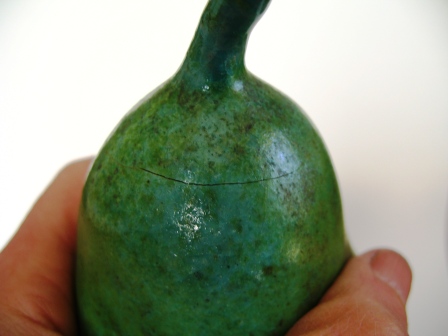
There are two fine pitchers, an excellent bottle, some lush double-walled bowls, a confident teapot, and a juicy green pear (looking artificially green in the photo; it's a little bluer in real life). I consider it a bonus that only one of the pitchers seeps, because--like every other pot I've produced in the past two years that has seeped--they're both made from Loafer's Glory clay. No more Loafer's Glory clay for me (regrettably; it's a lovely clay to work with when it's wet). I have a can of very dangerous highly toxic spray that's supposed to help seal pots, unless the can explodes or the spray poisons you in the process; I haven't tried it out yet, however, because I value functioning lungs, skin, and eyeballs more than I value my seeping pots, but maybe this spring I'll get out the goggles, gloves, and respirator and give it a whirl.


Here are some chickens mugging for the camera:

I will concede that the bubbly crusty purple stuff looks pretty good on chickens. Here's a close up of the crusty stuff on some cups, where it's less appealing (dry crusty stuff and lips don't go well together):

Upon pieces that are strictly objets d'art, the purple stuff is fine. The objet on the left is actually a vase form on its side, though I very much like the spherical look in the photo. I was planning to give up holes for a while, but I think I'm going to have to try making some hole-filled spheres.

On the Double Torus-Multiple Size Hole/Total Coverage Klein Bottle that's been patiently waiting to be fired since last summer, the purple is a little garish against the green glaze. What am I saying, the [w]hole thing is garish anyway:


I will try sanding the crusty bubbles off of pots that should be functional, such as this bowl and colander, as no one wants little bits of heavy-metal-laden glass to chip off into their noodles:

Also in the category of Pots-That-Have-Been-Waiting-Since-Last-Summer are several wheel thrown and altered oval boxes. Alas, instead of using my purple alumina hydrate wax on the lids, I wadded the lids--with the somewhat predictable result that most of the lids warped. Dang. From here on out, it's alumina hydrate wax for me.

In the Total Fail category are several pieces made from a highly recommended ^5-^8 porcelain that I purchased online. I'm used to porcelain being finicky and S-cracking in the bottoms of bowls and cups, but these pieces split in some very odd places. Several tumblers had vertical cracks down the side, often beginning well below the rim and ending well above the foot. In the photo below of the two tumblers, a long vertical crack cuts through the cup on the left, while some beads of water are leaking through a crack in the cup on the right. The salt-rock pear has a horizontal crack across the top that is, as far as I can tell, completely unrelated to the form. Homer Cat doesn't mind the cracks in the tumblers, since all he sees are People Cups, but these pieces are headed for the trash can. I bisqued all of my porcelain pots well before the outside temperatures dropped below freezing, so I'm at a loss to explain the defects. Schade.

To end on a more positive note, here are some non-crusty, lid-fitting oval jars (does that count as litotes?), and a picture of a flattery* penguin chatting it up with a chicken at an office party (penguin and penguin photo by Bob F.).

*as in, "imitation is the sincerest form of..."

Saturday, May 15, 2010

Grammar in Esgaroth

My friend Susan, who is well versed in religious and epic texts in assorted languages of old, insists I would appreciate Tolkien's prose more if I were better read in Middle English and Icelandic. Every sentence I threw at her, she read smoothly, without batting an eye or stumbling over a single missing comma.

So I decided to continue on with open mind after the death of Smaug in Esgaroth by Bard's last and best-aimed arrow [<--see what I in the narrative, that unfolds within the improvisational mind, have learned about strings of prepositional phrases!]. Full on the next paragraph I fell, and read aloud with epic voice these sentences: [<--apologies for the colon, I'm new at this]

"[The wind] twisted the white fog into bending pillars and hurrying clouds and drove it off to the West to scatter in tattered shreds over the marshes before Mirkwood. Then the many boats could be seen dotted dark on the surface of the lake, and down the wind came...No, dagnabbit. Wait a sec...and down the wind came...and down the...Ah, got it...and down the wind...came the voices of the people of Esgaroth lamenting their lost town and goods and ruined houses."

Reading with the epic voice helps.