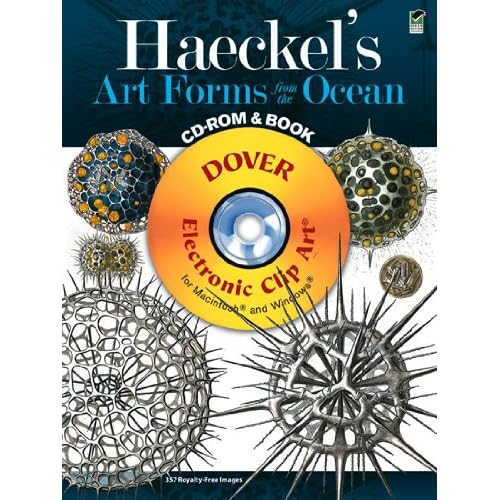
 I belatedly learned about diatoms over a year ago, but it wasn't until just the other week that I learned about radiolarians. I was leafing through some junk mail--the Dover catalog of children's books--when I came across Haeckel's Art Forms from the Ocean.* Thank you, junk mail! The Dover blurb states, "The tiny single-celled organisms known as radiolarians (or radiolaria) develop beautiful, intricate mineral skeletons that cover ocean floors throughout the world." Radiolarians? Spherical skeletons with lacy holes and spikes? Whoowee! Diatoms gone wild!
Naturally, I googled "radolaria[ns]" and found a wealth of swell images (most of which are copyrighted, of course, so, ya know, click on the ones below to see the original sources):
 I also googled Haeckel and learned that he faked illustrations of embryos in order to support his ideas about evolution, and that those fake illustrations have made their way into assorted contemporary biology textbooks. Perhaps he faked a few radiolarians as well; indeed, it's hard to believe he had real life sources for such fantastic microscopic skeletal remains as these: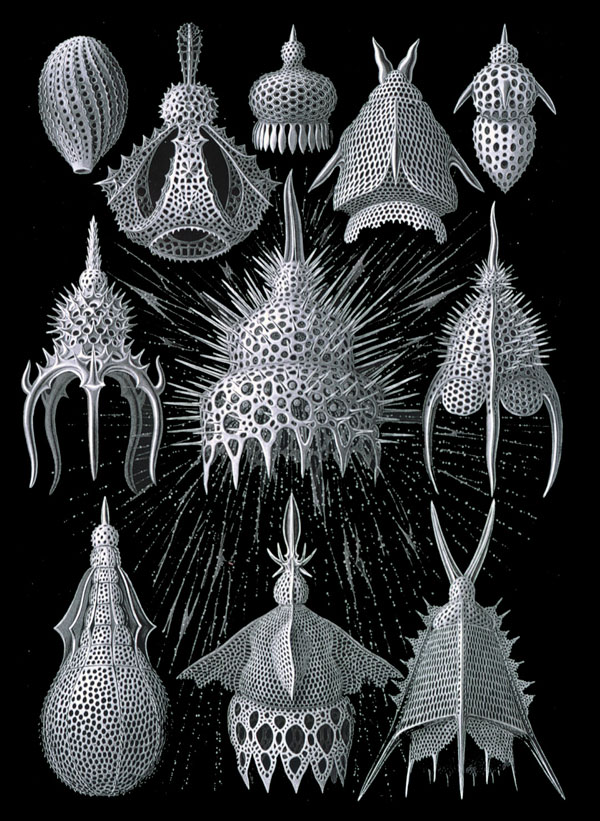
 While much radiolarian art on the interwebs is created using 3D printing (which, I dunno, kinda seems like cheating), one Bavarian ceramicist, Gerhard Lutz, hand builds exquisitely delicate porcelain radiolarians that put my wheel-thrown ones to shame.
*I'm not quite sure how a CD-ROM of an 1862 atlas of microscopic oceanic lifeforms got mixed in with Dover's At the Beach Fun Kit and Something's Fishy! Undersea Designs to Color, but I'm glad it did.
**I also gushed about the Pythagorean Cup, a.k.a. the Cup of Tantalus, a classical Greek wine goblet that punishes gluttony by siphoning out its entire contents when overfilled. It turned out no one in the class felt a need for an anti-gluttony cup, so we didn't try making any.


