
Showing posts with label geekitude. Show all posts
Showing posts with label geekitude. Show all posts
Monday, December 9, 2019
Fame and glory where it counts
How do you make a geek glow? You not only make her Klein bottle the pin-up model for October but also put it on the cover of the American Mathematical Society 2020 Calendar of Mathematical Imagery and then send her a bunch of copies. My math professor dad would have enjoyed this!


Monday, May 9, 2016
Third generation is the charm: reflections on cherry pie and slide rules
When I was a kid, my siblings and I would ask my mother to tell us bedtime stories about her childhood. "Tell us a story about the Olden Days," we would say, night after night, and she would oblige with sepia-tinted tales about life on the Indiana farm or in Hyde Park, Chicago.
The stories that stuck with me most were wonderful adventures foiled by tragedy, like the time my mom and a friend decided to make a cherry pie, so they picked the cherries from the tree on the farm all by themselves, and they made a pie crust all by themselves, and they filled up that pie crust and baked that cherry pie all by themselves, and then no one in my mom's family would even taste it.
(Years later, when I brought up the story and wondered how her family could have been so callous, she said "oh, didn't I mention that the cherries were full of pits and worms, and I'm sure we didn't add any sugar, and we made the crust from flour and water and it was like grey paste? I didn't even eat any of it." I had somehow deleted all of that in my childhood indignation.)
Then there was the story about when my mother, as a little girl, got her very first helium balloon. This was after World War II, because during the war, all the latex was going to the war effort instead of to wonderful frivolous things like balloons. As she was crossing the street, with the balloon tied safely around her tiny wrist so it wouldn't float away (or so I imagined), that wonderful very first balloon popped. Popped! O cruel fate!
(Years later, after I had a child of my own, my mother observed that unlike my own son, my siblings and I had always cried and cried when balloons popped, and she had never understood what was up with that. I asked how we could not have cried, in light of her poignant story of post-war balloon loss. "It was just a balloon," she said.)
One memorable story was less tragic and less sepia-toned, at least to me if not to my mother. As I remember it, the story went something like this: "once upon a time, long ago in the olden days, when my sweet-sixteen birthday rolled around, I hoped for the usual things a 16-year-old girl wants for a birthday present. A pearl necklace, or a new bicycle, or maybe a pony. Something pretty or fun. But I didn't get a pearl necklace, or a new bicycle, or a pony. Instead, my parents gave me a slide rule."
Perhaps I am mis-remembering, and I didn't hear that story until my own sixteenth birthday was approaching. In any case, because my mother has a sense of humor, I too received a slide rule when I turned sixteen: a six-inch long ca. 1936 Keuffel & Esser Ever-There No. 4097D in a slim leather case. Fifteen months later, when my sister had her sixteenth birthday, she too was gifted with a slide rule ("only because it was tradition," she confirmed last night via email).
I am proud that the coming-of-age slide-rule tradition began with women, passed from my mother, as the first recipient, to her daughters. Family lore does not record whether my mother's brother received a slide rule for his sixteenth birthday, and as far as I know, my older brother's slide rules were not affiliated with his sixteenth. (Yes, "slide rules," plural. He reports, "I think I was given more than one because I think I lost more than one.")
My mother broadened the tradition to include menfolk and rites of passage other than birthdays when I married S. She felt it was important to properly welcome my husband into the family, so she gave him a big, fancy, vintage engineer's slide rule with a sturdy leather holster to call his own: a 14-inch long duplex Engineer's No. 1510 in fashionable plastic-coated bamboo, made in Japan, presumably by Relay/Ricoh, for the US market, no date.
My father was a math professor. He owned a slide rule and knew how to wield it. When I was young, I enjoyed playing with its smoothly gliding bars, but by the time I was old enough that a slide rule could have helped with school math, the world had begun its shift to TI-30s and wasn't looking back.
Neither my sister, my husband, nor I ever learned how to use our slide rules. My sister's probably migrated to my parents' attic decades ago. For the past 20 years, S and I have kept ours in their leather cases, tucked away in a desk drawer (his) and in a box in a closet (mine), unused.
Until last week. My son, just thirteen months shy of his sixteenth birthday, is learning about logarithms at school.
"Logarithms?" I said brightly, when he told me. "Let me show you something."
I opened the top right-hand drawer of our roll-top desk and pulled out his father's marital slide rule. We removed it from its holster, and E and I went online to learn how to use it.
"This is SO COOL," E said, as he figured one square root after another to within two significant digits; "when the power goes out after the Zombie Apocalypse, I can calculate numbers without a calculator! Let's do another!"
He asked why we had such a fascinating object. I told him about his grandmother's sixteenth birthday, how she had wanted a pearl necklace or a new bicycle or a pony, and how she had gotten a slide rule instead, and then I fetched my own sweet-sixteen slide rule.
"That is sooooo cute," he said, picking it up.
"Yeah. It's not as fancy as papa's though," I said.
"But it's really cute. It's so small!," he squeaked in admiration.
I put an arm around my delighted child, pointed to the two slide rules on the table, and quoted from the Woozy Works: "Someday, son," I said, "all this will be yours."
And thus it came to pass that a questionable gift for a bright-eyed girl on the cusp of womanhood almost sixty years ago is finally bearing fruit, two generations later. This metaphorical homemade cherry pie will not just be tasted: to paraphrase Sir Francis Bacon, it will be chewed and digested. And thirteen months from now, my son will receive a slide rule to call his own.
The stories that stuck with me most were wonderful adventures foiled by tragedy, like the time my mom and a friend decided to make a cherry pie, so they picked the cherries from the tree on the farm all by themselves, and they made a pie crust all by themselves, and they filled up that pie crust and baked that cherry pie all by themselves, and then no one in my mom's family would even taste it.
(Years later, when I brought up the story and wondered how her family could have been so callous, she said "oh, didn't I mention that the cherries were full of pits and worms, and I'm sure we didn't add any sugar, and we made the crust from flour and water and it was like grey paste? I didn't even eat any of it." I had somehow deleted all of that in my childhood indignation.)
Then there was the story about when my mother, as a little girl, got her very first helium balloon. This was after World War II, because during the war, all the latex was going to the war effort instead of to wonderful frivolous things like balloons. As she was crossing the street, with the balloon tied safely around her tiny wrist so it wouldn't float away (or so I imagined), that wonderful very first balloon popped. Popped! O cruel fate!
(Years later, after I had a child of my own, my mother observed that unlike my own son, my siblings and I had always cried and cried when balloons popped, and she had never understood what was up with that. I asked how we could not have cried, in light of her poignant story of post-war balloon loss. "It was just a balloon," she said.)
One memorable story was less tragic and less sepia-toned, at least to me if not to my mother. As I remember it, the story went something like this: "once upon a time, long ago in the olden days, when my sweet-sixteen birthday rolled around, I hoped for the usual things a 16-year-old girl wants for a birthday present. A pearl necklace, or a new bicycle, or maybe a pony. Something pretty or fun. But I didn't get a pearl necklace, or a new bicycle, or a pony. Instead, my parents gave me a slide rule."
Perhaps I am mis-remembering, and I didn't hear that story until my own sixteenth birthday was approaching. In any case, because my mother has a sense of humor, I too received a slide rule when I turned sixteen: a six-inch long ca. 1936 Keuffel & Esser Ever-There No. 4097D in a slim leather case. Fifteen months later, when my sister had her sixteenth birthday, she too was gifted with a slide rule ("only because it was tradition," she confirmed last night via email).
 |
| My sweet-sixteen Keuffel & Esser Ever-There No. 4097D |
I am proud that the coming-of-age slide-rule tradition began with women, passed from my mother, as the first recipient, to her daughters. Family lore does not record whether my mother's brother received a slide rule for his sixteenth birthday, and as far as I know, my older brother's slide rules were not affiliated with his sixteenth. (Yes, "slide rules," plural. He reports, "I think I was given more than one because I think I lost more than one.")
My mother broadened the tradition to include menfolk and rites of passage other than birthdays when I married S. She felt it was important to properly welcome my husband into the family, so she gave him a big, fancy, vintage engineer's slide rule with a sturdy leather holster to call his own: a 14-inch long duplex Engineer's No. 1510 in fashionable plastic-coated bamboo, made in Japan, presumably by Relay/Ricoh, for the US market, no date.
 |
| S's hefty Engineer's No. 1510 is more than twice as long and twice as thick as my diminutive Keuffel & Esser Ever-There. Surely there's a Master's thesis waiting to be written about slide rules and gender. |
My father was a math professor. He owned a slide rule and knew how to wield it. When I was young, I enjoyed playing with its smoothly gliding bars, but by the time I was old enough that a slide rule could have helped with school math, the world had begun its shift to TI-30s and wasn't looking back.
Neither my sister, my husband, nor I ever learned how to use our slide rules. My sister's probably migrated to my parents' attic decades ago. For the past 20 years, S and I have kept ours in their leather cases, tucked away in a desk drawer (his) and in a box in a closet (mine), unused.
Until last week. My son, just thirteen months shy of his sixteenth birthday, is learning about logarithms at school.
"Logarithms?" I said brightly, when he told me. "Let me show you something."
I opened the top right-hand drawer of our roll-top desk and pulled out his father's marital slide rule. We removed it from its holster, and E and I went online to learn how to use it.
"This is SO COOL," E said, as he figured one square root after another to within two significant digits; "when the power goes out after the Zombie Apocalypse, I can calculate numbers without a calculator! Let's do another!"
He asked why we had such a fascinating object. I told him about his grandmother's sixteenth birthday, how she had wanted a pearl necklace or a new bicycle or a pony, and how she had gotten a slide rule instead, and then I fetched my own sweet-sixteen slide rule.
"That is sooooo cute," he said, picking it up.
"Yeah. It's not as fancy as papa's though," I said.
"But it's really cute. It's so small!," he squeaked in admiration.
I put an arm around my delighted child, pointed to the two slide rules on the table, and quoted from the Woozy Works: "Someday, son," I said, "all this will be yours."
 |
| "One day, son, ALL THIS WILL BE YOURS." My grandfather Mitch shows my uncle Bob the splendor of the junk in the barn; from Woozy Works: The Nearly Complete and Mostly Unexpurgated Writings of the Blue Spanch (1996). |
Friday, August 30, 2013
Zigzag
I'm working on a batch of zigzag pots using my two new ravioli wheels from Italy. By virtue of having been purchased in their country of origin, the new wheels exude a simplicity and elegance that surpasses the Italian import ravioli crimper I bought several years ago at a mall in the U.S.
I've just finished a bag of new (to me) clay: Standard 266. It should fire to a dark gray brown. A friend at Claymakers warned me about its tendency to bloat, so I've been reading up online on how to circumvent that. Hopefully her tip will keep me from losing lots of work.
Having futzed a bit with randomly and lazily mixed slip colors ("hmm, maybe I should dump in some cobalt"), I covered the 266 pots with white slip made from leftover Little Loafers. I also saved 266 slip as I went along, to use as a slip on Little Loafers pots--so I'll have pots that are light slip on dark clay and dark slip on light clay. This appeals to the...what...the math geek in me? Or the color wheel geek? I like the idea of positive/negative permutations.
What's been interesting for me as I work through these pots is how much thought and planning goes into each one. Maybe that's what craftsmanship is. Because the clay ends up getting stretched thin, I want the pots to be correspondingly light; but because the base gets stretched less, and because bases are generally thicker to begin with due to physics, the pots often have a bottom-heaviness I don't like. Since I can't use ribs on the outsides of the pots (they would obliterate the zigzags), there's no making up for an uneven base once I apply slip. This means paying attention, from the very beginning, to making an even and thin base.
So I throw a few of these pots, and each one has some imperfection that bugs me (and probably only me): a bulge at the base, a shoulder that's too flat, a neck that's too short or too tall, a throwing line that disrupts a curve, whatever. So I store up all the things that bug me, and with each new pot, I try to figure out how to avoid making the running list of mistakes. Sometimes this is a lesson in not futzing: instead of "fixing" things, see them as part of the process. Sometimes it's a lesson in surface geometry: if I want a gentler curve in the shoulder, change rib angles and don't apply slip so close to the top. Sometimes it's a lesson in patience: pause for the heat gun, pause for the heat gun, pause for the heat gun. Sometimes, minimalism: more clay doesn't always mean a bigger pot. Sometimes, rebellion: just because logic and tradition say to use a bat doesn't mean I need to use a bat.
Through all of this, while North Carolina is decimating public education and Syria is gassing its citizens, I think about how privileged I am that these are the sorts of problems I get to contemplate a few times a day.
I had to rotate the two detail shots above, since otherwise my eyes/brain reverse the raised/lowered parts of the pot. This is an optical illusion that reminds me of images of lunar craters, which I also tend to see in reverse.

See what I mean? No? Try clicking on the zag photo to enlarge it. Now do you see it? No? Maybe it's just me.
I've just finished a bag of new (to me) clay: Standard 266. It should fire to a dark gray brown. A friend at Claymakers warned me about its tendency to bloat, so I've been reading up online on how to circumvent that. Hopefully her tip will keep me from losing lots of work.
Having futzed a bit with randomly and lazily mixed slip colors ("hmm, maybe I should dump in some cobalt"), I covered the 266 pots with white slip made from leftover Little Loafers. I also saved 266 slip as I went along, to use as a slip on Little Loafers pots--so I'll have pots that are light slip on dark clay and dark slip on light clay. This appeals to the...what...the math geek in me? Or the color wheel geek? I like the idea of positive/negative permutations.
What's been interesting for me as I work through these pots is how much thought and planning goes into each one. Maybe that's what craftsmanship is. Because the clay ends up getting stretched thin, I want the pots to be correspondingly light; but because the base gets stretched less, and because bases are generally thicker to begin with due to physics, the pots often have a bottom-heaviness I don't like. Since I can't use ribs on the outsides of the pots (they would obliterate the zigzags), there's no making up for an uneven base once I apply slip. This means paying attention, from the very beginning, to making an even and thin base.
So I throw a few of these pots, and each one has some imperfection that bugs me (and probably only me): a bulge at the base, a shoulder that's too flat, a neck that's too short or too tall, a throwing line that disrupts a curve, whatever. So I store up all the things that bug me, and with each new pot, I try to figure out how to avoid making the running list of mistakes. Sometimes this is a lesson in not futzing: instead of "fixing" things, see them as part of the process. Sometimes it's a lesson in surface geometry: if I want a gentler curve in the shoulder, change rib angles and don't apply slip so close to the top. Sometimes it's a lesson in patience: pause for the heat gun, pause for the heat gun, pause for the heat gun. Sometimes, minimalism: more clay doesn't always mean a bigger pot. Sometimes, rebellion: just because logic and tradition say to use a bat doesn't mean I need to use a bat.
Through all of this, while North Carolina is decimating public education and Syria is gassing its citizens, I think about how privileged I am that these are the sorts of problems I get to contemplate a few times a day.
 |
| Zigs |
 |
| Zig: light on dark |
 |
| Zag: dark on light |
 |
| I grok the crater in the middle of this image, but not the one at the bottom. |

See what I mean? No? Try clicking on the zag photo to enlarge it. Now do you see it? No? Maybe it's just me.
Saturday, June 15, 2013
The NC Maker Faire and the easiest fipple in the world
Today E, S, and I went to the NC Maker Faire--our first Maker Faire experience.

E's highpoint was learning to solder:

He made his very own blinky Make LED robot pin:
When he came home, he added a piece of paper to the back to interrupt the circuit; otherwise the LEDs would blink until the battery ran out.
S's highpoint was seeing the robotic bugs by the folks at www.sheekgeek.com, although I suspect he also enjoyed showing off his biking finesse by zipping his way through SPARKcon's stationary bike race. S handily won the first race; E came from behind to win the second.

My highpoint was learning how to make the least fickle fipple in the world from wood artist Hal Papan. I was drawn to his table of wood whistles when I looked up to see a hands-on wood-whistle-finishing demo in progress. Hal kindly talked to me about fipples and let me finish a whistle too. He had prepared a bunch of nearly-finished whistles, having already carved the bores and cut the bevels and fipple plugs; my task was simply to orient the plug properly and insert it far enough into the bore that it lined up with the vertex of the bevel cut. He had to help me force the plug in far enough, since it was a tight fit, but the nudge-check-nudge-check process was helpful since I could easily hear the difference between the not-quite-there-yet sound and the loud tweet of the aligned plug. It's a very pretty whistle, with lovely knots and curves.

Of course, when I got home, I tried making one out of clay. It was quick work to roll a coil, push a dowel in, and make a plug for the open end. I was too impatient to wait for the tube to stiffen up, so I went ahead and used a wire cheese slicer to cut the bevel. A little bevel tidying and voila--a sounding whistle, with a remarkably straightforward fipple.

My first attempt was a little too big to put my lips around (which I was doing with a conflicted mixture of enthusiasm for the sound and worry that my bag of clay scraps had been growing bacteria for three months on my porch and I really shouldn't be putting the clay anywhere near my mouth), so I smushed the first iteration and tried again with half as much clay--and voila again
The result is a plain can-I-do-it experiment (yes! I can!), but there's clearly room for further experimenting to discover what kind of sound(s) I can get out of these sorts of whistles, to learn how they can be visually beautified (Joe is back at Penland making far more beautiful ones), and to find out whether there's any chicken potential. Tweet tweet.

E's highpoint was learning to solder:

He made his very own blinky Make LED robot pin:
When he came home, he added a piece of paper to the back to interrupt the circuit; otherwise the LEDs would blink until the battery ran out.
S's highpoint was seeing the robotic bugs by the folks at www.sheekgeek.com, although I suspect he also enjoyed showing off his biking finesse by zipping his way through SPARKcon's stationary bike race. S handily won the first race; E came from behind to win the second.

My highpoint was learning how to make the least fickle fipple in the world from wood artist Hal Papan. I was drawn to his table of wood whistles when I looked up to see a hands-on wood-whistle-finishing demo in progress. Hal kindly talked to me about fipples and let me finish a whistle too. He had prepared a bunch of nearly-finished whistles, having already carved the bores and cut the bevels and fipple plugs; my task was simply to orient the plug properly and insert it far enough into the bore that it lined up with the vertex of the bevel cut. He had to help me force the plug in far enough, since it was a tight fit, but the nudge-check-nudge-check process was helpful since I could easily hear the difference between the not-quite-there-yet sound and the loud tweet of the aligned plug. It's a very pretty whistle, with lovely knots and curves.

Of course, when I got home, I tried making one out of clay. It was quick work to roll a coil, push a dowel in, and make a plug for the open end. I was too impatient to wait for the tube to stiffen up, so I went ahead and used a wire cheese slicer to cut the bevel. A little bevel tidying and voila--a sounding whistle, with a remarkably straightforward fipple.

My first attempt was a little too big to put my lips around (which I was doing with a conflicted mixture of enthusiasm for the sound and worry that my bag of clay scraps had been growing bacteria for three months on my porch and I really shouldn't be putting the clay anywhere near my mouth), so I smushed the first iteration and tried again with half as much clay--and voila again
The result is a plain can-I-do-it experiment (yes! I can!), but there's clearly room for further experimenting to discover what kind of sound(s) I can get out of these sorts of whistles, to learn how they can be visually beautified (Joe is back at Penland making far more beautiful ones), and to find out whether there's any chicken potential. Tweet tweet.
Friday, June 15, 2012
Wrong vs. right


Avoiding kabob membership in the first place: RIGHT.
Monday, June 11, 2012
Chickodils
One of my favorite poems is "Daffodils" by William Wordsworth. In a fatigued but heady moment, after staying up late at Claymakers inhaling kiln-room fumes, glazing chicklets, and sending the first mini-whistle flock into the kiln, I pillaged Wordsworth's rhyme scheme, yielding the poem below. The poetry gods exacted vengeance by striking down the flock: I had hung the birds on a bead rack (two ceramic posts across which multiple high-temperature metal bars rest) that supposedly could handle a cone-6 firing, and every bar sagged and fell off the posts. The result? Fused chicklet-kabobs. The resilient poet has yet to engineer a bulk (i.e. full flock vs. individual bird) firing solution, but in the meantime, I offer the poem publicly to let Euterpe and her sisters know I will not be deterred. (Not that, you know, I'm dropping the gauntlet or anything; I would never diss a Muse.)
Chickodils
I wondered to myself out loud,
How that same self to entertain,
When all at once I thought: a crowd:
A flock of birds to play a strain
With notes chromatic, diatonic,
Up scale, down scale, enharmonic.
Continuous as the stars that shine
And twinkle o’er the fruited plain,
I threw a flock in one long line,
For weeks the focus of my brain.
Three dozen made I at a glance,
Tossing their heads in sprightly dance.
Their fipples are a pain to make,
But when they resonate—what glee!
A potter could not but be gay,
In such a jocund company.
I made—and made—but little thought
What wealth the flock to me had brought:
For oft, when on my couch I lie
In vacant or in pensive mood,
I play a bird! Notes low and high
Bring music to my solitude;
And then my heart with pleasure quickens,
and dances to the well-tuned chickens.
Saturday, May 19, 2012
Chicklets
Earlier this week, E found a plain little whistle I had made for a public school workshop. He suggested it would be nice to have a similar whistle, but with a hole for a piece of string so he could hang it around his neck. Thus was born the mini-chickarina: four holes, major sixth span (do re mi fa fi sol si la), and so cute, they make their larger counterparts look downright classy by comparison. See http://cuteoverload.com/tag/the-rules-of-cuteness/, Rules of Cuteness #s 3, 6, 7, 9, 14, 21, 28, 37, and 38.
The serious artist in me--the one who skillfully crafts forms of elegance and beauty--is a little concerned that all I want to make these days is chicken-shaped ocarinas; but the practical geek in me laughs and says this is the clear confluence of a PhD in music theory, years of practice on the pottery wheel, and a lifetime of cat ownership.
 |
| Family portrait |
 |
| Contemplating the origins of life |
Thursday, May 17, 2012
Eurekarina
In 1987, I moved 1,600 miles from home to attend graduate school in Tucson. During a conversation about home towns, my friends there didn't believe me when I said that back in Urbana, we had experimental cows with windows in their stomachs. Home on a break, I rode my bike over to the South Farms and took this photograph to show everyone:

I was reminded of that picture recently in the geek lab, where I have apparently been industriously re-inventing the wheel.
Perhaps you recall me mentioning that the 7-hole chickarina produces a 12-note chromatic octave and then some, with several built-in pitch redundancies. I speculated then that with fewer holes, I could still get a diatonic octave scale. You might also recall that the number of holes in the ocarina is one of the variables that affects tone quality: increasing the number of holes usually necessitates fipple adjustments. Perhaps, I thought yesterday, I can attain better tone quality by building a diatonic scale using fewer holes.
How many holes would be necessary?
Two holes of different sizes yield four pitches total:
(1) 0 0 (both holes closed)
(2) 0 1 (H1 open)
(3) 1 0 (H2 open)
(4) 1 1 (both holes open)
Four notes out of eight, right there! Add a third hole:
(1) 0 0 0
(2) 0 0 1
(3) 0 1 0
(4) 0 1 1
(5) 1 0 0
(6) 1 0 1
(7) 1 1 0
(8) 1 1 1
"But what has this to do with reinventing wheels, or with cows with windows?," you ask. I'm getting there.
The fingering inventory above doesn't automatically produce a diatonic scale on a chickarina: I need holes of appropriately tuned sizes so that, e.g., 0 0 1 doesn't sound the same as 0 1 0 and 1 0 0. Moreover, according to that most honorable and meticulously edited of sources, Wikipedia, "the [pitch on an ocarina] is dependent on the ratio of the total surface area of opened holes to the total cubic volume enclosed by the instrument. This means that, unlike a flute or recorder, sound is created by resonance of the entire cavity and the placement of the holes on an ocarina is largely irrelevant." This suggests that two holes with a total area A would affect pitch and tone quality in the same way that a single larger hole with area A would, although in practice, as I've pointed out above, this isn't always the case--thus the motivation for fewer holes. But it does mean that if I want eight distinct pitches with three holes, 1 0 0 not only can't equal 0 0 1 or 0 1 0, it also can't equal 0 1 1. (Incidentally, I love that the Wiki author[s] wrote "cubic volume." I'll add that combo to the Redundancy List right after truly unique and labium lip. Perhaps if I want to learn about Helmholtz resonators, I should consult more rigorous texts than Wikipedia.)
Further complicating things, for any given resonating chicken-shaped cavity, the higher the pitch, the larger a newly opened hole has to be to produce a given interval. That is, if I want, say, a major second, I need a smaller hole at lower frequencies (e.g. do-re), and a larger hole at higher frequencies (e.g. la-ti). Consequently, with three holes, the bottom of a scale might be in tune, but as you approach the top of the scale, the pitches become woefully flat: you need a fourth hole. Adding a fourth hole adds eight new fingering combinations (1 0 0 0, 1 0 0 1, 1 0 1 0, etc.), making room for pitch redundancy.
So: four holes.
For my birds, I based hole-size decisions on the intervals produced between 0 0 0 0 and each singly open hole (0 0 0 1, 0 0 1 0, 0 1 0 0, and 1 0 0 0):
H1 = major second
H2 = major third
H3 = perfect fourth
H4 = perfect fourth. Yes, H3 and H4 are the same size. There's room for redundancy.
These holes yield a diatonic scale thus:
Do: 0 0 0 0 (no holes open)
Re: 0 0 0 1 (H1 open)
Mi: 0 0 1 0 (H2 open)
Fa: 0 1 0 0 (H3 open)
Sol: 0 1 1 0 (H3+H2 open. You'd think it should be H4+H1, but that tends to be a little flat: 0 1 0 1 isn't equivalent to a major second plus a perfect fourth--in theory a perfect fifth--because, remember, the higher you go up the scale, the larger the holes need to be to produce a given interval. H3+H2 is a little sharp, but under-blowing lowers the pitch just fine.)
La: 1 1 0 0 (H3+H4 open. On most instruments, a perfect fourth plus a perfect fourth yields a minor seventh. On an ocarina, the interval is flat--a major sixth.)
Ti: 1 1 1 0 (H3+H4+H2 open. A would-be octave is flat--a slightly flat major seventh)
Do': 1 1 1 1 (all holes open. A flat tenth becomes a perfect octave).
You can get a chromatic scale (and then some) out of this, although you have to half-cover H1 for Ra. Pitches can also be tweaked by changing wind speed. You can't really overblow an ocarina, but underblowing bends pitches quite well.
Thus did I reinvent the wheel: the internets tell me a British mathematician named John Taylor invented the four-hole chromatic octave ocarina in 1964. I suppose I could have started my ocarina adventures by looking up fingering charts online, but in exchange for taking the empirical route--thinking for months like the pianist that I am (7-hole ocarinas) before thinking like a mathematician (4 holes)--yours truly got to enjoy a pretty exciting oceureka moment.
As for the cows, the resonating cavities of my chickens vary in size and shape, so the acoustics of the individual ocarinas vary. Whistle wall thickness also affects pitch and tone quality. Thus, while most of the 4-hole birds I made looked just fine, a particularly thin-walled ocarina required humongous H3 and H4 holes and ended up looking like this:

So you can see why I was thinking about cows with windows in their stomachs.
In the midst of all this research, a friend dropped by and observed that my chickens were starting to look a little uniform. Personally, I think they all look wildly different, as far as these guys go, but I will concede that most of the current birds lean to the left. Given North Carolina's recent shameful vote to add a bigoted amendment to our state constitution, I'm not keen on having right-leaning chickens in my flock right now. Here, two lefties show a stunned right-winger that they haven't disappeared even though he voted their civil rights away.


I was reminded of that picture recently in the geek lab, where I have apparently been industriously re-inventing the wheel.
Perhaps you recall me mentioning that the 7-hole chickarina produces a 12-note chromatic octave and then some, with several built-in pitch redundancies. I speculated then that with fewer holes, I could still get a diatonic octave scale. You might also recall that the number of holes in the ocarina is one of the variables that affects tone quality: increasing the number of holes usually necessitates fipple adjustments. Perhaps, I thought yesterday, I can attain better tone quality by building a diatonic scale using fewer holes.
How many holes would be necessary?
Two holes of different sizes yield four pitches total:
(1) 0 0 (both holes closed)
(2) 0 1 (H1 open)
(3) 1 0 (H2 open)
(4) 1 1 (both holes open)
Four notes out of eight, right there! Add a third hole:
(1) 0 0 0
(2) 0 0 1
(3) 0 1 0
(4) 0 1 1
(5) 1 0 0
(6) 1 0 1
(7) 1 1 0
(8) 1 1 1
"But what has this to do with reinventing wheels, or with cows with windows?," you ask. I'm getting there.
The fingering inventory above doesn't automatically produce a diatonic scale on a chickarina: I need holes of appropriately tuned sizes so that, e.g., 0 0 1 doesn't sound the same as 0 1 0 and 1 0 0. Moreover, according to that most honorable and meticulously edited of sources, Wikipedia, "the [pitch on an ocarina] is dependent on the ratio of the total surface area of opened holes to the total cubic volume enclosed by the instrument. This means that, unlike a flute or recorder, sound is created by resonance of the entire cavity and the placement of the holes on an ocarina is largely irrelevant." This suggests that two holes with a total area A would affect pitch and tone quality in the same way that a single larger hole with area A would, although in practice, as I've pointed out above, this isn't always the case--thus the motivation for fewer holes. But it does mean that if I want eight distinct pitches with three holes, 1 0 0 not only can't equal 0 0 1 or 0 1 0, it also can't equal 0 1 1. (Incidentally, I love that the Wiki author[s] wrote "cubic volume." I'll add that combo to the Redundancy List right after truly unique and labium lip. Perhaps if I want to learn about Helmholtz resonators, I should consult more rigorous texts than Wikipedia.)
Further complicating things, for any given resonating chicken-shaped cavity, the higher the pitch, the larger a newly opened hole has to be to produce a given interval. That is, if I want, say, a major second, I need a smaller hole at lower frequencies (e.g. do-re), and a larger hole at higher frequencies (e.g. la-ti). Consequently, with three holes, the bottom of a scale might be in tune, but as you approach the top of the scale, the pitches become woefully flat: you need a fourth hole. Adding a fourth hole adds eight new fingering combinations (1 0 0 0, 1 0 0 1, 1 0 1 0, etc.), making room for pitch redundancy.
So: four holes.
For my birds, I based hole-size decisions on the intervals produced between 0 0 0 0 and each singly open hole (0 0 0 1, 0 0 1 0, 0 1 0 0, and 1 0 0 0):
H1 = major second
H2 = major third
H3 = perfect fourth
H4 = perfect fourth. Yes, H3 and H4 are the same size. There's room for redundancy.
These holes yield a diatonic scale thus:
Do: 0 0 0 0 (no holes open)
Re: 0 0 0 1 (H1 open)
Mi: 0 0 1 0 (H2 open)
Fa: 0 1 0 0 (H3 open)
Sol: 0 1 1 0 (H3+H2 open. You'd think it should be H4+H1, but that tends to be a little flat: 0 1 0 1 isn't equivalent to a major second plus a perfect fourth--in theory a perfect fifth--because, remember, the higher you go up the scale, the larger the holes need to be to produce a given interval. H3+H2 is a little sharp, but under-blowing lowers the pitch just fine.)
La: 1 1 0 0 (H3+H4 open. On most instruments, a perfect fourth plus a perfect fourth yields a minor seventh. On an ocarina, the interval is flat--a major sixth.)
Ti: 1 1 1 0 (H3+H4+H2 open. A would-be octave is flat--a slightly flat major seventh)
Do': 1 1 1 1 (all holes open. A flat tenth becomes a perfect octave).
You can get a chromatic scale (and then some) out of this, although you have to half-cover H1 for Ra. Pitches can also be tweaked by changing wind speed. You can't really overblow an ocarina, but underblowing bends pitches quite well.
Thus did I reinvent the wheel: the internets tell me a British mathematician named John Taylor invented the four-hole chromatic octave ocarina in 1964. I suppose I could have started my ocarina adventures by looking up fingering charts online, but in exchange for taking the empirical route--thinking for months like the pianist that I am (7-hole ocarinas) before thinking like a mathematician (4 holes)--yours truly got to enjoy a pretty exciting oceureka moment.
As for the cows, the resonating cavities of my chickens vary in size and shape, so the acoustics of the individual ocarinas vary. Whistle wall thickness also affects pitch and tone quality. Thus, while most of the 4-hole birds I made looked just fine, a particularly thin-walled ocarina required humongous H3 and H4 holes and ended up looking like this:

So you can see why I was thinking about cows with windows in their stomachs.
In the midst of all this research, a friend dropped by and observed that my chickens were starting to look a little uniform. Personally, I think they all look wildly different, as far as these guys go, but I will concede that most of the current birds lean to the left. Given North Carolina's recent shameful vote to add a bigoted amendment to our state constitution, I'm not keen on having right-leaning chickens in my flock right now. Here, two lefties show a stunned right-winger that they haven't disappeared even though he voted their civil rights away.

Monday, April 30, 2012
Fickle fipples
The Durham spring Art Walk was this past weekend, and I spent a few hours on Saturday in front of Claymakers, providing wheel demos for passersby. I made chickens: they're quick and cute, and they offer great opportunities for one-liners. I used to demo chicken rattles, but of course this year I made chicken whistles, which facilitated pleasant cooing interactions with some morning doves in the awning above the door.

By the end of the afternoon, I had a bat full of chickens waiting to be transformed from single-note birds to full-octave gals, so on Sunday I spent a few hours on voicing.
The only annoying thing about making full-octave ocarinas is that while an ocarina might start out with a lovely clear tone and might hold onto that tone through the addition of a few finger holes, at some point you cut one hole too many and the clear tone vaporizes: poof, gone. The quickest fix is to plug the last hole, but that's not an option if you need the hole for building a diatonic scale.
Ocarina fipples* are fickle, fickle, fickle, and predicting and diagnosing fipple problems is difficult because so many variables are involved: number of holes in the resonating cavity, hole sizes (a hole that is too small can muffle the tone), distance from windway exit to labium,** bevel angle, bevel thickness, windway channel shape/size, changes in the fipple due to condensation (when you blow through the mouthpiece to test the tone, water from your breath condenses onto the clay), stray clay goobers that obstruct the windway, etc. Once a chicken becomes breathy, it's often easiest to fix tone problems by hand-building a mouthpiece and attaching it to the bird butt, rather than trying to adjust a built-in windway (i.e. a windway that is one with the chicken), but attached mouthpieces sometimes shift during drying, and even a slight change in angle can obliterate the tone again.
Recently I've been having pretty good luck with built-in windways, but I still lose the tone around the sixth or seventh finger hole. Today it finally occurred to me how to fix the problem.
Several online ocarina-making instructions say the bevel angle should be 45o, which in practice isn't the case--certainly not when an ocarina produces just a single tone. However, because the bevel is the thinnest part of the fipple, it dries faster than the rest of the ocarina. I noticed that ocarinas that had been well tuned were turning breathy after drying a bit, and guessed that the drying bevels might be shifting upwards, changing whatever angle happened to be working when the chickarina was first voiced. Gently pushing the bevel down fixed the problem. I transferred that solution to the chickarinas that were losing tone quality with the addition of finger holes and discovered that pushing the bevel down usually repairs the sound. When that fix doesn't work, an added mouthpiece does.
I expect this is going to save me hours of mouthpiece futzing. Another trial-and-error breakthrough in the geek lab, where I continue to fill gaps the world never knew it had.
*Another bonus of making ocarinas is getting to use technical terminology like fipple and labium.
**Monday night update: According to the Wikipedia article on fipples, the bevel of a fipple is called the labium lip. The term labium lip is redundant, of course, since labium is Latin for lip, so I'm editing the term down to just labium. I suppose I could pare it down to lip instead, but labium and fipple sound intriguing together, while "lip and fipple" sounds like a '70s comedy team.

By the end of the afternoon, I had a bat full of chickens waiting to be transformed from single-note birds to full-octave gals, so on Sunday I spent a few hours on voicing.
The only annoying thing about making full-octave ocarinas is that while an ocarina might start out with a lovely clear tone and might hold onto that tone through the addition of a few finger holes, at some point you cut one hole too many and the clear tone vaporizes: poof, gone. The quickest fix is to plug the last hole, but that's not an option if you need the hole for building a diatonic scale.
Ocarina fipples* are fickle, fickle, fickle, and predicting and diagnosing fipple problems is difficult because so many variables are involved: number of holes in the resonating cavity, hole sizes (a hole that is too small can muffle the tone), distance from windway exit to labium,** bevel angle, bevel thickness, windway channel shape/size, changes in the fipple due to condensation (when you blow through the mouthpiece to test the tone, water from your breath condenses onto the clay), stray clay goobers that obstruct the windway, etc. Once a chicken becomes breathy, it's often easiest to fix tone problems by hand-building a mouthpiece and attaching it to the bird butt, rather than trying to adjust a built-in windway (i.e. a windway that is one with the chicken), but attached mouthpieces sometimes shift during drying, and even a slight change in angle can obliterate the tone again.
Recently I've been having pretty good luck with built-in windways, but I still lose the tone around the sixth or seventh finger hole. Today it finally occurred to me how to fix the problem.
Several online ocarina-making instructions say the bevel angle should be 45o, which in practice isn't the case--certainly not when an ocarina produces just a single tone. However, because the bevel is the thinnest part of the fipple, it dries faster than the rest of the ocarina. I noticed that ocarinas that had been well tuned were turning breathy after drying a bit, and guessed that the drying bevels might be shifting upwards, changing whatever angle happened to be working when the chickarina was first voiced. Gently pushing the bevel down fixed the problem. I transferred that solution to the chickarinas that were losing tone quality with the addition of finger holes and discovered that pushing the bevel down usually repairs the sound. When that fix doesn't work, an added mouthpiece does.
I expect this is going to save me hours of mouthpiece futzing. Another trial-and-error breakthrough in the geek lab, where I continue to fill gaps the world never knew it had.
*Another bonus of making ocarinas is getting to use technical terminology like fipple and labium.
**Monday night update: According to the Wikipedia article on fipples, the bevel of a fipple is called the labium lip. The term labium lip is redundant, of course, since labium is Latin for lip, so I'm editing the term down to just labium. I suppose I could pare it down to lip instead, but labium and fipple sound intriguing together, while "lip and fipple" sounds like a '70s comedy team.
Tuesday, March 13, 2012
Pythagorean cups
I am pleased to report major developments in the Geek Lab: we re-engineered the Pythagorean Cup! Also known as the Cup of Tantalus, the Pythagorean cup punishes gluttony. Fill the cup a modest amount, and the drinker may consume the beverage in peace; overfill it, and it siphons all of its contents into the drinker's lap.
My 2012 Session 1 Claymakers "Pottery for Geeks" class mostly eagerly took on the redesign of the Pythagorean cup. I made a simplified test model, based on images from Wikipedia:
My 2012 Session 1 Claymakers "Pottery for Geeks" class mostly eagerly took on the redesign of the Pythagorean cup. I made a simplified test model, based on images from Wikipedia:
 |
| Image by Nevit Dilmen |
A hole at the base of the central cap allows the cap to fill as the cup fills. Once the liquid reaches the top edge of the inner pipe, it flows down through the center of the cup. Because of the cap, the outflowing liquid can only be replaced by more liquid, not by air, and the entire contents of the cup siphon out.
The test model worked extremely well, but several of us opined that the big round thang in the middle was unsightly and would arouse gluttons' suspicions.
After some geek conferencing, we decided to incorporate the siphon into the handle. I threw a few thin tori and kluged them into siphons. In the image below, the cup on the left siphons its contents from the cup into the inner torus, up into the outer torus, and out the bottom of the handle. The cup on the right siphons from the cup into the front torus, up into the back torus, and out the bottom.
 Aside from the handles looking clunky, it took significant effort to align, seal, and disguise the holes between the torus segments, and neither handle siphoned particularly well: both lacked sufficient water pressure for a satisfying drainage rate, and the curved handles sent water dribbling onto the undersides of the cups rather than straight down--that's Newton's first law for you. While Acme Klein Bottle sells a cup that siphons efficiently through its handle, these torus-handle models are duds.
The next design merely shifted Pythagoras's unsightly siphon from the center of the cup to the edge. The siphon was significantly easier to build than the torus handles, but remained unsightly. I attempted to distract the glutton's eye by covering the outside of the cup with tessellating lizards and positioning a lizard over the siphon, taking inspiration from Escher's Reptiles (1943).
 Wanting to further minimize the obtrusiveness of the siphon, I explored a final siphon experiment modeled on Acme Klein Bottle's Tantalus wine glass. The handbuilt, relatively small siphon was trivially easy to build, although the frog decoy perched upon it took a while to make.
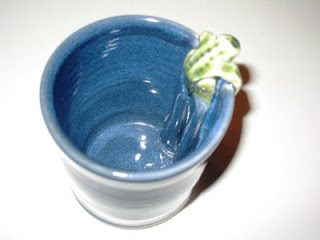 The lizard cup beat the frog: excellent water pressure made for smooth and rapid decanting. I suppose the frog cup might function acceptably during a gluttony emergency, but insufficient water pressure makes for a halfhearted dribble. With further tinkering--for example, making the inflow side of the siphon wider than the outflow side--the simple siphon* might yet prove worthy of replication.
Always the rebel, Schroeder Cat managed to drink out of the bottom of the cup.

*Simple siphon met a python
Going to the fair;
Said simple siphon to the python,
"Will you drink my ware?"
Said the python to simple siphon,
"You've poured one drink too many";
Said simple siphon to the python,
"But look, I have not any!"
The test model worked extremely well, but several of us opined that the big round thang in the middle was unsightly and would arouse gluttons' suspicions.
After some geek conferencing, we decided to incorporate the siphon into the handle. I threw a few thin tori and kluged them into siphons. In the image below, the cup on the left siphons its contents from the cup into the inner torus, up into the outer torus, and out the bottom of the handle. The cup on the right siphons from the cup into the front torus, up into the back torus, and out the bottom.
 Aside from the handles looking clunky, it took significant effort to align, seal, and disguise the holes between the torus segments, and neither handle siphoned particularly well: both lacked sufficient water pressure for a satisfying drainage rate, and the curved handles sent water dribbling onto the undersides of the cups rather than straight down--that's Newton's first law for you. While Acme Klein Bottle sells a cup that siphons efficiently through its handle, these torus-handle models are duds.
The next design merely shifted Pythagoras's unsightly siphon from the center of the cup to the edge. The siphon was significantly easier to build than the torus handles, but remained unsightly. I attempted to distract the glutton's eye by covering the outside of the cup with tessellating lizards and positioning a lizard over the siphon, taking inspiration from Escher's Reptiles (1943).
 Wanting to further minimize the obtrusiveness of the siphon, I explored a final siphon experiment modeled on Acme Klein Bottle's Tantalus wine glass. The handbuilt, relatively small siphon was trivially easy to build, although the frog decoy perched upon it took a while to make.
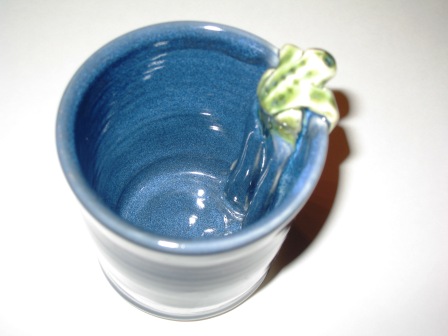 The lizard cup beat the frog: excellent water pressure made for smooth and rapid decanting. I suppose the frog cup might function acceptably during a gluttony emergency, but insufficient water pressure makes for a halfhearted dribble. With further tinkering--for example, making the inflow side of the siphon wider than the outflow side--the simple siphon* might yet prove worthy of replication.
Always the rebel, Schroeder Cat managed to drink out of the bottom of the cup.

*Simple siphon met a python
Going to the fair;
Said simple siphon to the python,
"Will you drink my ware?"
Said the python to simple siphon,
"You've poured one drink too many";
Said simple siphon to the python,
"But look, I have not any!"
Monday, May 23, 2011
Melodious chickens
 What with E's broken arm, there hasn't been much time to experiment this week. Pottery for Geeks has already covered nesting spheres, interlocking torus boxes, double-walled bowls, and two different Klein bottle strategies (the simple "double torus" and the elegant "Klein bottle bottle"). We might could* discuss Borromean rings, but there really isn't much point to making wheel-thrown ones. I'm running out of ideas, and we still have two classes left.
So after I tucked my plucky but tender boy into bed tonight, I brainstormed and decided to figure out how to make an ocarina that actually whistles. I've attempted ocarinas before, but they've been airy duds, and I figure there's abundant topical material here to keep geeks happy: air flow, turbulence, the sorry consequences of sloppy 45o angles, resonance cavities, frequency, pitch, sine waves, and, of course, chickens.** After a little reading, popsicle-stick collecting, and poking and prodding--eureka!
Because safety in the
*Note the proper colloquial usage of the Southern American English double modal.
**This is a joke. We're the science type of geek, not the type that bites heads off chickens (I hope). For the record, no chickens were harmed during the creation of these whistles.
Tuesday, May 10, 2011
Clay B.S. grinder
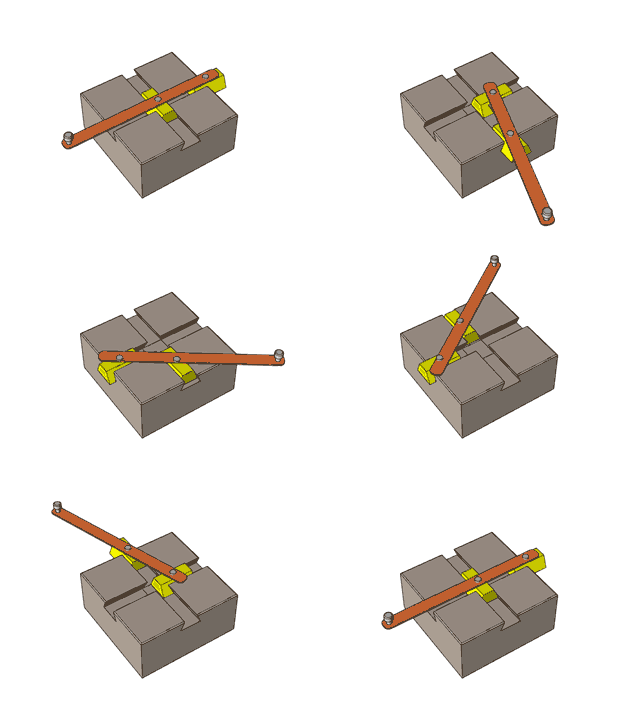 When I was a kid, my mom's parents had a toy they called a bullshit grinder. I just assumed my grandfather made up the name, but it turns out the term "bullshit grinder" is as classic as the toy itself.
If you search Wikipedia for "bullshit grinder," you will be redirected to the much more sanitary and academic "Trammel of Archimedes." The Trammel of Archimedes is noteworthy because its handle traces out an ellipse. Indeed, that appears to be the sole purpose of the Trammel of Archimedes, other than grinding bullshit.
Why do I bring this up? I recently made a petite model of the kitty geek toy. The whole toy fits neatly in the palm of one [human] hand, just like the Trammel of Archimedes, and with a slight flick of the wrist, it's easy to keep the inside ball in motion. The ball traces a circular rather than elliptical path, but the mind-numblingly pleasing yet useless repetitiveness of the non-goal-oriented process echoes the functionality of the bullshit grinder. While I have not tested the grinding efficacy of the Trammel of Archimedes, I have empirical evidence that the petite kitty geek toy is remarkably good at grinding wayward gnats.
All in a day's work, filling gaps the world never knew it had.

Sunday, May 1, 2011
Kitty geek toy
 It seems that my latest geek toys are inspired by my inner cat. It also seems that I'm predisposed to photograph works in progress rather than completed pieces. In any case, I've been having fun cutting into tori. The torus here has a ball inside, for one's inner cat to play with through the spiral gap. Please note the restraint with which I'm piercing holes these days: a little goes a long way.
 I spent a few nights this week dreaming about more elaborate spirals: although three is a magic number, a threefold spiral does make a torus look a little like a nuclear radiation warning symbol. My dreaming subconscious thought perhaps a twelve-fold spiral would look cool. It turns out that that number of twists makes a torus look like a cinnamon cruller, a so-called food I have detested since my earliest youth. Very unappetizing. It took me by surprise that cutting a torus into a spiral turns it into a spring: the spring will actually expand, contract, sag, wobble, and distort, at least until it sets up beyond the cuttable side of leather-hard. It was no great loss, then, that with all that wiggling, my twelve-fold cruller torus broke into several pieces today. Good riddance.
Friday, April 22, 2011
Borromean rings, take two
 I'm getting closer to decent wheel-thrown Borromean rings, though I'm still pretty sure coils are a better way to go. I could probably crank out a few hundred coil Borromean rings in the time it takes to make one set on the wheel. Nonetheless, efficiency isn't everything, and the process has reminded me of some useful tidbits. Listen up, class: (1) wet tori squish more easily than firm tori, so trim and squish them when they're as wet as possible; and (2) nothing disguises unsightly bulges better than hundreds of hand-cut holes.
To address my desire to access the insides of the rings (why make hollow rings if you can't tell they're hollow?), I cut holes into two of the rings to let light show through. Then I wrapped a small pile of hole detritus into a piece of paper towel and stuffed it inside the solid torus during ring-locking assembly. (You can see the access point at the top right of the photo; once the clay is stiffer, I'll smooth over the bulge). Thus, even though people won't be able to see through the solid ring, they'll be able to hear that it's hollow when all those clay bits rattle around inside it--because what's a person going to do with a quarter of a cubic foot of Borromean rings other than shake them up and down?
Wednesday, April 20, 2011
Variations
I've been meaning for a while to write about a set of organ variations by Marcel Dupré: Variations sur un noël op. 20 (1922). I've been meaning to write about how I've been dragging my feet studying them this past year, and how I finally decided to buckle down and really learn them because I ran out of Schumann and my organ teacher thinks the variations are a necessary evil good for me at this point in my musical development, and how I agree with him in theory but nonetheless find a bazillion creative ways to avoid practicing them. The variations are like diminutive exercises in learning to pat your head, rub your tummy, and chew gum all at the same time while standing on your head with your arms superglued together. You'd think blogging about avoiding them would be a good avoidance strategy, yet every time I sat down to blog, I'd think, "no, no, instead of writing about them, go practice them."*
 Thus it is that today I introduce my latest pottery geek experiment: wheel-thrown and altered Borromean Rings. They're made from three tori stretched and nudged into ellipses. It's a little disappointing that there's no way to get inside any of the tori, the way there is with a Klein Bottle or a Moebius diatom box. Why throw and alter hollow tori when you can roll out some coils much more easily? Clearly, further experimentation is necessary.
*Despite all my kicking and screaming, I'm going to conquer this beast. I've dutifully started a practice log, in order to generate evidence that I've actually been practicing (or not) and to focus on how I practice. I've started memorizing individual variations, which makes it a smidge easier squeeze some musicality from these mechanical pieces. A light is finally emerging at the end of the tunnel.
 Thus it is that today I introduce my latest pottery geek experiment: wheel-thrown and altered Borromean Rings. They're made from three tori stretched and nudged into ellipses. It's a little disappointing that there's no way to get inside any of the tori, the way there is with a Klein Bottle or a Moebius diatom box. Why throw and alter hollow tori when you can roll out some coils much more easily? Clearly, further experimentation is necessary.
*Despite all my kicking and screaming, I'm going to conquer this beast. I've dutifully started a practice log, in order to generate evidence that I've actually been practicing (or not) and to focus on how I practice. I've started memorizing individual variations, which makes it a smidge easier squeeze some musicality from these mechanical pieces. A light is finally emerging at the end of the tunnel.
Thursday, April 7, 2011
Geek ball


 I thought about putting a chicken inside the outer ball, but decided it would be better to use something that wouldn't look anthropomorphically forlorn in a spherical cage. Enter the clay wiffle ball, form of 10,000 uses!
As I've already had to kluge one of the outer-ball spokes back together, I have serious doubts that this geek toy is going to survive intact into bisquehood. Ah, ethereal art!
Friday, April 1, 2011
Eureka!
 "Pottery for Geeks" is coming up in a few weeks at Claymakers, so I'm doing a little prototyping.* From the how-did-the-world-ever-manage-without-this department, I proudly introduce the clay wiffle ball. Imagine how these babies will fly when hit with a clay bat. No, not that kind of bat; this kind of bat. I just need to figure out how to throw one on the wheel.
Truthfully, the balls aren't meant for wiffle anything; they're merely a first step en route to a multiple sphere geek toy. I'll post photos eventually if everything works out as planned.
*Verbifying "prototype" reminds me that this morning, I heard a guest on the Diane Rehm show on NPR use "offshore" as a verb--as in "companies are offshoring labor." Way to turn an adjective/adverb into a verb, eh?
Wednesday, October 27, 2010
Gee whiz
"Aging Reader" tells me I've been lax about posting lately, and he's right. So to keep him entertained, here are some updates about my exciting life.
The lot with the geo-thermal tubing balls now has a giant gaping hole surrounded by immense piles of North Carolina red clay. The first day of digging was pretty much the best digger action I've ever witnessed and made me want to borrow a toddler to share the joy.
Beamer and Leo now have three additional harlequin rasbora companions, named Leo 2, Leo 3, and Leo 4. We haven't bonded with the new guys yet, as they don't seem to have much personality (I'm sure the sentiment is mutual), but perhaps we'll grow on one another over time.
I'll be selling pottery in the Watts Hospital Hillandale Art Walk on Nov. 7. This will be my first sale since returning from our Germany hiatus last December, so I've started pulling pots off shelves and assessing my inventory. It's quite the eclectic mix, between the one-of-a-kind class demo pots and the intentional self-improvement pots. Self-improvement phases have apparently included Round Things, Tall Things, Oval Things, Stretched Things, Darted Things, Miniature Things (a phase that lasted about 30 minutes), Chickens, and--most impressively and somewhat disturbingly, when you put them all next to one another--things with holes in them. Lots and lots of holes. Wow.
It's especially nice to discover that pots I once felt ambivalent about--pots that, when removed from the kiln, looked nothing like I hoped they would when I put them in--actually look quite good thanks to several months' separation from my initial expectations.
My friend Adrian came over this morning to pick up a bunch of pieces to photograph for me, so I should have some quality pictures to post soon. In the meantime, here's some of the stuff he didn't take, looking oranger than in real life:

Because I like kitchen gadgets, I'll mention that the pots on the bottom right were made by zesting straight cylinders with a lemon zester, then stretching the cylinders from the inside, yielding the globe shapes with spiraled zest lines.
I've been working with clay for about eight years. I've been competent for perhaps the last five of those, meaning I've generally been the boss of the clay rather than vice versa--that is, I usually manage to turn the blob of clay I start with on the wheel into what I intend for it to become. I'm still waiting for some personal style to emerge, some characteristic detail or gesture that connects most of my work. Looking at the mish mash of pots in the photo is probably not the best way to find that connection, although the combination of zested pots, tall things, holes, and the isolated chicken has me leaning toward the "gee whiz" factor.
 A lifetime ago when I was a grad student in astronomy, the grad student cubicle room would occasionally get telephone questions from inquisitive members of the public. The questions usually dealt with what my peers called "gee whiz" astronomy--delectable popular astronomy tidbits that emerged from stunning satellite or telescope photographs, the sorts of images and ideas that make people say "gee whiz!" (as in, "gee whiz, that's where stars are born?" [Omega Nebula image credit: European Space Agency, NASA, and J. Hester (Arizona State University)]). Gee whizness is what led me into a master's thesis on interstellar gas and dust--which, frankly, is not as exciting as you might think once you take away the pretty pictures and the Vangelis soundtrack from Cosmos.
When I later became a music theorist, I noticed I was drawn to what I called "gee whiz" theory: bring to the fore previously unnoticed details and discuss them in engaging and artful narratives that make people say "gee whiz!" (as in "gee whiz, even though the ghost of Manfred's deceased beloved doesn't ever sing, I actually hear her generating pitches inside my head in that single measure of silence in the third act!").
Gee whizness doesn't answer big questions: it resides in snapshots and unexpected convergences, in flashes of forest seen amidst lots of trees. It's nifty, but not particularly useful or utilitarian in the grand scheme of things. It's like using a Van de Graaff generator to make your hair stand up rather than to produce extremely high voltages for accelerating sub-atomic particles.
I hope I'm not just flattering myself to think my pots are leaning toward a certain gee-whizness, built into the making if not apparent in the final result. The Klein Bottles are pretty obviously gee-whizzy, as are the double-walled bowls and (I think) the chickens (wheel-thrown chickens!). And personally, I think lemon zested oblate spheroids are pretty gee whiz too.
It's possible that I'm simply confusing gee whizness with nerdiness. I recently submitted a proposal to Claymakers for a new class I've dubbed "Pottery for Geeks." I sure hope they let me teach it.
In other news, the auto repair shop just called and we need a new front axle.
Here's wishing all the best to "Aging Reader," "Aging Breeder," and the rest of you in Pixel-land. Leave a comment sometime so I know you're out there!
The lot with the geo-thermal tubing balls now has a giant gaping hole surrounded by immense piles of North Carolina red clay. The first day of digging was pretty much the best digger action I've ever witnessed and made me want to borrow a toddler to share the joy.
Beamer and Leo now have three additional harlequin rasbora companions, named Leo 2, Leo 3, and Leo 4. We haven't bonded with the new guys yet, as they don't seem to have much personality (I'm sure the sentiment is mutual), but perhaps we'll grow on one another over time.
I'll be selling pottery in the Watts Hospital Hillandale Art Walk on Nov. 7. This will be my first sale since returning from our Germany hiatus last December, so I've started pulling pots off shelves and assessing my inventory. It's quite the eclectic mix, between the one-of-a-kind class demo pots and the intentional self-improvement pots. Self-improvement phases have apparently included Round Things, Tall Things, Oval Things, Stretched Things, Darted Things, Miniature Things (a phase that lasted about 30 minutes), Chickens, and--most impressively and somewhat disturbingly, when you put them all next to one another--things with holes in them. Lots and lots of holes. Wow.
It's especially nice to discover that pots I once felt ambivalent about--pots that, when removed from the kiln, looked nothing like I hoped they would when I put them in--actually look quite good thanks to several months' separation from my initial expectations.
My friend Adrian came over this morning to pick up a bunch of pieces to photograph for me, so I should have some quality pictures to post soon. In the meantime, here's some of the stuff he didn't take, looking oranger than in real life:

Because I like kitchen gadgets, I'll mention that the pots on the bottom right were made by zesting straight cylinders with a lemon zester, then stretching the cylinders from the inside, yielding the globe shapes with spiraled zest lines.
I've been working with clay for about eight years. I've been competent for perhaps the last five of those, meaning I've generally been the boss of the clay rather than vice versa--that is, I usually manage to turn the blob of clay I start with on the wheel into what I intend for it to become. I'm still waiting for some personal style to emerge, some characteristic detail or gesture that connects most of my work. Looking at the mish mash of pots in the photo is probably not the best way to find that connection, although the combination of zested pots, tall things, holes, and the isolated chicken has me leaning toward the "gee whiz" factor.
 A lifetime ago when I was a grad student in astronomy, the grad student cubicle room would occasionally get telephone questions from inquisitive members of the public. The questions usually dealt with what my peers called "gee whiz" astronomy--delectable popular astronomy tidbits that emerged from stunning satellite or telescope photographs, the sorts of images and ideas that make people say "gee whiz!" (as in, "gee whiz, that's where stars are born?" [Omega Nebula image credit: European Space Agency, NASA, and J. Hester (Arizona State University)]). Gee whizness is what led me into a master's thesis on interstellar gas and dust--which, frankly, is not as exciting as you might think once you take away the pretty pictures and the Vangelis soundtrack from Cosmos.
When I later became a music theorist, I noticed I was drawn to what I called "gee whiz" theory: bring to the fore previously unnoticed details and discuss them in engaging and artful narratives that make people say "gee whiz!" (as in "gee whiz, even though the ghost of Manfred's deceased beloved doesn't ever sing, I actually hear her generating pitches inside my head in that single measure of silence in the third act!").
Gee whizness doesn't answer big questions: it resides in snapshots and unexpected convergences, in flashes of forest seen amidst lots of trees. It's nifty, but not particularly useful or utilitarian in the grand scheme of things. It's like using a Van de Graaff generator to make your hair stand up rather than to produce extremely high voltages for accelerating sub-atomic particles.
I hope I'm not just flattering myself to think my pots are leaning toward a certain gee-whizness, built into the making if not apparent in the final result. The Klein Bottles are pretty obviously gee-whizzy, as are the double-walled bowls and (I think) the chickens (wheel-thrown chickens!). And personally, I think lemon zested oblate spheroids are pretty gee whiz too.
It's possible that I'm simply confusing gee whizness with nerdiness. I recently submitted a proposal to Claymakers for a new class I've dubbed "Pottery for Geeks." I sure hope they let me teach it.
In other news, the auto repair shop just called and we need a new front axle.
Here's wishing all the best to "Aging Reader," "Aging Breeder," and the rest of you in Pixel-land. Leave a comment sometime so I know you're out there!
Wednesday, June 16, 2010
Möbius strip joke
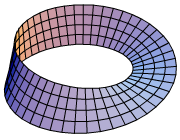 I was at Claymakers last week, gently chiseling bisqued clay goobers out of the holes of one of my Klein bottles before glazing it, when a gentleman asked me what a Klein bottle was. I explained that it is basically what you get when you sew two Möbius strips together.
After we talked topology, he said:
"Why did the chicken cross the Möbius strip?"*
I thought the best answer was "KABLOOIE!" (the sound of a brain self-destructing when faced with the oxymoronic contradiction of anything getting to the other side of a Möbius strip), but he said "to get to the same side," which is almost as good.
Other interesting questions are why a chicken is on a Möbius strip in the first place, and what happens to it once it reaches the same side. According to Frederick Winsor, author of The Space Child's Mother Goose, animals don't necessarily do well in Möbius environments:
Flappity, Floppity, Flip!
The Mouse on the Möbius Strip.
The Strip revolved,
The Mouse dissolved
In a chronodimensional skip.**
Incidentally, in Winsor's world, my high flying chicken*** might have enjoyed a happier ending:
Humpty Dumpty sat on a wall.
At three o'clock, he had his great fall.
The King set the Time Machine back to two.
Now Humpty's unscrambled and good as new.**
*And to think that we hadn't talked about chickens at all!
**The Space Child's Mother Goose, verses by Frederick Winsor, illustrations by Marian Parry (1958; first paperback edition, 1963).
***Consider the amazing power of punctuation: compare a high, flying chicken to a high-flying one. You won't find this example in Eats, Shoots & Leaves: The Zero Tolerance Approach to Punctuation by Lynne Truss (2004).
Wednesday, June 9, 2010

Subscribe to:
Posts (Atom)


