Showing posts with label möbius strips. Show all posts

Friday, March 4, 2011

Post-firing debriefing

As always, I need time to come to terms with my pots post-firing. For example, what I considered yesterday to be disturbing crusty bubbly purple stuff, I now consider (just one good night's sleep later) merely befuddling crusty bubbly purple stuff. But I'm getting ahead of myself. Good news first:

The Moebius Diatom Boxes experienced minimal warpage, and none of the parts stuck together. The photos make them look toastier and bagelier than they are in reality. I expect future MDBs will end up electric or gas fired, maybe with some stains for color, to reduce preparatory exasperation.

My four favorite pieces are square boxes (wheel thrown and altered!) that I glazed top to bottom. They responded beautifully to the soda. The tallest box is about 5" high.

There are two fine pitchers, an excellent bottle, some lush double-walled bowls, a confident teapot, and a juicy green pear (looking artificially green in the photo; it's a little bluer in real life). I consider it a bonus that only one of the pitchers seeps, because--like every other pot I've produced in the past two years that has seeped--they're both made from Loafer's Glory clay. No more Loafer's Glory clay for me (regrettably; it's a lovely clay to work with when it's wet). I have a can of very dangerous highly toxic spray that's supposed to help seal pots, unless the can explodes or the spray poisons you in the process; I haven't tried it out yet, however, because I value functioning lungs, skin, and eyeballs more than I value my seeping pots, but maybe this spring I'll get out the goggles, gloves, and respirator and give it a whirl.


Here are some chickens mugging for the camera:

I will concede that the bubbly crusty purple stuff looks pretty good on chickens. Here's a close up of the crusty stuff on some cups, where it's less appealing (dry crusty stuff and lips don't go well together):

Upon pieces that are strictly objets d'art, the purple stuff is fine. The objet on the left is actually a vase form on its side, though I very much like the spherical look in the photo. I was planning to give up holes for a while, but I think I'm going to have to try making some hole-filled spheres.

On the Double Torus-Multiple Size Hole/Total Coverage Klein Bottle that's been patiently waiting to be fired since last summer, the purple is a little garish against the green glaze. What am I saying, the [w]hole thing is garish anyway:


I will try sanding the crusty bubbles off of pots that should be functional, such as this bowl and colander, as no one wants little bits of heavy-metal-laden glass to chip off into their noodles:

Also in the category of Pots-That-Have-Been-Waiting-Since-Last-Summer are several wheel thrown and altered oval boxes. Alas, instead of using my purple alumina hydrate wax on the lids, I wadded the lids--with the somewhat predictable result that most of the lids warped. Dang. From here on out, it's alumina hydrate wax for me.

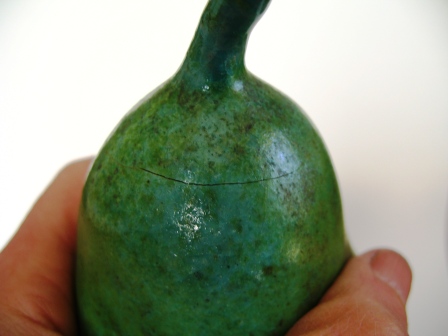
In the Total Fail category are several pieces made from a highly recommended ^5-^8 porcelain that I purchased online. I'm used to porcelain being finicky and S-cracking in the bottoms of bowls and cups, but these pieces split in some very odd places. Several tumblers had vertical cracks down the side, often beginning well below the rim and ending well above the foot. In the photo below of the two tumblers, a long vertical crack cuts through the cup on the left, while some beads of water are leaking through a crack in the cup on the right. The salt-rock pear has a horizontal crack across the top that is, as far as I can tell, completely unrelated to the form. Homer Cat doesn't mind the cracks in the tumblers, since all he sees are People Cups, but these pieces are headed for the trash can. I bisqued all of my porcelain pots well before the outside temperatures dropped below freezing, so I'm at a loss to explain the defects. Schade.

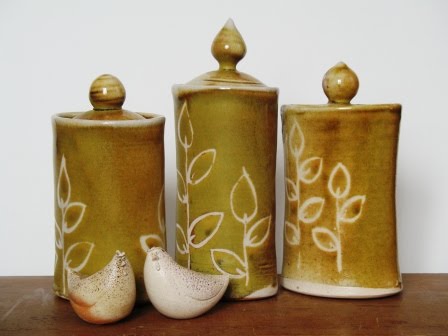
To end on a more positive note, here are some non-crusty, lid-fitting oval jars (does that count as litotes?), and a picture of a flattery* penguin chatting it up with a chicken at an office party (penguin and penguin photo by Bob F.).

*as in, "imitation is the sincerest form of..."
Friday, February 25, 2011

Lessons learned

Friends and I are firing pots in the wood kiln at Cedar Creek this weekend, which means I'm up late tonight organizing and prepping pots. Near the end of the firing, we will spray into the kiln a solution of soda ash that has been dissolved in boiling water. The sodium in the soda ash will react with silica in the clay bodies, creating sodium silicate (glass), effectively glazing the pots. Soda ash is a flux, so it will also lower the melting point of any glazes that we might use to decorate the pots, hopefully creating beautiful glaze effects.

To prevent the pots from glass-fusing to the kiln shelves, we will glue little balls of wadding under the pots. Wadding is a mixture of kaolin (clay), alumina hydrate, and grog (ground bisqued clay); it doesn't react to soda ash. We also use wadding to keep lids from fusing to pots--and depending on how we stack things, also to keep pots from fusing to pots.

Enter my four prototype Moebius Diatom Boxes. I can't separate the two Moebius strips with wadding because there's no way to prop either up on wadding without impractical and precarious balancing acts. Moreover, if the two strips end up touching one another, they'll likely fuse together at the contact point.

So I surfed the internets and found a strategy: coat the edges of the two Moebius strips with wax that has alumina hydrate dissolved in it. After the wax burns off, the remaining thin layer of alumina hydrate will protect the clay from the soda ash. I found assorted recipes for this special wax, most of which can be summarized as follows: "use, oh, a spoonful or so alumina hydrate in, oh, half a pint or so of thinned wax."

So I bought a little container of wax and added some red food coloring to distinguish it from my unadultered wax, and then I added two teaspoons of alumina hydrate. Turns out alumina hydrate doesn't dissolve in cold un-thinned wax, so I had to give the container a nice warm bath this evening. Also turns out that pink wax is next to impossible to see on pink bisque ware. I subsequently added some blue food coloring, but it turns out that purple wax is also next to impossible to see. It also turns out that it's next to impossible for one person alone to wax the rims of two clay Moebius strips without the patient assistance of a Moebius-Strip Bearer (a.k.a. S), for if the wet wax on one strip touches the surface of the other strip, it will (in theory) leave a deposit of alumina hydrate on the pot, preventing soda from reacting with the clay in that spot.

Anyway, it was a pain in the patootie to wax the things, which suggests they will remain very rare items indeed. Now I'm going to bed.

Monday, January 3, 2011

Prototype

Announcing another breakthrough from the Non-Orientable Manifold Lab!

I said I was going to call it a "Bagel Box," but that's so 2010. It's a new year, and "Möbius Diatom Box"* has a better ring to it (so to speak).

I took advantage of Saturday's warm weather to throw some tori.


Then it rained for two days, so I moved the tori inside to dry; and then winter returned, so after I trimmed the tori outside in the subfreezing night air (brrr), I moved production into the dining room.

I carefully marked and cut the first torus, going for an angular look.


Silly me. Those 90o angles locked the two rings together with impressive efficiency. I had to smoosh the clay to get the torus open, and both rings ripped a bit.


Oh well, back to the drawing board.

I carefully marked and cut the second torus. No sharp angles this time.


Incidentally, in preparation for this experiment, this weekend I tried (and failed) to slice four bagels into interlocked halves; the near-lack of bagel holes left no room to maneuver the knife. I can now say it's significantly easier to cut a clay torus this way than a bagel, but the rough edges stand out more in the clay than on the bagel, mainly because a linked-sliced bagel is almost entirely rough edges, whereas a hollow clay torus has the potential to be lovely and smooth all over.

Despite some jagged lines, the slicing achieved the desired outcome.


It turns out that this kind of box is a two-person job. My beloved engineer patiently held each ring in succession while I tidied up the other ring's rough edges.

Of course, no clay math toy is complete without holes.


*George Hart calls the cut surfaces "two-twist Möbius strips." Although that second twist means the cut surface isn't really a Möbius strip, I'm sticking with the name "Möbius diatom box."

Wednesday, June 16, 2010

Möbius strip joke

I was at Claymakers last week, gently chiseling bisqued clay goobers out of the holes of one of my Klein bottles before glazing it, when a gentleman asked me what a Klein bottle was. I explained that it is basically what you get when you sew two Möbius strips together.

After we talked topology, he said:

"Why did the chicken cross the Möbius strip?"*

I thought the best answer was "KABLOOIE!" (the sound of a brain self-destructing when faced with the oxymoronic contradiction of anything getting to the other side of a Möbius strip), but he said "to get to the same side," which is almost as good.

Other interesting questions are why a chicken is on a Möbius strip in the first place, and what happens to it once it reaches the same side. According to Frederick Winsor, author of The Space Child's Mother Goose, animals don't necessarily do well in Möbius environments:

Flappity, Floppity, Flip!
The Mouse on the Möbius Strip.
The Strip revolved,
The Mouse dissolved
In a chronodimensional skip.
**

Incidentally, in Winsor's world, my high flying chicken*** might have enjoyed a happier ending:

Humpty Dumpty sat on a wall.
At three o'clock, he had his great fall.
The King set the Time Machine back to two.
Now Humpty's unscrambled and good as new.**

*And to think that we hadn't talked about chickens at all!

**The Space Child's Mother Goose, verses by Frederick Winsor, illustrations by Marian Parry (1958; first paperback edition, 1963).

***Consider the amazing power of punctuation: compare a high, flying chicken to a high-flying one. You won't find this example in Eats, Shoots & Leaves: The Zero Tolerance Approach to Punctuation by Lynne Truss (2004).

Friday, February 19, 2010

Killing two gee whiz pots with one stone

On Thursday, in the middle of an otherwise mundane afternoon, as I was walking from Point A to Point B, my potter's mind was struck by a sudden flash of inspiration. I'm hoping that by stating my idea in a public forum, witnessed by you five or so regular readers and the occasional visiting spammer who leaves comments of an inappropriate nature in Chinese hanzi that I subsequently have to delete, I will be more likely to make it a reality.

But first, some necessary background information. The photo above shows a small portion of "Dr. Lizardo's Museum of Gee Whiz Pots (being various works of a functional, semi-functional, impractical, or nonsensical nature)."

Exhibit 1 is a model of a Möbius strip--relatively mundane. The items in Exhibit 2 are more exotic: "We're 3-dimensional models of Klein Bottles—representations of 4-dimensional non-orientable manifolds," reads the Museum Guidebook. "We’re what you get when you sew the edges of two mirror-image Möbius Strips together. You can get from our outsides to our insides without crossing any edges—meaning our outside and inside are on the same surface. If we were actually 4-D, we’d have zero-volume; being 3-D, we have volume and make handy m&m and red-hots holders."

The Museum exhibit is scattered at present: all of the Klein Bottles have been dispersed to good homes, and all of the red hots and m&ms, if not already consumed, are inedibly stale by now. So it is clearly time for me to make some new Klein Bottles, even though they're labor intensive and relatively useless.

At the same time, as I have written previously, I am somewhat obsessed with the impractical habit of drilling holes in pots whenever the opportunity presents itself. I have some lovely, very large (9 pounds untrimmed) bowls in the works over at Claymakers right now. They're made from Loafer's Glory clay--a silky smooth white clay that's more forgiving than porcelain--and I'm fantasizing about bringing them home and staying up all night poking holes in them. But then they'd no longer make good mixing bowls, which is what they were born to be. And while the hole punching usually yields interesting results, interesting isn't always a good thing. Consider, for example, the bizarre could-have-been-a-vase thing shown here. We use it occasionally for votive candles, but since I wasn't thinking of candles when I made it, I didn't provide any easy way to get a match inside. Plus, who really needs a giant glowing first-trimester votive candle holder?

So my stroke of genius is this: why not kill two impractical birds with one stone? That is, why not make a Klein Bottle that's full of holes? Imagine being able to see the m&ms on the inside (which is also the outside) from the outside (which is also the inside). I don't know about you, but I find this idea pretty thrilling. I anticipate the hole punching will be easiest if I make a Klein Bottle of the less complicated double torus variety, as seen in the Hitchhiker's Guide model above. I plan to document my progress--if such a thing as "progress" can conceivably be associated with a project like this--in future installments of this blog, so stay tuned.