Showing posts with label fish. Show all posts

Monday, June 25, 2018

The Great Fish Tank Crisis of 2018

Readers who have been following this blog for a while might remember The Great Ice Storm of '02 and The Great 2010 Fish Tank Catastrophe. What these events have in common--along with most other snow storms and home calamities--is that S is out of town for them.

Today, S is here:


Scenic Les Diablerets, Switzerland! What a lovely place for an academic conference, with free time scheduled in for hiking and biking. When the conference ends, S will spend several days biking from Les Diablerets to Bavaria, where he'll spend a week visiting his mom. Fifteen days from now, he'll fly home.

The timing could thus not be any better for The Great Fish Tank Crisis of 2018 to commence.

Yesterday, E and I noticed that the fish tank filter spray bar was making a lot of noise. This happens when enough water evaporates that the spray bar is no longer under water, creating a fountain as the filtered water returns to the tank; and it was odd, given that S had recently replenished the tank.

This morning, as E and I were rushing out the door, we noticed the noise was even louder. How odd that another inch of water could have evaporated so quickly out of the 45-gallon tank. Then we noticed the water seeping out of the bottom of the tank, meandering down--a drip here, a rivulet there--into the expanding puddle on the floor below. I looked at the fish; the fish looked at me. And then, with fingers crossed that the tank would not burst in the next 20 minutes, E drove us to his job (he's still 8 practice hours and 2.5 months away from getting his driver's license) while I texted S in a panic.

The fish tank and its accompanying geekery are S's deal. I know about as much about maintaining the tank as he knows about making pottery--which is to say, usually enough, but not much when the clock is ticking. For example, I know how to feed the fish, and how to add tea-tree oil if someone takes a bite out of someone else's tail, and how to pull out and rinse off the filter, just as S knows how to appreciate a form and fill a handmade bowl with salad, and how to blow into a chickarina butt to make music. He doesn't know how to throw a pot or load a kiln under time pressure, just as I don't know how to stop a tank from emptying out onto the floor or how to set up a hospital tank and relocate 25 living fish into it. (Yes, S guided me through the Great 2010 Fish Tank Catastrophe over the telephone--at 3 a.m., Germany time--but in that case there were, alas, but two survivors to relocate, and the tank wasn't threatening to burst.)

Thankfully, our neighbor R was available and came to the rescue, with S checking in periodically by phone from his scenic bike ride near Les Diablerets. (The above photos were taken at each phone-call stop.) All fish have been transferred to the hospital tank in the kitchen, including the powerful giant plecostomus that resisted netting and that R consequently carried by its tail through the dining room; all plants have been transferred to a second spare tank and bucket; and enough tank water was salvaged to keep everyone healthy and happy through a water change or two. So that E and I don't have to enjoy the scent of decaying fish poop for two weeks, R and I scooped all the gravel out of the tank, carried it outside, rinsed it off, and spread it on cardboard on the porch to dry, and then we carried the tank outside and R rinsed that too. Then we pulled the fish tank stand away from the living room wall, so the floorboards will have a chance to dry out and hopefully unbuckle.

And then peace descended upon the house once more. When S returns, he can repair and reassemble the tank, and it will be ready for a brand new crisis the next time he goes out of town.


From less troubled times:

Friday, January 23, 2015

The Terror of the Tank

Over winter break, S revamped the fishtank, which had become overrun with algae. In the process, he woke a monster.


Meet Gyrinocheilus aymonieri. When we took him in a few years ago, we thought we were doing a good deed. About 5 cm long, he was one of a handful of fish we inherited from a neighbor across the street who was trading in her tank for a hamster.* Sold by pet stores as an algae eater, Gyrinocheilus is a reclusive fish; we saw ours only a few times a year.

When S overhauled the aquarium, he temporarily moved all of the fish into two smaller tanks, upon which we discovered that Gyrinocheilus had grown. He was 12 cm long and angry as hell. He spent his days seething, saving his energy for darkest night, when he would fling gravel across new abode in a futile attempt to dig himself a hole to hide in. The gravel-flinging clicks intrigued our cat Schroeder. We covered the temporary tanks with cardboard, lest the cat spend his nights plotting ways to remove the lids. Then I donated a long, narrow, oval soda-fired pot to Gyrinocheilus; he moved in immediately and found his new cave-like space calming.

With the 45-gallon tank scrubbed clean, furnished with new lighting, new gravel, and new plants, and with water quality stabilized, all of the fish moved back in. Gyrinocheilus had an especially untraumatic transfer, as S moved him in the safety of his pottery cave.

We bought a few new fish for the tank: six wee rasboras, six black neon tetras, and, because we're the local fish orphanage, one black skirt tetra to fill out a small school we had inherited from yet another friend who was shutting down her tank.

Because we're now in month four of a two-month upstairs bathroom renovation, we sleep downstairs in our living room near the fish tank. The night after new-fish move-in day, we drifted off to the sound of flicking gravel. Come morning, every single wee rasbora was gone. "Et," as we say in the south.

After lecturing the perpetrator ("Bad fish. Bad. I hope you get a tummy ache"), S turned to Google and discovered that Gyrinocheilus are not actually great algae eaters. They get big and cranky with age and "develop an appetite for meatier fare."

We attempted to freecycle the carnivorous beast: "Free to a good (preferably) or bad (we don't really care) home: one Gyrinocheilus aymonieri" etc. Our honest ad received but one response: "Great, that sounds perfect for my prahok. Is he still available?" Alas, the responder never came to pick up the fish.

We nixed the idea of donating Gyrinocheilus to E's school, as we didn't think it would be any more pleasant for young children to witness fish carnivorism than it was for us, no matter how great the potential for instructional lessons about predators and prey. E immediately rejected my suggestion that we give Gyrinocheilus to Schroeder. (Hope springs eternal in that feline breast: someday, Schroeder knows, through a combination of razor-sharp extended claws, the powerful springlike action of highly evolved hind legs, and sheer will power, he will crush the quarter-inch thick aquarium glass that stands between him and the fish.)

The needs of the many outweigh the needs of the one. A few days later, when our school of six mid-sized black neon tetras turned into a school of five and an eighth, it was time for the Terror of the Tank to go. Sic semper tyrannis. Suffice it to say that his demise was, we hope, gentler than being eaten alive.

Two weeks later, peace has returned to the tank. Some of the new plants are sending squiggly shoots up to the water's surface to bloom. A committee of six industrious nerite snails now handles algae control. And with the voracious carnivore gone, the schooling fish are intermingling. A friend says our tank is a fine metaphor for corporate America.

*When I first mentioned Gyrinocheilus in this blog, I wrote that we purchased him ourselves. S is adamant that we inherited him, which is entirely possible--although I wonder, now that Gyrinocheilis has revealed himself to be a voracious carnivore, whether we're saying we inherited him in order to put greater distance between ourselves and his crimes.

The Terror of the Tank, belly full, poses in front of his handmade soda-fired cave

Wednesday, May 1, 2013

The Treachery of Fish: Ceci n'est pas un Bowfin

When I was an 11-yr-old 7th*-grader, I dutifully followed teacher instructions. When the science teacher said, "in case of a fire drill, blow out your Bunsen burners and go outside," I thought, "why blow them out instead of turning them off?," but I figured the teacher knew more than I did so I didn't say anything. When the fire drill rolled around, I blew out my Bunsen burner and went outside, where I was so disturbed by the thought of gas piping into the science room that I talked to a classmate about it. She told the teacher, and he went inside and shut off the gas, and we all survived and neither the science room nor the school blew up. 

I write this because a generation later, my own beloved 11-yr-old has apparently inherited my need to unquestioningly obey authority figures. This  came up last night when he had to answer a question about what kind of scales a bowfin has. He looked up the technical term online, and I asked him if that matched what he had seen on the fish his group had dissected last week in Science class.

"Well, no; I mean, I don't know, because we dissected a perch."

--"A perch? I thought you were writing about a bowfin."

"I am. The bowfin didn't come in on time, so Mr. G. put me in the perch group. But he said they're basically the same fish, so I should still do the bowfin."

--"But you didn't dissect a bowfin, you dissected a perch."

"I know!" He rolled his eyes at my cluelessness. "But Mr. G. said I should do the bowfin anyway."

Ceci n'est pas un perch
We went back and forth like this for a while. Eventually I appealed to the power of the grading rubric: "Look, how are you supposed to write a Conclusion Section about what you learned dissecting a bowfin if all of your data is about a perch?" Thus was born a compromise: answer the bowfin questions, but ask them about the perch.

Ceci n'est pas non plus un perch
On the bright side, this boy of mine, when he saw my collection of Dover books, picked up The Odyssey and asked, "ooh, is this for me? Did you know The Odyssey is the second oldest known story in western civilization, after The Iliad?"

Ceci n'est pas un bowfin. Ceci sont deux perches.
 *7th and 8th grades were combined in my high school; we were called "subfreshmen."

Wednesday, April 17, 2013

R.I.P. Leo and Beamer

On March 28, we lost Leo H. Rasbora. By the time we noticed he was gone, he had been mostly consumed by his tank mates. Born into a schooling breed, he became a loner following the Great Fish Tank Catastrophe of 2010. He never took to the four perky harlequin rasboras we added to the tank this past winter. Maybe they're the ones who ate him.

S usually tries to ease the transition from life to death for our aquatic pets. When he notices a clearly dying fish in the tank, he prepares a small container of tank water, gently transfers the fish, and then puts it in the freezer. This is an "old school" method. There's heated debate online regarding whether freezing is humane compared to other methods of euthanasia, but it does seem kinder than being eaten by your cohabitants.

As sometimes happens with couples that have spent their lives together, Beamer followed Leo out of this earthly realm last Sunday. She was 11, and had spent her last year in a frenzied procreative love affair with her unnamed mate, who in his time of loss appears to be less morose than hungry. It's hard to read the emotional state of a fish.

S froze Beamer. She was floating on her side by the time he got to her, quite likely already dead, but he wanted to ease her along just in case. This morning, I opened the freezer door and saw what I thought was a container of shiny silver toothpicks--another one of E's experiments, perhaps. But no, it was Beamer's dorsal fin, which hadn't quite fit into the plastic casket (a clean Chobani yogurt container, pineapple flavor). It was shocking to see her so undignifiedly frozen into a funerary chunk of ice.

Pondering these weighty thoughts, I googled "fish death," hoping to find something meaningful to say about fish and ice cubes. Thus I discovered a Wikihow article on How to Get over a Fish's Death: 7 Steps, for which someone was surely underpaid. My favorite suggestion is #5: "If you have things that remind you of your fish, put them in a scrapbook," although the photo of the toilet for #1 ("Give your fish a burial") comes in a close second. Don't miss the link at the bottom, How to Tell If Your Fish Is Dead: 9 Steps.

R.I.P. Leo H. Rasbora
In the staring contest with death, you emerged victorious
~2005-2013

Good night sweet Beamer
And schools of Angel Fish swim thee to thy rest
~2002-2013

Tuesday, February 5, 2013

Big Fish

One of the lessons I learned through my Penland experience last summer was to take advantage of the clay workshops offered closer to home--cheaper, faster, and easier to access (albeit not as scenic, and without the great food). I've taken three excellent workshops at Claymakers since then: one with Susan Feagin on screen printing and slip transfer, one with Kent McLaughlin on hand-making brushes (lovely brushes with bamboo handles and--oy--bristles cut from sanitized, neon-dyed deer tails from tackle shops; no matter how well cleaned or fluorescently colored, deer tails still feel and smell like deer tails and probably would have benefited the deer more than me); and one this past weekend with Alan Bennett on sculpting and raku-firing fish.

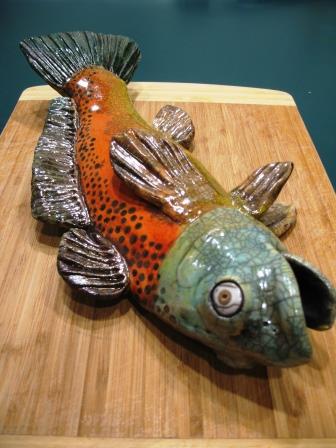
In about 30 hours, Alan took us from wet clammy clay to finished fired fish. We sculpted fish Saturday morning into early afternoon, encouraged them to dry in front of fans while Alan demoed glazing, and then gutted the fish from behind to thin their walls. They went directly into the electric kilns to dry, were bisque fired overnight, and remarkably came out mostly whole the next morning. We glazed and raku-fired Sunday afternoon, and everyone left with finished work by early evening. My main take-aways: how to make eyeballs and eyelids; how to sculpt a fish in under two hours; how to gut a solid form; and the knowledge that fish have eyelids, nostrils, lips, and ears. (As my friend N commented, "imagine that--it's like they have entire FACES!"; yet even with a tank full of fish at home, I'd never looked closely enough to notice anything but the lips. I now notice their nostrils, but remain unconvinced that they have eyelids.)

One of my fish--the last one I made, so the wettest on Saturday evening--cracked widthwise, from the dorsal fin through the tail and into the belly. He became my glaze test tile. I think the colors look a little too paint-by-numbers-ish, although friends in the workshop pulled out photographs of fish that have similarly discrete color transitions.


Fish two was a quick expendable extra--a whistle, to see how whistles make it through raku. The unglazed portions of clay blackened as the piece cooled outside the kiln in sawdust (when the sawdust burns, it creates a reduction atmosphere around the clay). The eyeball whites and the fangs, made from porcelain, were brushed with a solution of gerstley borate to keep them from blackening.


I saved the largest fish for last. It was the first one I made on Saturday and consequently had enough time to dry prior to bisquing that it didn't crack. I worked harder at blending the colors on this guy. It's hard to see in the photo, but there's a lovely fluid transition on the body from red to yellow to vaguely green, with no crackle on the spots and lots of crackle on the belly. The head merges from blue at the nose to greenish with hints of red and yellow at the gills.

Sunday, December 23, 2012

Summer recaps finished: Penland and flutes

Warm November flew away, and barely-cold December is also on its way out, so here's my last summer catch-up blog. I'm sure I'll never catch up with autumn blogging, so I'll spill the highlights right away: (1) our determined angel fish laid new eggs every 2-3 weeks and the young fry got eaten by their carnivorous tank-mates and parents every darned time; and (2) Schroeder lost his carrot, causing distress and consternation, but my mom knitted him a new one and everyone is content once more. Ooh, and (3) I worked towards coming to terms with glazes fired in oxidation, attempting to mimic the variation of reduction-fired surfaces by spraying layers of different Claymakers' studio glazes à le Steven Hill, and it's going well enough that I recently bought a used compressor and spray gun, with hopes of building (and, by extension, finding room for) a spray booth for my home studio; but that's a story that lacks photos and will have to wait until 2013 for blog development.

So back to the summer. I spent the last two weeks of August at the Penland School of Crafts, taking a class entitled "Shape Shift: The Pot," taught by Jim Lawton. I had been meaning to take a Penland class for almost a decade, and the stars had finally aligned between a class I was very interested in, two unencumbered weeks, and manageable kidcare. At Penland, I learned a lot about darting, making holes, and assembling well-proportioned altered pots, worked intensely from morning to night, met a lot of interesting and talented people, ate super duper well, and happily jogged almost daily along beautiful mountain roads (only getting lost once, when what I thought was a 180o-sum turn on curvy roads turned out to be only about 85o, and a 3-mile trip turned into 7 miles, so that I missed breakfast on the last day).

One of my Penland classmates, Joe, is a glass artist who was honing his clay skills. We had a shared interest in clay instruments; I showed him how to make ocarinas, and he showed me how to make a flute. It took until late this fall for me to finally attempt making a flute; the initial results are played below, with a chickarina for comparison (apologies to Beethoven for the flubs). Ocarinas are easier to play, although the tone quality and range aren't as good. Both flutes were tuned by ear; maybe next time I'll pull out my tuner. As with the chickarina, some pitches +/- can be replicated with multiple fingerings, which helps some with the tuning. It would probably help too if I actually knew how to play the flute. As it is, I feel disturbingly light-headed after playing these things. I'm sure good tone quality and hyperventilating don't always have to go hand-in-hand.

There are assorted online guides to making clay, wood, and PVC-tubing flutes. Handouts for assorted college-level acoustics labs tend to go into more precise detail than I was interested in, so I followed the suggested measurements in Barry Hall's book, From Mud to Music, which offers the same hole-positioning advice as this website by Mark Shepard. The detail that can't be stressed enough is that hole size hugely affects the tuning. After some trial and error, I abandoned the distance-of-finger-hole-from-mouthpiece measurements and relied on hole size to enable comfortable finger placements. But maybe that's part of why I have to hyperventilate when I play.

Another lesson I took away from Penland was to register for more workshops at Claymakers--way cheaper and way more convenient to get to than Penland (although the food and scenery, of course, can't compare). Thus I enjoyed a late-summer workshop with Susan Feagin (Penland's clay studio manager) and a mid-autumn brush-making workshop with Kent McLaughlin.

And now for some pastoral Beethoven...


Tuesday, September 11, 2012

Fish fry

I wrote recently that I had a very busy summer, so here's the first installment in my attempt to catch up a bit. I'm starting easy with an animal report, since this blog has sorta degenerated into Pots'n'Pets. But wait--don't hang up yet!--this is going to be a good one: it's about FISH.

When I last wrote about our fish, we were down to two courageous survivors of the Great 2010 Fish Tank Catastrophe. Leo, the lonely stressed-out harlequin rasbora, and Beamer, the studly voracious angel fish, eventually moved across the street to a friend's house, and we dismantled the hospital tank in the kitchen to make room for a cherry-red Kitchen-Aid mixer.

As is our way with things, we let our 45-gallon tank sit empty in the living room for another year and a half, until we cautiously decided to move it to the basement. (We're slow and measured decision-makers.) The realization that we would need to clear space in the basement became motivation to resurrect the tank instead. Thus, two weeks and a flurry of eBay plant and gravel orders later, in January our tank was back in business.

We populated the tank with colorful fish we hadn't realized we'd been missing: radiant red and blue cardinal tetras, a Chinese algae eater who isn't living up to its name, a reclusive pair of black-and-white polka-dotted corydoras, a half dozen beautiful bleeding-heart tetras, a dinosaur-like plecostomus who kicked the bucket early on, and a youthful black-striped angel fish.

In the spring, we got a phone call from our friend across the street. She had made a deal with her parents and was trading in the fish for a hamster. A hamster! So Leo and Beamer moved back in with us, along with a few odds'n'ends scrappy companions with whom they had cohabited during the previous year. It was just like old times.

Our nameless youthful angelfish was not to be outdone by the much older and distinguished Beamer. Within a few weeks, he grew to match her size, and soon, instead of nipping on one another's fins like our previous angel fish did (R.I.P.), they became an inseparable pair. In the heat of midsummer, they publicly demonstrated their commitment to one another by laying and fertilizing a couple hundred eggs on the filter pipe. Unsatisfied with the locale, they ate all of them.

Then they tried laying eggs on a leaf. Angel fish eggs gestate for about 60 hours. The second clutch hatched and survived into fry-hood, and their doting parents tended them aggressively, vigilantly keeping all the other fish in the tank at bay. They kept the herd together, catching strays in their mouths and spitting them back into the fold. The other fish did not seem particularly interested in chowing down on angel fish fry, but Beamer and Youthful Angel Fish didn't let that stand in their way. S and I thought we would give the parents a break by putting a barrier in the tank between the perceived predators and the young family. Beamer and Youthful Angel Fish responded by eating every single one of their babies.

They have since laid about five or six clutches, which means they have enjoyed about five or six really tasty high-protein meals. A friend who used to have a 96-gallon tank with angel fish warned us it would be so, but we hold out hope that someday a wee baby angel fish will charm its way past egghood through fryhood and into adulthood. Until then, we have home movies to watch to remember the good ol' days when the family was still intact...


Wednesday, October 27, 2010

Gee whiz

"Aging Reader" tells me I've been lax about posting lately, and he's right. So to keep him entertained, here are some updates about my exciting life.

The lot with the geo-thermal tubing balls now has a giant gaping hole surrounded by immense piles of North Carolina red clay. The first day of digging was pretty much the best digger action I've ever witnessed and made me want to borrow a toddler to share the joy.

Beamer and Leo now have three additional harlequin rasbora companions, named Leo 2, Leo 3, and Leo 4. We haven't bonded with the new guys yet, as they don't seem to have much personality (I'm sure the sentiment is mutual), but perhaps we'll grow on one another over time.

I'll be selling pottery in the Watts Hospital Hillandale Art Walk on Nov. 7. This will be my first sale since returning from our Germany hiatus last December, so I've started pulling pots off shelves and assessing my inventory. It's quite the eclectic mix, between the one-of-a-kind class demo pots and the intentional self-improvement pots. Self-improvement phases have apparently included Round Things, Tall Things, Oval Things, Stretched Things, Darted Things, Miniature Things (a phase that lasted about 30 minutes), Chickens, and--most impressively and somewhat disturbingly, when you put them all next to one another--things with holes in them. Lots and lots of holes. Wow.

It's especially nice to discover that pots I once felt ambivalent about--pots that, when removed from the kiln, looked nothing like I hoped they would when I put them in--actually look quite good thanks to several months' separation from my initial expectations.

My friend Adrian came over this morning to pick up a bunch of pieces to photograph for me, so I should have some quality pictures to post soon. In the meantime, here's some of the stuff he didn't take, looking oranger than in real life:


Because I like kitchen gadgets, I'll mention that the pots on the bottom right were made by zesting straight cylinders with a lemon zester, then stretching the cylinders from the inside, yielding the globe shapes with spiraled zest lines.

I've been working with clay for about eight years. I've been competent for perhaps the last five of those, meaning I've generally been the boss of the clay rather than vice versa--that is, I usually manage to turn the blob of clay I start with on the wheel into what I intend for it to become. I'm still waiting for some personal style to emerge, some characteristic detail or gesture that connects most of my work. Looking at the mish mash of pots in the photo is probably not the best way to find that connection, although the combination of zested pots, tall things, holes, and the isolated chicken has me leaning toward the "gee whiz" factor.

A lifetime ago when I was a grad student in astronomy, the grad student cubicle room would occasionally get telephone questions from inquisitive members of the public. The questions usually dealt with what my peers called "gee whiz" astronomy--delectable popular astronomy tidbits that emerged from stunning satellite or telescope photographs, the sorts of images and ideas that make people say "gee whiz!" (as in, "gee whiz, that's where stars are born?" [Omega Nebula image credit: European Space Agency, NASA, and J. Hester (Arizona State University)]). Gee whizness is what led me into a master's thesis on interstellar gas and dust--which, frankly, is not as exciting as you might think once you take away the pretty pictures and the Vangelis soundtrack from Cosmos.

When I later became a music theorist, I noticed I was drawn to what I called "gee whiz" theory: bring to the fore previously unnoticed details and discuss them in engaging and artful narratives that make people say "gee whiz!" (as in "gee whiz, even though the ghost of Manfred's deceased beloved doesn't ever sing, I actually hear her generating pitches inside my head in that single measure of silence in the third act!").

Gee whizness doesn't answer big questions: it resides in snapshots and unexpected convergences, in flashes of forest seen amidst lots of trees. It's nifty, but not particularly useful or utilitarian in the grand scheme of things. It's like using a Van de Graaff generator to make your hair stand up rather than to produce extremely high voltages for accelerating sub-atomic particles.

I hope I'm not just flattering myself to think my pots are leaning toward a certain gee-whizness, built into the making if not apparent in the final result. The Klein Bottles are pretty obviously gee-whizzy, as are the double-walled bowls and (I think) the chickens (wheel-thrown chickens!). And personally, I think lemon zested oblate spheroids are pretty gee whiz too.

It's possible that I'm simply confusing gee whizness with nerdiness. I recently submitted a proposal to Claymakers for a new class I've dubbed "Pottery for Geeks." I sure hope they let me teach it.

In other news, the auto repair shop just called and we need a new front axle.

Here's wishing all the best to "Aging Reader," "Aging Breeder," and the rest of you in Pixel-land. Leave a comment sometime so I know you're out there!

Sunday, September 19, 2010

Fish health and the great cat experiment

Following the fish tank catastrophe, Beamer the angel fish has been thriving in the tiny hospital tank in the kitchen. At feeding time, s/he hovers with tail fin wagging and agape mouth aimed upward toward the surface of the water, waiting for those dry, colorful little fish'n'shrimp chips to fall from the hand of the life-giving deity (me). Beamer grows visibly larger daily and is strong, radiantly healthy, and about as cuddly as a cold-blooded angel fish can be.

Alas, Leo the harlequin rasbora, being a schooling fish, is not so happy. Indeed, Leo spends the daylight hours hiding behind the filter pump, waiting morosely for his/her aquarium glass reflection to come out and play. The profound loneliness isn't aided by the fact that S repeatedly forgets Leo's name and calls him/her "Alex."

In other pet news, I have decided to toilet train Homer, our lithe and schmusig geriatric passive-aggressive cat. NB Homer: this is what you get when you pee all over the bath mat for three weeks when your humans are on vacation, even if (just guessing) the housesitter never bothered to change the litterbox until the night before we came home.

The device I am using for Homer's re-education is known as the Litter Kwitter. I did a little comparison shopping and, based on 165 thoughtful and compelling customer reviews from around the globe, chose the Litter Kwitter over a cheaper, flimsier system. We are placing our confidence in the award-winning system despite the tacky "Kw-."

Homer responded to Stage 1--the appearance, on the floor next to the downstairs toilet, of the red litter-filled tray within the white imitation toilet bowl rim--with general disinterest. We recently began Stage 2, stationing the red litter-filled tray again within the imitation toilet bowl rim, but now clipping the imitation rim onto the actual toilet bowl rim. See how this works? Homer responded to Stage 2 with initial disinterest, after which a human needed to use the downstairs toilet and inadvertently returned the system to Stage 1. As you might observe, this is not the most convenient system, but four to six patience-filled weeks from now, when Homer is completely, unerringly, Litter Kwitter affirmingly toilet trained and no longer expressing his wrath by peeing on towels, we'll be laughing all the way to the litter-free bank.

Saturday, August 28, 2010

A sad way to go

We returned from Germany a week ago Friday to a sorry state of animal affairs. To make a long story short, about fifteen fish in our 45-gallon tank lost their lives to an overfeeding-fueled, oxygen-depriving, algae-bloom calamity that somehow went unnoticed by our determinedly oblivious housesitter until it was too late. Thankfully, the two surviving fish, Leo and Beamer (survivors of a disaster like this deserve names), seem to be holding up well in their little hospital tank on the kitchen counter.

In an expression of solidarity and disdain, our cat Homer occupied himself during our 3.5-week absence by peeing exclusively on the downstairs bathmat.

Putting the best possible spin on all of this, I can only express amazement at our housesitter's superpower: Nose of Steel.