Present-day me thinks 13-year-old me was onto something when she disliked The Scarlet Letter. I haven't made it to the main story yet, because it has taken me two weeks to slog through the 31-page opening, "The Custom-House: Introductory to 'The Scarlet Letter.'" (On the bright side, needing a break, I read the first two chapters of George Herbert Palmer's 1921 translation of The Odyssey out loud to E, and we both thought it was pretty engaging.)
About halfway through "The Custom-House," I googled "scarlet letter narrator patronizing jerk" but didn't get any useful hits. One enthusiastic video claims that contrary to initial appearances, the Introductory isn't actually boring--Really! It echoes the book, in
miniature! Isn't that cool? Such forced enthusiasm suggests the Introductory is, in fact,
boring to its present-day primary audience of distressed middle- and high-school readers. (One wonders how Hawthorne's depressed narrator would feel about that; he'd probably just nod his head, knowingly.)
I took notes in the margins while I read and have culled the following five themes, which I offer here to any student desperate for an essay topic:
1. You can't trust the Federal government. That vixenly American eagle looks protectively tender, but she'll claw your eyes out in a heartbeat. Customs officers rely too much on Uncle Sam.
2. Salem is drab and decaying, and the narrator would prefer to be pretty much anywhere else. He has lived in other places, but repeatedly returns to Salem, thanks in large part to the pull of the bones of his imposing Puritan ancestors, who were cruel bigwigs in Salem's early days, and compared to whom the narrator feels like an unremarkable loser. Eventually, the narrator will make a break for it, either in actuality, or through his literary imagination, or by dying. He pretends to be dead near the end of the Introductory so that he can feel like less of a jerk for having written it: "...the sketch which I am now bringing to a close [i.e. "The Custom-House"], if too autobiographical for a modest person to publish in his lifetime, will readily be excused in a gentleman who writes from beyond the grave. Peace be with all the world! My blessing on my friends! My forgiveness to my enemies! For I am in the realm of quiet!"
3. The men who work at the Custom House like to tip their chairs back against the wall, sometimes while they sleep on the job. The narrator offers this detail several times in the Introductory; perhaps he thought it was particularly funny, or so subtle that it bore repeating. To the forlorn high school student with an essay due tomorrow, I offer the following quotes and page numbers:
- p. 4, "[You would discern]...a row of venerable figures, sitting in old-fashioned chairs, which were tipped on their hind legs back against the wall. Oftentimes they were asleep."
- p. 9, "They spent a good deal of time, also, asleep in their accustomed corners, with their chairs tilted back against the wall..."
- p. 10, "...it was pleasant to hear them chatting in the back entry, a row of them all tipped against the wall, as usual..."
- p. 27, "[Might I not, like some of my loser colleagues, decide to make] the dinner-hour the nucleus of the day, and to spend the rest of it, as an old dog spends it, asleep in the sunshine or the shade?" The astute reader should conclude that in Salem, old dogs slept in chairs tipped against the wall.
4. Happy people should be mocked (or, the narrator is a patronizing jerk):
- p. 10, "Externally, the jollity of aged men has much in common with the mirth of children...In one case, however, it is real sunshine; in the other, it more resembles the phosphorescent glow of decaying wood."
- p. 12, "[The 80-year-old Head Inspector, despite outliving everyone else in his family, remained happy]....He was, in truth, a rare phenomenon: so perfect in one point of view; so shallow, so delusive, so impalpable, such a nonentity, in every other. My conclusion was that he had no soul, no heart, no mind...."
- p. 12, in which the happy Head Inspector is compared to a dog: "One point, in which he had vastly the advantage over his four-footed brethren, was his ability to recollect the good dinners which it had made no small portion of the happiness of his life to eat."
- p. 14, regarding the Collector, "Nevertheless, looking at the old warrior with affection,--for, slight as was the communication between us, my feeling towards him, like that of all bipeds and quadrupeds who knew him, might not improperly be termed so,--I could discern the main points of his portrait." Note, incidentally, the use of litotes here!
- p. 15, suggesting the General is a wuss by comparing him to females: "A trait if native elegance, seldom seen in the masculine character after childhood or early youth, was shown in the General's fondness for the sight and fragrance of flowers. An old soldier might be supposed to prize only the bloody laurel on his brow; but here was one, who seemed to have a young girl's appreciation of the floral tribe."
- p. 16, in which the narrator observes he's improving his own character by spending time with people he has criticized for being too happy, vapid, feminine, or sleepy: "It contributes greatly towards a man's moral and intellectual
health to be brought into habits of companionship with
individuals unlike himself, who care little for his pursuits,
and whose sphere and abilities he must go out of himself to
appreciate."
5. The narrator is fascinated by how a wig that was buried for 80 years has managed to hold up.
- p. 20, on how the remains of Surveyor Jonathan Pue were "recently" dug up and moved: "Nothing, if I rightly call to mind, was left of my
respected predecessor, save an imperfect skeleton, and some
fragments of apparel, and a wig of majestic frizzle, which,
unlike the head that it once adorned, was in very satisfactory
preservation."
- p. 22: "It
impressed me as if the ancient Surveyor,...wearing his immortal wig—which was
buried with him, but did not perish in the grave—had met me in
the deserted chamber of the Custom-House."
- p. 23: "'Do this,' said the
ghost of Mr. Surveyor Pue, emphatically nodding the head that
looked so imposing within its memorable wig..."
One friend shared with me that she had also felt ambivalent about The Scarlet Letter in high school, but that when she re-read it a few years ago, Hawthorne struck her as a sort of punk rock feminist. I hope he will eventually strike me that way too, as I move into the main body of the book. In any case, given that the Introductory is supposed to encapsulate the story's central themes, I look forward to observing how the five themes described above unfold.
Showing posts with label litotes. Show all posts
Showing posts with label litotes. Show all posts
Thursday, May 9, 2013

Thursday, September 27, 2012
Summer recap continued: Bridges 2012
Way back in July, my pottery-, parenthood-, and standing-in-line-friend Dr. J (Duke PhD in Mathematics, 2009) and I traveled to Towson University to attend the Bridges Conference. According to the Bridges website, the conference is the largest mathematics and art interdisciplinary conference in the world, so you can see why J was the perfect travel companion.
I had some ceramic pieces in both the conference exhibit and an associated month-long exhibit in the Towson University art gallery. I knew I was in clay-geek heaven when, as I unpacked my nested spheroids for display, a mathematartist came over for a peek and, hearing the pieces were handmade, said, "you mean you didn't make those with a 3D printer? What did you say those are made of??" Yep, I make my nested spheroids the old fashioned way: by hand, from clay, on a potter's wheel, just as generations of my ancestors would have done before me, had they had the opportunity, the years of training, and the sense that it was actually necessary.
J and I attended numerous talks, browsed assorted displays of math-related art, books, and toys, perused the art exhibits, explored small downtown Towson, conversed with enthusiastic math-art folk, went on an "Excursion Day" tour of Baltimore, and overall had a swell time.
There's a nice video summary of the art exhibits here: http://bridgesmathart.org/past-conferences/bridges-2012/2012-art-exhibition/ . (If you want proof that J and I were really there, pay attention at 1:09.)
With multiple concurrent sessions, it was impossible to get to all of the talks. Of the ones I attended, those that stood out enhanced my understanding of both math and art. These included a sort of six-degrees-of-separation networks talk by Brian Evans; a talk by Greg Frederickson on polygon dissections, with beautiful animated videos illustrating not only that any polygon, properly dissected, can be reassembled into another polygon of equal area (think of Tanagrams), but also highlighting the different ways to transform the pieces (reflections, rotations, etc.); a delightful lecture-demonstration by mathematician and former professional clown Mike Naylor on using math to predict, describe, and invent juggling patterns; and an amusingly touchy-feely group workshop, led by Luke Wolcott, on imagining negative-dimensional space (-1D, -2D, etc.) that had us dancing in circles by the end.
One of my conference highlights was meeting the inventor of Space Chips, Dick Esterle. He had a large-scale collaborative Space-Chips vision that he wanted to realize at the conference, so he brought a few thousand bright orange 5-slit chips with him to make it happen. (There were, in fact, multiple artists with large-scale visions for collaborative art in assorted different media. It would not be inaccurate--litotes!--to say there was a competitive undercurrent between folks who wanted their visions realized. Largest, tallest, mostest, firstest, pointiest, originalest, elaboratest-Greek-prefix-before-"hedron," etc.) The Space Chips project started a few days into the conference; J and I wandered into the construction extravaganza around 4pm, when we couldn't handle attending yet another talk. Little did we know we'd get sucked in for eight straight hours. We tried to escape for dinner, but our ringleader looked so disappointed, we ended up turning back and suggesting we order out for pizza instead. A major downpour deterred our second attempt to escape at 11pm, so we stuck it out until the last component was put in place, and the vision--a giant orange Space Chips megalohedron--was realized. It turns out that this was a vision that kept on giving: if you spend 8 hours assembling 3,200 bright orange Space Chips into a giant ball, what you dream about all night long is bright orange space chips.


Below are two other projects that required group efforts to realize. J and I learned how to fold and assemble the playing-cards mock-up in the foreground of the photo below, but bailed before visionary George Hart moved the party on to the larger cardboard creation.

Late Thursday night, while we were inside working on the orange megalohedron, another group was tempting fate outside by building this tall pointy thing in a brewing thunderstorm. Sorry, I remember the names of neither the visionary nor the components.

No conference talks were scheduled on Friday because it was Excursion Day. J and I and 148 or so other conference attendees headed to Baltimore. The first stop was the Walters Museum of Art, where we were treated to a fascinating lecture by Will Noel on the Archimedes Palimpsest. In the 13th century, a monk harvested the parchment out of Archimedes' Codex C (presumed to have been copied from original scrolls in the 10th c.) and a bunch of other outdated books to create a new prayer book; the pages of the codex were cut up and refolded, mixed up with pieces of parchment from other books, the original texts wiped off, and new text written on the primed pages. Noel and the Walters Museum led a 12-year multinational project that, using assorted imaging techniques, deciphered the original texts. You can find assorted videos on YouTube on the palimpsest-decoding project, including Noel's TED talk. After the talk, we had some time to peruse the museum.
Our next stop was the Baltimore Museum of Art. J and I were feeling a little art-museumed out, so we skipped out of the guided tours and had lunch a few blocks away. To get back, we had to cross over to the far side.

The Baltimore Museum of Art is a good place for thinkers.

From there, it was on to Fort McHenry. During the War of 1812, on September 13, 1814 (1812 was a long year), the British fleet bombarded the fort. An American lawyer was on one of the British ships, negotiating a prisoner exchange when the Battle of Baltimore started; when he saw, through the dawn's early light, that a star-spangled banner yet waved o'er the fort (are you getting patriotic goosebumps yet? The Visitors Center video was very good at inducing patriotic goosebumps), he penned a four-stanza poem entitled "Defense of Fort McHenry." His brother-in-law set the words to a popular tune ("The Anacreontic Song") that is so hard to sing, we can be grateful our national anthem only uses the first verse of Frances Scott Key's poem. (Personally, I think we'd be better off both in music and sentiment with "America the Beautiful," but oh well.) Incidentally, Key spent much of his later legal career prosecuting anti-slavery activists for supposed rabble rousing, which puts an interesting spin on the line "the land of the free."
J and I ditched the group tour at the Visitors Center and went off to explore the fort on our own. There, I learned that when the flag was raised daily over Fort McHenry, it was often to the tune Yankee Doodle. Of course I immediately set to learning to finger the tune on the handy chicklet ocarina I was wearing around my neck. During the rest of the conference, this new-found facility served to entertain primarily me, but also the occasional inquiring mathematician.

After visiting Fort McHenry, everyone piled wearily back into the buses, and we headed to Baltimore's Inner Harbor, where we were sent off to entertain ourselves until the evening. As it was a hot, hot day, J took a carefree barefoot gallivant through a fountain (too swift to completely capture on camera).

We spent the rest of the afternoon at the invitingly cool, soothing National Aquarium. No pix, as the lights were dim and the fish were fast.
The conference continued until Sunday evening, but alas, work beckoned, so J and I left on Saturday afternoon. Consequently--can you believe this?--my chicklet and I missed the Bridges 2012 Informal Music Night! Dang! I'll have to plan better next time. And there will be a next time, if not in one year, then in 2, or 3, or 5, or 8, or 13, or...
Update 9/28: J reminded me via a comment about Henry Segerman's talk on 3D-printed representations of regular 4D polytopes, the analogues of the 3-dimensional regular polyhedra; which reminded me that I also failed to mention Carlo Sequin's talk on Klein Knottles; which sent me perusing the gallery again, reminding me of Bjarne Jespersen's amazing wood knots (he's written a book showing how he makes them) as well as David Chappell's mesmerizing prints (which showed, in a gallery full of vibrant colors and multi-dimensional representations, how immensely satisfying grey 2D can be).
I had some ceramic pieces in both the conference exhibit and an associated month-long exhibit in the Towson University art gallery. I knew I was in clay-geek heaven when, as I unpacked my nested spheroids for display, a mathematartist came over for a peek and, hearing the pieces were handmade, said, "you mean you didn't make those with a 3D printer? What did you say those are made of??" Yep, I make my nested spheroids the old fashioned way: by hand, from clay, on a potter's wheel, just as generations of my ancestors would have done before me, had they had the opportunity, the years of training, and the sense that it was actually necessary.
 |
| "You mean you didn't make those with a 3D printer?"--Renowned Mathematartist at Bridges 2012 |
J and I attended numerous talks, browsed assorted displays of math-related art, books, and toys, perused the art exhibits, explored small downtown Towson, conversed with enthusiastic math-art folk, went on an "Excursion Day" tour of Baltimore, and overall had a swell time.
There's a nice video summary of the art exhibits here: http://bridgesmathart.org/past-conferences/bridges-2012/2012-art-exhibition/ . (If you want proof that J and I were really there, pay attention at 1:09.)
With multiple concurrent sessions, it was impossible to get to all of the talks. Of the ones I attended, those that stood out enhanced my understanding of both math and art. These included a sort of six-degrees-of-separation networks talk by Brian Evans; a talk by Greg Frederickson on polygon dissections, with beautiful animated videos illustrating not only that any polygon, properly dissected, can be reassembled into another polygon of equal area (think of Tanagrams), but also highlighting the different ways to transform the pieces (reflections, rotations, etc.); a delightful lecture-demonstration by mathematician and former professional clown Mike Naylor on using math to predict, describe, and invent juggling patterns; and an amusingly touchy-feely group workshop, led by Luke Wolcott, on imagining negative-dimensional space (-1D, -2D, etc.) that had us dancing in circles by the end.
One of my conference highlights was meeting the inventor of Space Chips, Dick Esterle. He had a large-scale collaborative Space-Chips vision that he wanted to realize at the conference, so he brought a few thousand bright orange 5-slit chips with him to make it happen. (There were, in fact, multiple artists with large-scale visions for collaborative art in assorted different media. It would not be inaccurate--litotes!--to say there was a competitive undercurrent between folks who wanted their visions realized. Largest, tallest, mostest, firstest, pointiest, originalest, elaboratest-Greek-prefix-before-"hedron," etc.) The Space Chips project started a few days into the conference; J and I wandered into the construction extravaganza around 4pm, when we couldn't handle attending yet another talk. Little did we know we'd get sucked in for eight straight hours. We tried to escape for dinner, but our ringleader looked so disappointed, we ended up turning back and suggesting we order out for pizza instead. A major downpour deterred our second attempt to escape at 11pm, so we stuck it out until the last component was put in place, and the vision--a giant orange Space Chips megalohedron--was realized. It turns out that this was a vision that kept on giving: if you spend 8 hours assembling 3,200 bright orange Space Chips into a giant ball, what you dream about all night long is bright orange space chips.


Below are two other projects that required group efforts to realize. J and I learned how to fold and assemble the playing-cards mock-up in the foreground of the photo below, but bailed before visionary George Hart moved the party on to the larger cardboard creation.

Late Thursday night, while we were inside working on the orange megalohedron, another group was tempting fate outside by building this tall pointy thing in a brewing thunderstorm. Sorry, I remember the names of neither the visionary nor the components.

No conference talks were scheduled on Friday because it was Excursion Day. J and I and 148 or so other conference attendees headed to Baltimore. The first stop was the Walters Museum of Art, where we were treated to a fascinating lecture by Will Noel on the Archimedes Palimpsest. In the 13th century, a monk harvested the parchment out of Archimedes' Codex C (presumed to have been copied from original scrolls in the 10th c.) and a bunch of other outdated books to create a new prayer book; the pages of the codex were cut up and refolded, mixed up with pieces of parchment from other books, the original texts wiped off, and new text written on the primed pages. Noel and the Walters Museum led a 12-year multinational project that, using assorted imaging techniques, deciphered the original texts. You can find assorted videos on YouTube on the palimpsest-decoding project, including Noel's TED talk. After the talk, we had some time to peruse the museum.
 |
| We saw Gilbert Stuart's iconic 1825 rendering of George Washington, plus lots of other stuff I didn't take photos of. |
Our next stop was the Baltimore Museum of Art. J and I were feeling a little art-museumed out, so we skipped out of the guided tours and had lunch a few blocks away. To get back, we had to cross over to the far side.

The Baltimore Museum of Art is a good place for thinkers.

From there, it was on to Fort McHenry. During the War of 1812, on September 13, 1814 (1812 was a long year), the British fleet bombarded the fort. An American lawyer was on one of the British ships, negotiating a prisoner exchange when the Battle of Baltimore started; when he saw, through the dawn's early light, that a star-spangled banner yet waved o'er the fort (are you getting patriotic goosebumps yet? The Visitors Center video was very good at inducing patriotic goosebumps), he penned a four-stanza poem entitled "Defense of Fort McHenry." His brother-in-law set the words to a popular tune ("The Anacreontic Song") that is so hard to sing, we can be grateful our national anthem only uses the first verse of Frances Scott Key's poem. (Personally, I think we'd be better off both in music and sentiment with "America the Beautiful," but oh well.) Incidentally, Key spent much of his later legal career prosecuting anti-slavery activists for supposed rabble rousing, which puts an interesting spin on the line "the land of the free."
J and I ditched the group tour at the Visitors Center and went off to explore the fort on our own. There, I learned that when the flag was raised daily over Fort McHenry, it was often to the tune Yankee Doodle. Of course I immediately set to learning to finger the tune on the handy chicklet ocarina I was wearing around my neck. During the rest of the conference, this new-found facility served to entertain primarily me, but also the occasional inquiring mathematician.

After visiting Fort McHenry, everyone piled wearily back into the buses, and we headed to Baltimore's Inner Harbor, where we were sent off to entertain ourselves until the evening. As it was a hot, hot day, J took a carefree barefoot gallivant through a fountain (too swift to completely capture on camera).

We spent the rest of the afternoon at the invitingly cool, soothing National Aquarium. No pix, as the lights were dim and the fish were fast.
The conference continued until Sunday evening, but alas, work beckoned, so J and I left on Saturday afternoon. Consequently--can you believe this?--my chicklet and I missed the Bridges 2012 Informal Music Night! Dang! I'll have to plan better next time. And there will be a next time, if not in one year, then in 2, or 3, or 5, or 8, or 13, or...
Update 9/28: J reminded me via a comment about Henry Segerman's talk on 3D-printed representations of regular 4D polytopes, the analogues of the 3-dimensional regular polyhedra; which reminded me that I also failed to mention Carlo Sequin's talk on Klein Knottles; which sent me perusing the gallery again, reminding me of Bjarne Jespersen's amazing wood knots (he's written a book showing how he makes them) as well as David Chappell's mesmerizing prints (which showed, in a gallery full of vibrant colors and multi-dimensional representations, how immensely satisfying grey 2D can be).
Sunday, March 13, 2011
Vacation Days 2-3: Engineering Open House
When we rescheduled our trip to Illinois, we planned dates so that we could attend the University of Illinois' way cool Engineering Open House. The UIUC College of Engineering is one of the largest and finest engineering schools in the nation, and every spring the different departments open their doors for two days of posters, demos, and hands-on displays. We learned about charge and electric current, magnetic levitation, fluid dynamics, inertia, high-resolution imaging, 3D printing, plenaria flat worm regeneration, clown fish sexuality, air pressure and the Bernoulli effect, liquid nitrogen and ice cream, electric cars, fruit batteries, CAT-scans and computer modeling, flotation and boat design, bubbles, tempering, mechano- and photo-sensitive polymers, vehicle simulators, induction, gears, levers, pulleys, magnetic accelerators, conservation of energy, gravity, molecular fluorescence, glue-and-borax goop, high-speed imaging, infrared imaging, lithography, copper electroplating, Prince Rupert's drops, vacuums, air pressure, optical illusions, angular momentum, and a bunch of other stuff. I also learned, with some nostalgia, that the Physics Geek uniform has not changed since I proudly wore it as an Illinois undergrad (corduroys + flannel shirt); and that the university still has lovingly crafted wooden models of intersecting geometric forms squirreled away in the most unexpected places.

For E, two topics stood out: the egg drop and non-Newtonian fluids.
The egg drop involved designing a structure to protect an egg from breaking on impact following a drop from a second-story window. All participants received an egg, a paper cup, two feet of masking tape, and ten xeroxed dollars with which to buy assorted materials (rubber bands, yarn, balloons, cotton balls, popsicle sticks, newspaper). E made a blanket of cotton balls to cushion his egg inside the cup.

S--a German engineer, after all--rigged up an elegant but time-consumingly detailed suspension network of rubber bands inside his cup.

I, the practical potter, spent most of my engineering dollars on quick and easy packing material--wads of newspaper.

The carnage below the window did not bode well for our cargo.

 The egg in the plush cotton ball blanket turned out to be our sacrificial lamb, paving the way for our two survivors. We figured two out of three wasn't bad (litotes!).
Although we spent a lot of time with the eggs, the exhibits that occupied us the most were those on non-Newtonian fluids. A Newtonian fluid is one whose shear stress and shear rate are related linearly by a constant known as viscosity. A non-Newtonian fluid is a fluid that deviates from that relation in any way. The most common non-Newtonian fluids have viscosities that decrease with increasing shear rate. The non-Newtonian fluids we saw at EOH were unusual, however, in that their viscosity dramatically increased with increasing shear rate. They were so much fun to play with that we've decided to have a non-Newtonian fluids fest for E's next birthday party.
To make your own non-Newtonian fluid at home, mix cornstarch with water in appropriate proportions (a little water goes a long way). Punch the mixture, and it behaves like a solid; hold it gently in your hand, and it trickles through your fingers. We're told that water, 150 pounds of cornstarch, and a kiddie pool are the necessary ingredients for running barefoot across a non-Newtonian fluid. If you keep things moving quickly, you can also play catch with cornstarch suspensions.


For E, two topics stood out: the egg drop and non-Newtonian fluids.
The egg drop involved designing a structure to protect an egg from breaking on impact following a drop from a second-story window. All participants received an egg, a paper cup, two feet of masking tape, and ten xeroxed dollars with which to buy assorted materials (rubber bands, yarn, balloons, cotton balls, popsicle sticks, newspaper). E made a blanket of cotton balls to cushion his egg inside the cup.

S--a German engineer, after all--rigged up an elegant but time-consumingly detailed suspension network of rubber bands inside his cup.

I, the practical potter, spent most of my engineering dollars on quick and easy packing material--wads of newspaper.

The carnage below the window did not bode well for our cargo.

 The egg in the plush cotton ball blanket turned out to be our sacrificial lamb, paving the way for our two survivors. We figured two out of three wasn't bad (litotes!).
Although we spent a lot of time with the eggs, the exhibits that occupied us the most were those on non-Newtonian fluids. A Newtonian fluid is one whose shear stress and shear rate are related linearly by a constant known as viscosity. A non-Newtonian fluid is a fluid that deviates from that relation in any way. The most common non-Newtonian fluids have viscosities that decrease with increasing shear rate. The non-Newtonian fluids we saw at EOH were unusual, however, in that their viscosity dramatically increased with increasing shear rate. They were so much fun to play with that we've decided to have a non-Newtonian fluids fest for E's next birthday party.
To make your own non-Newtonian fluid at home, mix cornstarch with water in appropriate proportions (a little water goes a long way). Punch the mixture, and it behaves like a solid; hold it gently in your hand, and it trickles through your fingers. We're told that water, 150 pounds of cornstarch, and a kiddie pool are the necessary ingredients for running barefoot across a non-Newtonian fluid. If you keep things moving quickly, you can also play catch with cornstarch suspensions.


Friday, March 4, 2011
Post-firing debriefing
As always, I need time to come to terms with my pots post-firing. For example, what I considered yesterday to be disturbing crusty bubbly purple stuff, I now consider (just one good night's sleep later) merely befuddling crusty bubbly purple stuff. But I'm getting ahead of myself. Good news first:

 The Moebius Diatom Boxes experienced minimal warpage, and none of the parts stuck together. The photos make them look toastier and bagelier than they are in reality. I expect future MDBs will end up electric or gas fired, maybe with some stains for color, to reduce preparatory exasperation.
 My four favorite pieces are square boxes (wheel thrown and altered!) that I glazed top to bottom. They responded beautifully to the soda. The tallest box is about 5" high.
There are two fine pitchers, an excellent bottle, some lush double-walled bowls, a confident teapot, and a juicy green pear (looking artificially green in the photo; it's a little bluer in real life). I consider it a bonus that only one of the pitchers seeps, because--like every other pot I've produced in the past two years that has seeped--they're both made from Loafer's Glory clay. No more Loafer's Glory clay for me (regrettably; it's a lovely clay to work with when it's wet). I have a can of very dangerous highly toxic spray that's supposed to help seal pots, unless the can explodes or the spray poisons you in the process; I haven't tried it out yet, however, because I value functioning lungs, skin, and eyeballs more than I value my seeping pots, but maybe this spring I'll get out the goggles, gloves, and respirator and give it a whirl.


Here are some chickens mugging for the camera:
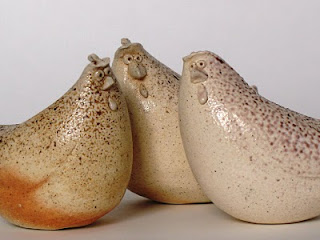 I will concede that the bubbly crusty purple stuff looks pretty good on chickens. Here's a close up of the crusty stuff on some cups, where it's less appealing (dry crusty stuff and lips don't go well together):

 Upon pieces that are strictly objets d'art, the purple stuff is fine. The objet on the left is actually a vase form on its side, though I very much like the spherical look in the photo. I was planning to give up holes for a while, but I think I'm going to have to try making some hole-filled spheres.

 On the Double Torus-Multiple Size Hole/Total Coverage Klein Bottle that's been patiently waiting to be fired since last summer, the purple is a little garish against the green glaze. What am I saying, the [w]hole thing is garish anyway:


I will try sanding the crusty bubbles off of pots that should be functional, such as this bowl and colander, as no one wants little bits of heavy-metal-laden glass to chip off into their noodles:

 Also in the category of Pots-That-Have-Been-Waiting-Since-Last-Summer are several wheel thrown and altered oval boxes. Alas, instead of using my purple alumina hydrate wax on the lids, I wadded the lids--with the somewhat predictable result that most of the lids warped. Dang. From here on out, it's alumina hydrate wax for me.


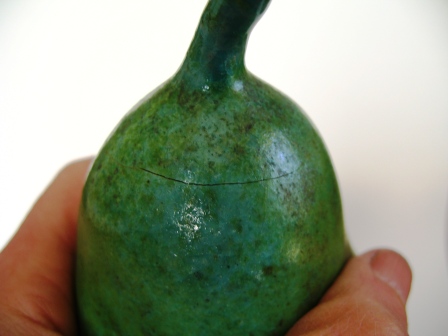
In the Total Fail category are several pieces made from a highly recommended ^5-^8 porcelain that I purchased online. I'm used to porcelain being finicky and S-cracking in the bottoms of bowls and cups, but these pieces split in some very odd places. Several tumblers had vertical cracks down the side, often beginning well below the rim and ending well above the foot. In the photo below of the two tumblers, a long vertical crack cuts through the cup on the left, while some beads of water are leaking through a crack in the cup on the right. The salt-rock pear has a horizontal crack across the top that is, as far as I can tell, completely unrelated to the form. Homer Cat doesn't mind the cracks in the tumblers, since all he sees are People Cups, but these pieces are headed for the trash can. I bisqued all of my porcelain pots well before the outside temperatures dropped below freezing, so I'm at a loss to explain the defects. Schade.


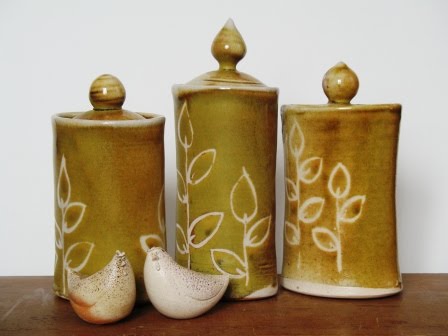
 To end on a more positive note, here are some non-crusty, lid-fitting oval jars (does that count as litotes?), and a picture of a flattery* penguin chatting it up with a chicken at an office party (penguin and penguin photo by Bob F.).
*as in, "imitation is the sincerest form of..."


 The Moebius Diatom Boxes experienced minimal warpage, and none of the parts stuck together. The photos make them look toastier and bagelier than they are in reality. I expect future MDBs will end up electric or gas fired, maybe with some stains for color, to reduce preparatory exasperation.
 My four favorite pieces are square boxes (wheel thrown and altered!) that I glazed top to bottom. They responded beautifully to the soda. The tallest box is about 5" high.
There are two fine pitchers, an excellent bottle, some lush double-walled bowls, a confident teapot, and a juicy green pear (looking artificially green in the photo; it's a little bluer in real life). I consider it a bonus that only one of the pitchers seeps, because--like every other pot I've produced in the past two years that has seeped--they're both made from Loafer's Glory clay. No more Loafer's Glory clay for me (regrettably; it's a lovely clay to work with when it's wet). I have a can of very dangerous highly toxic spray that's supposed to help seal pots, unless the can explodes or the spray poisons you in the process; I haven't tried it out yet, however, because I value functioning lungs, skin, and eyeballs more than I value my seeping pots, but maybe this spring I'll get out the goggles, gloves, and respirator and give it a whirl.


Here are some chickens mugging for the camera:
 I will concede that the bubbly crusty purple stuff looks pretty good on chickens. Here's a close up of the crusty stuff on some cups, where it's less appealing (dry crusty stuff and lips don't go well together):
 Upon pieces that are strictly objets d'art, the purple stuff is fine. The objet on the left is actually a vase form on its side, though I very much like the spherical look in the photo. I was planning to give up holes for a while, but I think I'm going to have to try making some hole-filled spheres.
 On the Double Torus-Multiple Size Hole/Total Coverage Klein Bottle that's been patiently waiting to be fired since last summer, the purple is a little garish against the green glaze. What am I saying, the [w]hole thing is garish anyway:

I will try sanding the crusty bubbles off of pots that should be functional, such as this bowl and colander, as no one wants little bits of heavy-metal-laden glass to chip off into their noodles:

 Also in the category of Pots-That-Have-Been-Waiting-Since-Last-Summer are several wheel thrown and altered oval boxes. Alas, instead of using my purple alumina hydrate wax on the lids, I wadded the lids--with the somewhat predictable result that most of the lids warped. Dang. From here on out, it's alumina hydrate wax for me.

In the Total Fail category are several pieces made from a highly recommended ^5-^8 porcelain that I purchased online. I'm used to porcelain being finicky and S-cracking in the bottoms of bowls and cups, but these pieces split in some very odd places. Several tumblers had vertical cracks down the side, often beginning well below the rim and ending well above the foot. In the photo below of the two tumblers, a long vertical crack cuts through the cup on the left, while some beads of water are leaking through a crack in the cup on the right. The salt-rock pear has a horizontal crack across the top that is, as far as I can tell, completely unrelated to the form. Homer Cat doesn't mind the cracks in the tumblers, since all he sees are People Cups, but these pieces are headed for the trash can. I bisqued all of my porcelain pots well before the outside temperatures dropped below freezing, so I'm at a loss to explain the defects. Schade.

 To end on a more positive note, here are some non-crusty, lid-fitting oval jars (does that count as litotes?), and a picture of a flattery* penguin chatting it up with a chicken at an office party (penguin and penguin photo by Bob F.).
*as in, "imitation is the sincerest form of..."

Thursday, March 3, 2011
Unloading
 We unloaded the kiln today. Serene Wadding Buddha got a hefty dusting of black soot plus some disturbingly green mystery powder, yet still he sits contentedly on his mat with his wee bird companion and cup of tea (which is not 3/4 full of unmelted glaze). Nothing fazes him.
Here are photos of the front and back stack:

 What's that, you say? It looks like something is amiss with the far end of the bag wall*? Why, you're right! It collapsed during the firing. Fortunately, it slumped sideways into the kiln wall rather than tumbling onto the loaded shelves. Casualties included just two bowls, a cup, and a chicken, none of which fell from the wall. Thanks, Serene Wadding Buddha (and to you too, Chipper Dog, of whom I have no post-firing photo)!

The pots were a little dry this time, with a bubbly purple crustiness I've never seen before. If you are less uptight than I am, or if crusty bubbly purple stuff is your thing, or if you are able to squint in just the right way, or if you are one of fifty or so clay chickens, you might be able to find such random and non-replicable surface treatments not entirely displeasing.** I'm working on it. Cedar Creek potter T.T. wondered whether the kiln might have been fuming copper or tin left over from a previous firing ("A.B. sometimes puts pretty wacky stuff in the kiln..."). Indeed, Serene Wadding Buddha's dusting of green looks suspiciously like copper carbonate. Fortunately, a few glazed gems are mixed in with the crustiness. I'll post some photos soon.
*I don't know why a kiln's bag wall is called a bag wall--OED, how could you fail me so?--other than that the bag wall protects the pots by creating a bag of air between the pots and the burning fuel. OED does offer a definition for bag from 18th-century coal-mining lingo that seems to make sense here--"a cavity filled with gas or water."
**I recently learned from a friend that the rhetorical term for these backhanded compliments is litotes.
Subscribe to:
Posts (Atom)


