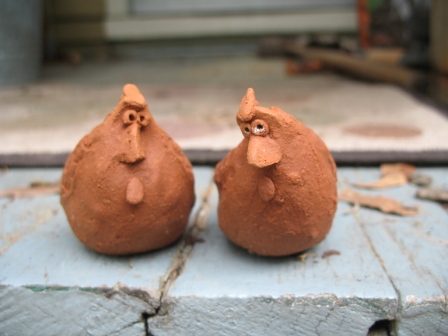
Our builder, Lee, excavated several pounds of brick-red North Carolina clay while digging the holes for the new pilings. I will slake the clay and sieve out the rocks and twigs, and then I'll see what I can make with it. In the meantime, two newborn birds peer over the porch edge and contemplate the origins of life:
Tuesday, May 1, 2012
Goodbye, hello
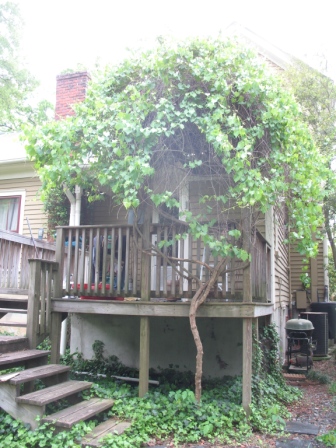
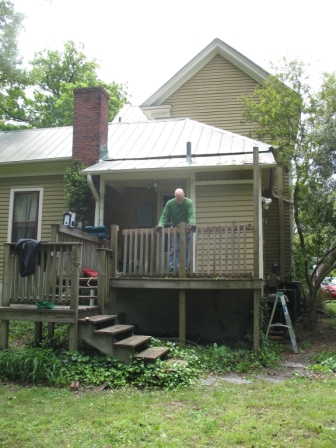
We're having the deck on the back of our house replaced with a screened-in porch. Consequently, we had to bid adieu to a sprawling scuppernong. Whereas S considered the loss of this North Carolina native grape unfortunate, I considered it motivation for promptly submitting paperwork to the city planning department. (Our house is a local historic landmark, so we needed to obtain a Certificate of Appropriateness before altering the exterior.) Farewell, sprawling mosquito-harboring bearer of thick-skinned, seedy fruit!
Our builder, Lee, excavated several pounds of brick-red North Carolina clay while digging the holes for the new pilings. I will slake the clay and sieve out the rocks and twigs, and then I'll see what I can make with it. In the meantime, two newborn birds peer over the porch edge and contemplate the origins of life:
Monday, April 30, 2012
Fickle fipples
The Durham spring Art Walk was this past weekend, and I spent a few hours on Saturday in front of Claymakers, providing wheel demos for passersby. I made chickens: they're quick and cute, and they offer great opportunities for one-liners. I used to demo chicken rattles, but of course this year I made chicken whistles, which facilitated pleasant cooing interactions with some morning doves in the awning above the door.
By the end of the afternoon, I had a bat full of chickens waiting to be transformed from single-note birds to full-octave gals, so on Sunday I spent a few hours on voicing.
The only annoying thing about making full-octave ocarinas is that while an ocarina might start out with a lovely clear tone and might hold onto that tone through the addition of a few finger holes, at some point you cut one hole too many and the clear tone vaporizes: poof, gone. The quickest fix is to plug the last hole, but that's not an option if you need the hole for building a diatonic scale.
Ocarina fipples* are fickle, fickle, fickle, and predicting and diagnosing fipple problems is difficult because so many variables are involved: number of holes in the resonating cavity, hole sizes (a hole that is too small can muffle the tone), distance from windway exit to labium,** bevel angle, bevel thickness, windway channel shape/size, changes in the fipple due to condensation (when you blow through the mouthpiece to test the tone, water from your breath condenses onto the clay), stray clay goobers that obstruct the windway, etc. Once a chicken becomes breathy, it's often easiest to fix tone problems by hand-building a mouthpiece and attaching it to the bird butt, rather than trying to adjust a built-in windway (i.e. a windway that is one with the chicken), but attached mouthpieces sometimes shift during drying, and even a slight change in angle can obliterate the tone again.
Recently I've been having pretty good luck with built-in windways, but I still lose the tone around the sixth or seventh finger hole. Today it finally occurred to me how to fix the problem.
Several online ocarina-making instructions say the bevel angle should be 45o, which in practice isn't the case--certainly not when an ocarina produces just a single tone. However, because the bevel is the thinnest part of the fipple, it dries faster than the rest of the ocarina. I noticed that ocarinas that had been well tuned were turning breathy after drying a bit, and guessed that the drying bevels might be shifting upwards, changing whatever angle happened to be working when the chickarina was first voiced. Gently pushing the bevel down fixed the problem. I transferred that solution to the chickarinas that were losing tone quality with the addition of finger holes and discovered that pushing the bevel down usually repairs the sound. When that fix doesn't work, an added mouthpiece does.
I expect this is going to save me hours of mouthpiece futzing. Another trial-and-error breakthrough in the geek lab, where I continue to fill gaps the world never knew it had.
*Another bonus of making ocarinas is getting to use technical terminology like fipple and labium.
**Monday night update: According to the Wikipedia article on fipples, the bevel of a fipple is called the labium lip. The term labium lip is redundant, of course, since labium is Latin for lip, so I'm editing the term down to just labium. I suppose I could pare it down to lip instead, but labium and fipple sound intriguing together, while "lip and fipple" sounds like a '70s comedy team.
By the end of the afternoon, I had a bat full of chickens waiting to be transformed from single-note birds to full-octave gals, so on Sunday I spent a few hours on voicing.
The only annoying thing about making full-octave ocarinas is that while an ocarina might start out with a lovely clear tone and might hold onto that tone through the addition of a few finger holes, at some point you cut one hole too many and the clear tone vaporizes: poof, gone. The quickest fix is to plug the last hole, but that's not an option if you need the hole for building a diatonic scale.
Ocarina fipples* are fickle, fickle, fickle, and predicting and diagnosing fipple problems is difficult because so many variables are involved: number of holes in the resonating cavity, hole sizes (a hole that is too small can muffle the tone), distance from windway exit to labium,** bevel angle, bevel thickness, windway channel shape/size, changes in the fipple due to condensation (when you blow through the mouthpiece to test the tone, water from your breath condenses onto the clay), stray clay goobers that obstruct the windway, etc. Once a chicken becomes breathy, it's often easiest to fix tone problems by hand-building a mouthpiece and attaching it to the bird butt, rather than trying to adjust a built-in windway (i.e. a windway that is one with the chicken), but attached mouthpieces sometimes shift during drying, and even a slight change in angle can obliterate the tone again.
Recently I've been having pretty good luck with built-in windways, but I still lose the tone around the sixth or seventh finger hole. Today it finally occurred to me how to fix the problem.
Several online ocarina-making instructions say the bevel angle should be 45o, which in practice isn't the case--certainly not when an ocarina produces just a single tone. However, because the bevel is the thinnest part of the fipple, it dries faster than the rest of the ocarina. I noticed that ocarinas that had been well tuned were turning breathy after drying a bit, and guessed that the drying bevels might be shifting upwards, changing whatever angle happened to be working when the chickarina was first voiced. Gently pushing the bevel down fixed the problem. I transferred that solution to the chickarinas that were losing tone quality with the addition of finger holes and discovered that pushing the bevel down usually repairs the sound. When that fix doesn't work, an added mouthpiece does.
I expect this is going to save me hours of mouthpiece futzing. Another trial-and-error breakthrough in the geek lab, where I continue to fill gaps the world never knew it had.
*Another bonus of making ocarinas is getting to use technical terminology like fipple and labium.
**Monday night update: According to the Wikipedia article on fipples, the bevel of a fipple is called the labium lip. The term labium lip is redundant, of course, since labium is Latin for lip, so I'm editing the term down to just labium. I suppose I could pare it down to lip instead, but labium and fipple sound intriguing together, while "lip and fipple" sounds like a '70s comedy team.
Labels:
chickens,
geekitude,
music,
pottery,
things you blow in
Friday, April 20, 2012
Pottery photos
The postmark deadline for Lark's new 500 Teapots book is today, and in about ten minutes, I will go to the post office to mail off four photos taken by a friend, professional photographer Adrian Moreno. I also wanted to submit a detail photo for one of the teapots, but I didn't have any from Adrian and--procrastinator that I am--didn't leave time to ask him to take any. Having also procrastinated about that 2010-into-2011 New Year's resolution to build a workable set up for photographing my pots, I ended up spending this morning futzing with my old dented Canon PowerShot A620, trying to get some good close ups. I took the teapot outside for some natural partly cloudy light and took about 100 pictures. I learned a lot about glare and the complete randomness of getting the microphotography feature to actually focus, developed an increasingly steady hand (I was too lazy to get out a tripod, but not too lazy to take 100 photos), and ended up with this:
It looks a little sharper after it's run through an "autocorrect" filter, but the submission guidelines say not to do that, so that's that. I'm impressed by the detail of the crystals; thanks to the photo, I'm noticing details on the pot that I'd never seen before.
In other photograph submission news, I sent some shots of assorted geek pots to the 2012 Bridges conference on math/art intersections, and they were accepted! Charlie Evergreen took the first two photos below. I took the third--yes, I need to work on that photography set up--yet it's the tori that are going into the month-long (vs. conference-long) exhibit in Towson's College of Fine Arts gallery. Just goes to show what happens when mathematicians instead of potters evaluate your work.
It looks a little sharper after it's run through an "autocorrect" filter, but the submission guidelines say not to do that, so that's that. I'm impressed by the detail of the crystals; thanks to the photo, I'm noticing details on the pot that I'd never seen before.
In other photograph submission news, I sent some shots of assorted geek pots to the 2012 Bridges conference on math/art intersections, and they were accepted! Charlie Evergreen took the first two photos below. I took the third--yes, I need to work on that photography set up--yet it's the tori that are going into the month-long (vs. conference-long) exhibit in Towson's College of Fine Arts gallery. Just goes to show what happens when mathematicians instead of potters evaluate your work.
Saturday, March 31, 2012
Generation upon generation
Part of the legacy of my brilliant grandmother Woozy is this story about my uncle Bob--a story for the generations. As Heinrich Heine put it in Dichterliebe, "Es ist eine alte Geschichte / doch bleibt sie immer neu" ("It's an old story, but it remains ever new"). Heine, of course, was poetizing about unrequited love, not good books on the john, but I like to think both Woozy and Heine would approve. E, we're on to you.

"Dinner time," Wooz called.
"I have to make a BM" said Ahbut Dafoots Botsybee. So they all ate up the soup and crackers and meat and potatoes and sweet corn and green beans.
"Dinner time," Wooz called.
"I'm not finished," said Ahbut Dafoots Botsybee. So they all ate up the lettuce and scallions and green onions and radishes and cucumbers.
"Dinner time," Wooz called.
"I'm not finished," said Ahbut Dafoots Botsybee. So they all ate up the strawberry shortcake with whipped cream.
"I'm finished," said Ahbut Dafoots Botsybee. "It was a VERY LONG BOOK."

"Dinner time," Wooz called.
"I have to make a BM" said Ahbut Dafoots Botsybee. So they all ate up the soup and crackers and meat and potatoes and sweet corn and green beans.
"Dinner time," Wooz called.
"I'm not finished," said Ahbut Dafoots Botsybee. So they all ate up the lettuce and scallions and green onions and radishes and cucumbers.
"Dinner time," Wooz called.
"I'm not finished," said Ahbut Dafoots Botsybee. So they all ate up the strawberry shortcake with whipped cream.
"I'm finished," said Ahbut Dafoots Botsybee. "It was a VERY LONG BOOK."
Sunday, March 18, 2012
Tracking prey
According to Wikipedia, "Persistence hunting is a hunting technique in which hunters use a combination of running and tracking to pursue prey to the point of exhaustion. While humans can sweat to reduce body heat, their quadrupedal prey would need to slow from a gallop in order to pant....Persistence hunting requires endurance running–running many miles for extended periods of time. Among primates, endurance running is only seen in humans, and persistence hunting is thought to have been one of the earliest forms of human hunting, having evolved 2 million years ago."
In his bestselling book, Born to Run, Christopher McDougall argues that human feet evolved to support this type of endurance running. Forget those fancy over-engineered supportive sneakers: people can run longer and farther and with fewer injuries if they run barefoot. S and I have both bought into this reasoning; we've ditched our Asics and spend most of our travel time in minimalist Merrills and Stems.
I was thinking about this last night, as I listened to Schroeder pant. Perhaps prehistoric Man persistence-hunted Felis silvestris lybica into domestication; or perhaps prehistoric Woman simply tossed a few hand-knit carrot finger puppets into the Savannah, and Felis silvestris catus was born.
In his bestselling book, Born to Run, Christopher McDougall argues that human feet evolved to support this type of endurance running. Forget those fancy over-engineered supportive sneakers: people can run longer and farther and with fewer injuries if they run barefoot. S and I have both bought into this reasoning; we've ditched our Asics and spend most of our travel time in minimalist Merrills and Stems.
I was thinking about this last night, as I listened to Schroeder pant. Perhaps prehistoric Man persistence-hunted Felis silvestris lybica into domestication; or perhaps prehistoric Woman simply tossed a few hand-knit carrot finger puppets into the Savannah, and Felis silvestris catus was born.
Tuesday, March 13, 2012
Pythagorean cups
I am pleased to report major developments in the Geek Lab: we re-engineered the Pythagorean Cup! Also known as the Cup of Tantalus, the Pythagorean cup punishes gluttony. Fill the cup a modest amount, and the drinker may consume the beverage in peace; overfill it, and it siphons all of its contents into the drinker's lap.
My 2012 Session 1 Claymakers "Pottery for Geeks" class mostly eagerly took on the redesign of the Pythagorean cup. I made a simplified test model, based on images from Wikipedia:
![]() |
| Image by Nevit Dilmen |
A hole at the base of the central cap allows the cap to fill as the cup fills. Once the liquid reaches the top edge of the inner pipe, it flows down through the center of the cup. Because of the cap, the outflowing liquid can only be replaced by more liquid, not by air, and the entire contents of the cup siphon out.
The test model worked extremely well, but several of us opined that the big round thang in the middle was unsightly and would arouse gluttons' suspicions.
After some geek conferencing, we decided to incorporate the siphon into the handle. I threw a few thin tori and kluged them into siphons. In the image below, the cup on the left siphons its contents from the cup into the inner torus, up into the outer torus, and out the bottom of the handle. The cup on the right siphons from the cup into the front torus, up into the back torus, and out the bottom.
Aside from the handles looking clunky, it took significant effort to align, seal, and disguise the holes between the torus segments, and neither handle siphoned particularly well: both lacked sufficient water pressure for a satisfying drainage rate, and the curved handles sent water dribbling onto the undersides of the cups rather than straight down--that's Newton's first law for you. While Acme Klein Bottle sells a cup that siphons efficiently through its handle, these torus-handle models are duds.
The next design merely shifted Pythagoras's unsightly siphon from the center of the cup to the edge. The siphon was significantly easier to build than the torus handles, but remained unsightly. I attempted to distract the glutton's eye by covering the outside of the cup with tessellating lizards and positioning a lizard over the siphon, taking inspiration from Escher's Reptiles (1943).
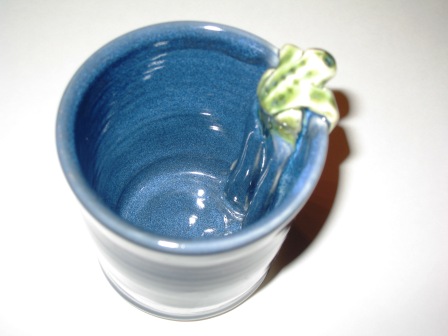
Wanting to further minimize the obtrusiveness of the siphon, I explored a final siphon experiment modeled on Acme Klein Bottle's Tantalus wine glass. The handbuilt, relatively small siphon was trivially easy to build, although the frog decoy perched upon it took a while to make.
The lizard cup beat the frog: excellent water pressure made for smooth and rapid decanting. I suppose the frog cup might function acceptably during a gluttony emergency, but insufficient water pressure makes for a halfhearted dribble. With further tinkering--for example, making the inflow side of the siphon wider than the outflow side--the simple siphon* might yet prove worthy of replication.
Always the rebel, Schroeder Cat managed to drink out of the bottom of the cup.

*Simple siphon met a python
Going to the fair;
Said simple siphon to the python,
"Will you drink my ware?"
Said the python to simple siphon,
"You've poured one drink too many";
Said simple siphon to the python,
"But look, I have not any!"
The test model worked extremely well, but several of us opined that the big round thang in the middle was unsightly and would arouse gluttons' suspicions.
After some geek conferencing, we decided to incorporate the siphon into the handle. I threw a few thin tori and kluged them into siphons. In the image below, the cup on the left siphons its contents from the cup into the inner torus, up into the outer torus, and out the bottom of the handle. The cup on the right siphons from the cup into the front torus, up into the back torus, and out the bottom.
The next design merely shifted Pythagoras's unsightly siphon from the center of the cup to the edge. The siphon was significantly easier to build than the torus handles, but remained unsightly. I attempted to distract the glutton's eye by covering the outside of the cup with tessellating lizards and positioning a lizard over the siphon, taking inspiration from Escher's Reptiles (1943).
Always the rebel, Schroeder Cat managed to drink out of the bottom of the cup.

*Simple siphon met a python
Going to the fair;
Said simple siphon to the python,
"Will you drink my ware?"
Said the python to simple siphon,
"You've poured one drink too many";
Said simple siphon to the python,
"But look, I have not any!"
Sunday, March 4, 2012
Learning the classics
Calculus fans that we are, we have learned how to maximize sleep while minimizing our weekday morning routine. S and I get up at 7:45; we wake E up at 7:50 and consent to "just one more minute" before forcing him out of bed at 7:55. He gets dressed ("hurry up dude, it's 8:00!"), brushes his teeth ("hurry up dude, it's five past eight!"), eats a leisurely breakfast ("dude, focus! focus!"), packs his backpack ("yo, dude!"), and slides on his already-tied shoes ("dude, we're going to be late!") in time for us to pull out of the driveway by 8:17. We turn into the school parking lot at 8:27, which gives him three full minutes to walk to his classroom and still be on time. Surely two of those minutes could have been spent sleeping.
The consequence of this carefully honed routine is that E spends the ten-minute drive to school staring vacantly out the car window, while I'm still pumped up on the adrenaline it took to get us out the door. Occasionally we'll exchange pleasantries about the weather or analyze another driver's crappy driving (a gift passed from my father to me and now from me to my son), but usually conversation is minimal. "I'm tired," E explains, when I nudge him to talk. I understand: it takes time to get the mental wheels moving after you've been asleep for 10.5 hours.
Then a school assignment injected some verve into the morning drive: E had to memorize the Preamble to the U.S. Constitution, so we learned the Schoolhouse Rock version together, and spent two weeks singing it on the way to school. When we got to the point where we could both recite it without singing, and without pausing after "ensure domestic tranquility-ee-ee-ee [2 3 4]," it was time to move on.
"You need to learn some poetry," I declared. "If you can memorize the preamble, you can learn some poetry."
--"Do I have to?"
"Yes," I said. E still hasn't figured out that he doesn't have to do everything I tell him.
--"No."
"Yes. Do it. It'll be fun!"
--"Uhhh..."
"Here, repeat after me."
I chose a classic to start him off:
Humpty Dumpty sat on a wall.
At three o'clock he had his great fall.
The King set his time machine back to two;
Now Humpty's together and good as new.
After two attempts, he had it down. "There, OK, I'm done," he said, and went back to vacant staring.
The next day we moved on to another rhyme from The Space Child's Mother Goose:
Little Jack Horner
Sits in a corner
Extracting cube roots to infinity.
An assignment for boys
To minimize noise
And produce a more peaceful vicinity.
Done. Easy. The next day, it was time to pull out the big guns.
"OK dude," I said, "it's time to learn 'Jabberwocky.'"
--"But I already learned some poems."
"Yes--and they were fun, weren't they? You're doing great! Now you need to learn 'Jabberwocky.' Ready?"
--"No. Why do I need to learn it?"
"Because you know I'm going to recite it over and over again until you try."
By the time we pulled into the school parking lot, he had a good start on the first stanza, but he was still skeptical.
--"So why do I need to learn this?"
"It'll give you something to say at parties when you don't have anything else to say. Trust me, it's very useful."
It only took another two days before he got tired of the stanza-per-day method and zoomed ahead. At home, I showed him the page in my well-worn copy of Through the Looking Glass. Was it any coincidence that the spine had broken in half, years ago, right on that very page? We held it up to a mirror so he could read it, and there was no going back.
Last night, E dug out his cape, built himself a Tum-Tum tree, and hung a Jabberwock from the stairwell. Needless to say, I'm thrilled that he seems to enjoy this most excellent poem as much as I do. Perhaps in a few weeks, he'll be willing to move on to Sarah Cynthia Sylvia Stout (who would not take the garbage out).
Incidentally, if you listen carefully at the beginning, you might hear the Jabberwock meowing behind the camera.
The consequence of this carefully honed routine is that E spends the ten-minute drive to school staring vacantly out the car window, while I'm still pumped up on the adrenaline it took to get us out the door. Occasionally we'll exchange pleasantries about the weather or analyze another driver's crappy driving (a gift passed from my father to me and now from me to my son), but usually conversation is minimal. "I'm tired," E explains, when I nudge him to talk. I understand: it takes time to get the mental wheels moving after you've been asleep for 10.5 hours.
Then a school assignment injected some verve into the morning drive: E had to memorize the Preamble to the U.S. Constitution, so we learned the Schoolhouse Rock version together, and spent two weeks singing it on the way to school. When we got to the point where we could both recite it without singing, and without pausing after "ensure domestic tranquility-ee-ee-ee [2 3 4]," it was time to move on.
"You need to learn some poetry," I declared. "If you can memorize the preamble, you can learn some poetry."
--"Do I have to?"
"Yes," I said. E still hasn't figured out that he doesn't have to do everything I tell him.
--"No."
"Yes. Do it. It'll be fun!"
--"Uhhh..."
"Here, repeat after me."
I chose a classic to start him off:
Humpty Dumpty sat on a wall.
At three o'clock he had his great fall.
The King set his time machine back to two;
Now Humpty's together and good as new.
After two attempts, he had it down. "There, OK, I'm done," he said, and went back to vacant staring.
The next day we moved on to another rhyme from The Space Child's Mother Goose:
Little Jack Horner
Sits in a corner
Extracting cube roots to infinity.
An assignment for boys
To minimize noise
And produce a more peaceful vicinity.
Done. Easy. The next day, it was time to pull out the big guns.
"OK dude," I said, "it's time to learn 'Jabberwocky.'"
--"But I already learned some poems."
"Yes--and they were fun, weren't they? You're doing great! Now you need to learn 'Jabberwocky.' Ready?"
--"No. Why do I need to learn it?"
"Because you know I'm going to recite it over and over again until you try."
By the time we pulled into the school parking lot, he had a good start on the first stanza, but he was still skeptical.
--"So why do I need to learn this?"
"It'll give you something to say at parties when you don't have anything else to say. Trust me, it's very useful."
It only took another two days before he got tired of the stanza-per-day method and zoomed ahead. At home, I showed him the page in my well-worn copy of Through the Looking Glass. Was it any coincidence that the spine had broken in half, years ago, right on that very page? We held it up to a mirror so he could read it, and there was no going back.
Last night, E dug out his cape, built himself a Tum-Tum tree, and hung a Jabberwock from the stairwell. Needless to say, I'm thrilled that he seems to enjoy this most excellent poem as much as I do. Perhaps in a few weeks, he'll be willing to move on to Sarah Cynthia Sylvia Stout (who would not take the garbage out).
Incidentally, if you listen carefully at the beginning, you might hear the Jabberwock meowing behind the camera.
Subscribe to:
Posts (Atom)