Showing posts with label cultural differences. Show all posts
Showing posts with label cultural differences. Show all posts
Friday, February 23, 2018
About that last blog post...
I'm in NC, and S just phoned from Germany to say his mom really liked the idea of that lemon cake we made, so could I give him the recipe; and I told him where to find the recipe and didn't even think to say "WTF dude. PIE. It's called PIE." Sigh.

Saturday, January 27, 2018
Coming to terms: Torte, Kuchen, and pie
Big news: after 29 years of loving S and learning about him and Deutsche Kultur, I finally understand the difference between Torte and Kuchen, and why certain Germans insist on calling American pie Kuchen (even though they shouldn't).
Distinguishing Torte from Kuchen: an introduction

Thus our definition of Kuchen begins with Obsthkuchen. You use Kuchenboden for Obstkuchen.
Tortenboden, in contrast, is the Biskuit that you would put at the bottom of a Torte--and in the middle of Torte, as many times as you want, and on the top of Torte, if you want it there too. That is what make Tortenboden fundamentally different from Kuchenboden. (If you are thinking that the big difference is Murbeteig, think again; our Bavarian Kochbuch recommends Murbeteig under both Kuchen and Torten.)
Torte is almost always made with layers of sponge cake, with filling in between and optional stuff on top. Kuchen is just one layer of cake--sponge cake if you want, but any other kind of cake is fine too, including Murbeteig all by itself--with optional stuff on top.
Did you catch that?
For Americans, layers of cake with stuff in between is called "layer cake." A layer of cake with stuff on top is also cake. It's all cake. Torte is fancy cake.
So in the context of making Obstkuchen and Torte, the question "Kuchenboden oder Tortenboden" is a weird cultural thing--a sort of cake phoneme--because the cake parts of both Böden are THE SAME THING. Bake a batch of Biskuitteig for Obstkuchen, and voilà (or schau hier): Kuchenboden. Layer those babies, and voilà/schau hier: Tortenboden. Indeed, the recipe we eventually chose for the Kuchen describes the result as Luftigt-leichter Kuchen, perfekt für Torten--"light-as-air cake, perfect for Torte."
I double checked with S. "Did you really say 'Kuchenboden oder Tortenboden'?" "Yes," he said, "because they're different."
Perhaps he was thinking ahead to the Nusstorte (nut torte) I was going to bake. While you probably wouldn't add nuts to Biskuitteig for Obstkuchen, they're certainly fair game in plain ol' non-Obst Kuchen (which remains Kuchen forever and a day unless you layer it--then BAM, Torte).
Here's a photo of a hazelnut-almond Torte I made in Steinebach last summer (and a photo of H helping). The four layers were laced with Kirschwasser and filled with cherry jam, chocolate cream, and sour cherries, then covered with more chocolate cream.

Exceptions to the rules
Rules wouldn't be rules if there weren't exceptions. Here are four:
Pie has its very own word in English, because unlike Torte and Kuchen, pie is NOT cake. Even assuming all pies had double crusts--which they don't--pie is NOT gedeckter Kuchen, because pie crust is neither cake nor shortbread.
Pie does consist of a base layer of non-sponge flour-based dough, with stuff on top, so it is more akin to Kuchen than to Torte--but that does not make pie "cake" any more than saying humans are "birds" because humans are more akin to birds than to boulders. If German can borrow words like Spaghetti, Toast, and Computer from other languages, it can borrow Pei.
One more rule
Our Bavarian neighbor F arrived on Sunday eager to talk definitions. He suggested that Torte filling almost always involves cream. This would explain why gedeckte Apfelkuchen can never be Torte, even though it's layered. It might squeak past the "usually sponge cake" rule, but the lack of cream keeps it out of the realm of Torte. This might also explain why bottomless cheesecake might be considered Torte, given the creamy dairy content.
Well, you might think that. But if you Google gedeckte Apfe..., oh dear: the search brings up both Apfelkuchen and Apfeltorte, and the photos look identical. To that, we say, "perhaps it's a regional difference" (which is our way of saying "uncle! We give up!").
Test your understanding
After lengthy discussion and Q&A with our neighbors, we gave them a quiz. Can you tell what's what? Answers and recipes are below.
Answers:
A: Pie. This is pie. It is not cake. It is pie.
B: Obstkuchen.
C: Pie. Why is this so difficult for you?
D: Obstkuchen.
E: Trick question. There's visible cream and there's presumably cake underneath that, but you can't tell if it's Torte or Kuchen without cutting it open. But by process of elimination in this particular context, you know it has to be Torte. (If this question were on the ACT/SAT, the test-writers would call Torte the "best answer," which would annoy teens who understand nuance and complexity.)
Appendix: Recipes
We had a gluten-intolerant guest, so we made everything gluten-free. We used gluten-free flour for pie A and Obstkuchen; we purchased gluten-free pie crusts for the pies; and we used ground hazelnuts and no flour in the Nusstorte.
A. The recipe for this lemon custard pie is here. Until last year, it was the only lemon custard pie I had ever made (and I had only made it once.) It's silky-creamy and lemony-tart, with a nice lightness.
B and D: Here's the Biskuitteig recipe I used for the Obstkuchen. This recipe is enough for two Obstkuchen: bake all of the batter in one springform pan and then slice it in half to make two discs. The recipe calls for Speisestärke (starch). In Germany, that would be potato starch. We used cornstarch, but next time I'd probably just add a little more flour. We thought the cake was too sweet, so next time we'll reduce the sugar. S and E were in charge of the topping: a thin layer of jam, a layer of vanilla pudding, artfully arranged fruit, and a pectin glaze on top.
C. Oh my. Oh oh my. This is "Shaker Lemon Pie." Images kept popping up when I was trying to locate the recipe for pie A. Shaker Lemon Pie is stunningly beautiful, startlingly delicious, and super tart--but beware the sugar high. I found assorted recipes online and combined them into this: 5 unpeeled organic lemons (recipes ranged from 2 large to 6 small; some specified Meyer lemons, but we used Eurekas), sliced very thinly with a mandoline, and seeds picked out; toss gently with 1.75 c. sugar, and macerate until sugar dissolves (this takes only a few hours--recipes all said 24-hours or overnight). Stir in four beaten eggs and pour into an unbaked pie crust. (A few recipes said pre-baked. We tried pre-baking the gluten-free crust and it cracked, so that the filling oozed under the crust and glued parts of the crust to the pan. We didn't pre-bake the crust for A and it tasted fine, so next time we'll skip the pre-baking.) Bake at 325oF for 50-60 minutes. (Recipes said 450oF for 15 minutes and then 375oF for 20 minutes, but we had another pie to bake at the same time that required gentler heat. Slow baking worked beautifully.)
D. See B.
E. Here's my version of Nusstorte, adapted and honed over several years from a base recipe by H. Despite all the steps, it's easy to make if you have an electric beater.

The epiphany actually came last July, while we were visiting H in Steinebach. I was too busy hiking to blog then, but we finally had an opportunity to take up the question again this past Sunday, when we hosted Kaffee und Kuchen [und Torte und pie] for the neighbors on our block. Guests arrived at 3:45 p.m. We defined terms at 4:00 p.m., then ate the evidence.
Distinguishing Torte from Kuchen: an introduction
We started baking on Saturday afternoon. I asked S if he had a good recipe for Biskuitteig (no, not biscuit dough--sponge cake). He responded, "What are you making? Kuchenboden oder Tortenboden?"
Kuchenboden is cake base (literally, cake floor); Tortenboden is torte floor. Kuchenboden is often a layer of Murbeteig--shortbread dough--topped with a layer of Biskuitteig--sponge cake batter. In Obstkuchen, that Kuchenboden is topped with delectable fruit, often with pectin or gelatin or melted jam on top of the whole shebang to make it shiny.
Kuchenboden is cake base (literally, cake floor); Tortenboden is torte floor. Kuchenboden is often a layer of Murbeteig--shortbread dough--topped with a layer of Biskuitteig--sponge cake batter. In Obstkuchen, that Kuchenboden is topped with delectable fruit, often with pectin or gelatin or melted jam on top of the whole shebang to make it shiny.
Here are two photos of non-shiny Obstkuchen I made last summer in Steinebach. There's a layer of vanilla pudding between the cakes and the fruit, and maybe a thin layer of jam too, but I can't remember. There is not any Murbeteig under either Biskuit, but they're both clearly still Obstkuchen.


Thus our definition of Kuchen begins with Obsthkuchen. You use Kuchenboden for Obstkuchen.
Tortenboden, in contrast, is the Biskuit that you would put at the bottom of a Torte--and in the middle of Torte, as many times as you want, and on the top of Torte, if you want it there too. That is what make Tortenboden fundamentally different from Kuchenboden. (If you are thinking that the big difference is Murbeteig, think again; our Bavarian Kochbuch recommends Murbeteig under both Kuchen and Torten.)
Torte is almost always made with layers of sponge cake, with filling in between and optional stuff on top. Kuchen is just one layer of cake--sponge cake if you want, but any other kind of cake is fine too, including Murbeteig all by itself--with optional stuff on top.
Did you catch that?
Torte: layers of cake with stuff in between and optional stuff on top.In between, Torte. On top, Kuchen.
Kuchen: one layer of cake with optional stuff on top.
For Americans, layers of cake with stuff in between is called "layer cake." A layer of cake with stuff on top is also cake. It's all cake. Torte is fancy cake.
So in the context of making Obstkuchen and Torte, the question "Kuchenboden oder Tortenboden" is a weird cultural thing--a sort of cake phoneme--because the cake parts of both Böden are THE SAME THING. Bake a batch of Biskuitteig for Obstkuchen, and voilà (or schau hier): Kuchenboden. Layer those babies, and voilà/schau hier: Tortenboden. Indeed, the recipe we eventually chose for the Kuchen describes the result as Luftigt-leichter Kuchen, perfekt für Torten--"light-as-air cake, perfect for Torte."
I double checked with S. "Did you really say 'Kuchenboden oder Tortenboden'?" "Yes," he said, "because they're different."
Perhaps he was thinking ahead to the Nusstorte (nut torte) I was going to bake. While you probably wouldn't add nuts to Biskuitteig for Obstkuchen, they're certainly fair game in plain ol' non-Obst Kuchen (which remains Kuchen forever and a day unless you layer it--then BAM, Torte).
Here's a photo of a hazelnut-almond Torte I made in Steinebach last summer (and a photo of H helping). The four layers were laced with Kirschwasser and filled with cherry jam, chocolate cream, and sour cherries, then covered with more chocolate cream.


Exceptions to the rules
Rules wouldn't be rules if there weren't exceptions. Here are four:
- Tiny Obstkuchen are called Obsttörtchen, because why the hell not? The -chen ending is a diminutive suffix--little fruit tortelets--and because adding -chen changes the German o to an ö, let's change the vowel in English too and call them tartlets. This is allowed only because they're cute, and probably necessary because Obstkuchenchen is too hard to say (but Obstkuchlein isn't, and it's not like being difficult to pronounce stops other German words from existing). Note that chen in Kuchen is not diminutive--it's Kuch-en, not Ku-chen. I'm going to take a stab at a pun by observing that a diminutive cow might be a Kuhchen--but no German would ever pronounce Kuchen (coo-hen) and Kuhchen (coo-hyen) the same way, so no German would ever find that pun remotely funny.
- Linzertorte, already controversial in its own right, is actually Kuchen, according to the in between / on top rule. It's also Kuchen according to the Torte-is-usually-sponge-cake rule. It made me very happy to discover, browsing through the index of our Bavarian Kochbuch, that the Bible of Bavarian cooking calls it Linzerkuchen.
- Sometimes Kuchen can have an extra layer of Teig on top--e.g. a layer of Murbeteig on the bottom, with apples on top, and then another layer of Murbeteig on top of that. This is called gedeckter Apfelkuchen--covered apple cake--rather than Apfeltorte, because it lacks the sponge cake that is essential for all Torte (except Linzertorte, which is really a gedeckter Kuchen, and Obsttörtchen, which are diminutive.) I hope you are following the logic here.
- Finally, S says there is Bodenlose Kaesekuchen--bottomless cheesecake--which, as you might guess, has no base layer of cake and is entirely made of the optional stuff on top. To confirm, we looked it up in the Kochbuch, where it is called Quarktorte ohne Boden--cheese TORTE without bottom. S says "this is a dumb cookbook."
Pie has its very own word in English, because unlike Torte and Kuchen, pie is NOT cake. Even assuming all pies had double crusts--which they don't--pie is NOT gedeckter Kuchen, because pie crust is neither cake nor shortbread.
Pie does consist of a base layer of non-sponge flour-based dough, with stuff on top, so it is more akin to Kuchen than to Torte--but that does not make pie "cake" any more than saying humans are "birds" because humans are more akin to birds than to boulders. If German can borrow words like Spaghetti, Toast, and Computer from other languages, it can borrow Pei.
One more rule
Our Bavarian neighbor F arrived on Sunday eager to talk definitions. He suggested that Torte filling almost always involves cream. This would explain why gedeckte Apfelkuchen can never be Torte, even though it's layered. It might squeak past the "usually sponge cake" rule, but the lack of cream keeps it out of the realm of Torte. This might also explain why bottomless cheesecake might be considered Torte, given the creamy dairy content.
Well, you might think that. But if you Google gedeckte Apfe..., oh dear: the search brings up both Apfelkuchen and Apfeltorte, and the photos look identical. To that, we say, "perhaps it's a regional difference" (which is our way of saying "uncle! We give up!").
Test your understanding
After lengthy discussion and Q&A with our neighbors, we gave them a quiz. Can you tell what's what? Answers and recipes are below.
 |
| A (left); B (right) |
 |
| C |
 |
| D |
 |
| E |
A: Pie. This is pie. It is not cake. It is pie.
B: Obstkuchen.
C: Pie. Why is this so difficult for you?
D: Obstkuchen.
E: Trick question. There's visible cream and there's presumably cake underneath that, but you can't tell if it's Torte or Kuchen without cutting it open. But by process of elimination in this particular context, you know it has to be Torte. (If this question were on the ACT/SAT, the test-writers would call Torte the "best answer," which would annoy teens who understand nuance and complexity.)
 |
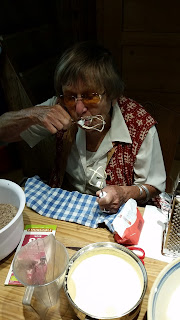
| The sacrifices we make for the sake of cultural understanding |
 |
| Another view of the sacrifices we make |
 |
| Aha! Layers! Torte! |
We had a gluten-intolerant guest, so we made everything gluten-free. We used gluten-free flour for pie A and Obstkuchen; we purchased gluten-free pie crusts for the pies; and we used ground hazelnuts and no flour in the Nusstorte.
A. The recipe for this lemon custard pie is here. Until last year, it was the only lemon custard pie I had ever made (and I had only made it once.) It's silky-creamy and lemony-tart, with a nice lightness.
B and D: Here's the Biskuitteig recipe I used for the Obstkuchen. This recipe is enough for two Obstkuchen: bake all of the batter in one springform pan and then slice it in half to make two discs. The recipe calls for Speisestärke (starch). In Germany, that would be potato starch. We used cornstarch, but next time I'd probably just add a little more flour. We thought the cake was too sweet, so next time we'll reduce the sugar. S and E were in charge of the topping: a thin layer of jam, a layer of vanilla pudding, artfully arranged fruit, and a pectin glaze on top.
C. Oh my. Oh oh my. This is "Shaker Lemon Pie." Images kept popping up when I was trying to locate the recipe for pie A. Shaker Lemon Pie is stunningly beautiful, startlingly delicious, and super tart--but beware the sugar high. I found assorted recipes online and combined them into this: 5 unpeeled organic lemons (recipes ranged from 2 large to 6 small; some specified Meyer lemons, but we used Eurekas), sliced very thinly with a mandoline, and seeds picked out; toss gently with 1.75 c. sugar, and macerate until sugar dissolves (this takes only a few hours--recipes all said 24-hours or overnight). Stir in four beaten eggs and pour into an unbaked pie crust. (A few recipes said pre-baked. We tried pre-baking the gluten-free crust and it cracked, so that the filling oozed under the crust and glued parts of the crust to the pan. We didn't pre-bake the crust for A and it tasted fine, so next time we'll skip the pre-baking.) Bake at 325oF for 50-60 minutes. (Recipes said 450oF for 15 minutes and then 375oF for 20 minutes, but we had another pie to bake at the same time that required gentler heat. Slow baking worked beautifully.)
D. See B.
E. Here's my version of Nusstorte, adapted and honed over several years from a base recipe by H. Despite all the steps, it's easy to make if you have an electric beater.

Thursday, March 2, 2017
Because who has the time, right?
Back in 2010, I wrote about the News & Observer's coverage of Drive-thru Easter at two NC churches, and I proposed that the Chosen People keep pace with a Drive-thru Seder. That hasn't happened yet, as far as I know, but thanks to an N&O report on Drive-thru Ash Wednesday, I'm reminded that there are still 5.5 weeks for synagogues to prepare to keep up with the Joneses. "Next This year, within driving distance!"
(Revisiting those old blog posts, I am disappointed to discover that the online presence of newspaper articles is apparently less than seven years. That should teach me to write in more detail rather than rely on links, but I'm a slow learner, as this post attests.)
(Revisiting those old blog posts, I am disappointed to discover that the online presence of newspaper articles is apparently less than seven years. That should teach me to write in more detail rather than rely on links, but I'm a slow learner, as this post attests.)
Sunday, September 9, 2012
Marital strife
Driving to work this morning, I heard on the radio that money is the number one topic couples argue about. A quick Google search yields assorted articles on the internets that confirm this claim, including some that say fights about money are a decent predictor for divorce. Sitting in my car, I thought: S and I are not a typical couple.
We rarely fight about money. In fact, neither of us can think of a time in the 24 years we've been in love that we've fought about money. We didn't fight about money when we were freshly-married graduate students relatively strapped for funds, nor when we had real grown-up jobs and started making major life-altering decisions about expensive things like raising a baby and buying a house. We've been lucky: our parents and jobs got us through our undergrad degrees, and jobs and assistantships got us through grad school. We've been lucky never to have had to make tough choices about whether to eat or pay bills.
We're also lucky that after 24 years together, we still make each other laugh, we still share fundamental values and goals, and he's still ravishingly gorgeous (his crows feet still make me swoon, and his delicately greying sideburn tips are ooh la la). We've negotiated a reasonably healthy balance between work, family, and household chores. He works a regular 24/7 academic job; I have a flexible mix of part-time and freelance gigs. He covers kidcare when I'm at work evenings and weekends; I cover kidcare during the week. He loads the dishwasher; I unload it. He tunes up my bike once a year and inflates the tires as needed; I organize every aspect of our socials lives. He loves his family by making snazzy breakfasts; I love my family by making snazzy dinners and angel food cake. He takes out the trash; I generate it. He dances with the vacuum cleaner; I take the cats to the vet. We're a Myers-Briggs match made in heaven.
Nonetheless, we do fight. Early on, we had relationship-threatening difficulties with time. Given our backgrounds, that came as a surprise to both of us. He's German, yet he defies all stereotypes about German punctuality. (He might explain that punctuality is a Prussian virtue, and he's not Prussian, he's Bavarian.) I'm U.S. American and grew up with a mathematician dad who back-calculated, based on traffic density and wind speed, precisely when we needed to leave the house in order to reach our destinations on time. My inherited obsession with punctuality and S's lack thereof almost broke us up on multiple occasions, until I realized he was operating on European Metric Time (100 seconds per minute, 100 minutes per hour) and I was operating on American Standard Time (60 seconds per minute, 60 minutes per hour). I put together a conversion table and made copies for both of us, and it's been mostly smooth sailing since then.
Our challenges are different now, so many more years into our lives together. The most frequent cause of our most turbulent arguments these days? Antecedentless pronouns.
S is a wonderful man who comes from a long line of wonderful men who are genetically predisposed to have conversations inside their heads while thinking outsiders can follow along. He knows exactly what he means when he talks about it, them, and that, while I'm usually clueless. I realize I sound like I'm blaming S for our strife, but I have evidence that it's us, not him: our son carries on the patrilineal tradition, and he and S can have five-word conversations consisting almost entirely of antecedentless pronouns, conversations of which I understand virtually nothing, while they clearly understand everything and take action accordingly.
Consequently, S and I often fight about that. Literally, that. Not whatever that refers to, since that as often as not has no clear antecedent, but that itself. Presented with an antecedentless pronoun, I'll bristle and ask, chillingly, "What's that supposed to mean?" And S hears not "beloved, to what antecedent did you intend the pronoun that to refer, and did you perhaps forget to state that word out loud?" but rather "how could you possibly say such a thing?" We're usually well into a heated argument before the lightbulbs go on and we realize we're yet again fighting about a missing antecedent, at which point I usually say something rude like "[S.I.G.H.] If you're going to f*ing use pronouns, you need to give them f*ing antecedents."
To my knowledge, no studies have been conducted that indicate arguments about antecedentless pronouns are predictors for divorce, so I think our relationship will probably survive this (as well as this).
Monday, July 11, 2011
Saturday, December 4, 2010
Compound cookies
Want to make Lebkuchen (a traditional German Christmas cookie*)? You need look no further for a recipe than in the classic Bayerisches Kochbuch (Bavarian Cookbook).
 We have two copies: to the right, the 18th edition, published in 1938 in Fraktur (the same font as the cover text). The font, coupled with hindsight, makes the pre-war national pride in the introduction rather chilling: to paraphrase, "at the frontline stands the German Woman from the countryside and from the town, securing the national diet and health of the Volk."
Our other copy is the 54th edition, published in 1992 in assorted Courier-ish fonts. National pride has been replaced with more practical advice on the nutritive content and chemical behavior of common ingredients.
You might observe the stylish celebration of white-colored foods on the cover of the 1992 edition: white pork roast, white Knoedel (dumplings), white sauer Kraut (cabbage), and off-white beer foam. It's permissible to spruce up white food with the occasional ornamental vegetable, but unless you want people to eat the decorations, keep the color to a minimum with only a few parsley leaves and a single tomato wedge. Radishes, by the way, are especially useful, because they're white on the inside, so they match the rest of the food after you bite past the ornamental red skin.
But back to Lebkuchen.
When you look up a recipe in the index, you must draw on all your knowledge of the precise German language. Under Lebkuchen, you will find a mere three recipes: Lebkuchen --feine (fine), --mit Kunsthonig (with artificial syrup), and --Weisse (white). Looking for hazelnut Lebkuchen? Well, that's a compound noun, so you have to look under H for Haselnusslebkuchen. Look under E for Elisenlebkuchen, under G for Gewuertzlebkuchen, and under S for Schokoladenlebkuchen. What the heck, scan the whole index lest you miss some other variety.
 I made Elisenlebkuchen I. Art (Elisenlebkuchen, version I). They're pretty tasty and would be even better if they could age in a closed container with some dried apples for a month or two. I messed up some of the measurements, so the Lebkuchen dough ran off the Bakoblaten (communion wafer-like rice-flour disks that keep the dough from cementing itself to the baking sheet). Fortunately, I had a silicone baking sheet, so I didn't need to chisel anything off the pan.
For more information on German baking, see this previous discussion on my Wadlstrumpf blog. Here, I'll simply point out the irony of recipes that tell you to weigh out ingredients in grams (a system supposedly more precise than American cup measures) and then to "bake slowly at, oh, I dunno, 150-160oC, until done."
The Elisenlebkuchen I. Art recipe follows the footnote.
*At dinner last night, as I was talking about the cookies still in the oven, E kept asking excitedly, "what cookies? What cookies are you talking about?" And I kept saying, "what cookies do you think I'm talking about? Think." And E would say again, "you made cookies? What kind of cookies did you make?"--even though he was with me when I was making the Lebkuchen. "Dude: think!" I said. S kindly intervened and explained to E, "Mama calls Lebkuchen 'cookies.'" "Ohh!," said my son with sudden wise understanding. That just goes to show how much better E has internalized German than I have. The -kuchen part of Lebkuchen literally means cake, although no American would ever conceive of Lebkuchen that way. Once again, the perennial issue of cultural concepts for assorted foods rears its head: just as Germans have no mental file cabinet for concepts like pie, Americans have no data storage space that allows a Lebkuchen to be anything but a cookie.
To confirm this claim, I nonchalantly said to S, as he walked by just now, "so would you call Lebkuchen 'cookies'?" and he frowned and said unequivocally, "no. Cookies are Plaetzchen; Lebkuchen are Lebkuchen." There ya go.
Elisenlebkuchen, version I
Beat together until thick and foamy:
5 eggs
500 g sugar
Add:
2 tsp ground cinnamon
3/4 tsp ground cloves
1 knife tip ground cardamom
1 knife tip ground mace (I didn't use any)
Peel from 2 lemons, juice from 1/2 lemon
Whap up in food processor:
100 g candied lemon peel (I used a 113 g container)
100 g candied orange peel (ditto)
Add to batter. Shell and then whap up in food processor:
500 (650) unshelled almonds or half almonds, half nuts. (Seriously? Like I'm going to count and shell 500-650 almonds? The authors provided no explanation of the parenthetical 650. I assumed they meant 500 g--not enough, which is probably why the dough spread off the Oblaten--and used 454 g toasted almonds and guesstimated an additional 150 g toasted hazelnuts.)
Add nuts to batter. Spoon onto Oblaten (you can skip this if you have a silicone baking sheet. Trust me, butter alone on a baking sheet will not do the job. The dough is like cement.) In theory, let sit for a hour. (I skipped that.) Bake slowly at, oh, I dunno, 150-160oC, until done. (How about we say 325oF for 20-30 minutes.)
Sunday, April 4, 2010
Drive-thru follow-up
The whole Drive-Thru Easter thang has me wondering why Christians should have all the fun. OK, so Westwood Baptist in Cary explicitly avoided labeling their production "fun" because, after all, "it is a crucifixion," but Duke Memorial Baptist Church in Spring Hope, NC, didn't hesitate to advertise the pleasurable aspects of its similar event, inviting people to "Come out and re-live the final week of Christ! Enjoy it from the comfort of your car!"
This morning I started thinking about my own religious upbringing, and about what we Jews might do to compete with the Easter Bunny, marshmallow Peeps, and Drive-Thru Crucifixions, and suddenly it popped into my head: the vast, untapped potential of the Drive-Thru Seder, American style! ("The original Last Supper, updated to accommodate the hustle and bustle of modern life!") Would the Jews have bothered slogging between the parted waters of the Red Sea if they could have driven out of Egypt instead? And why wander in the desert for forty years, when we've got GPS and iPhones? Surely G*d understands that three hours is a long time for a meal these days.
With the Drive-Thru Seder, you can be assured that this night really will be different from all other nights, as you and your family cruise comfortably from one plague to the next: Blood! Frogs! Lice! Wild beasts! Pestilence! Boils! Hail! Locusts! Darkness! Death of the firstborn! Pull into the parking lot, roll down your windows, tilt your seats back, and enjoy a sampler plate of deep-fried Maror, Charoset, Zeroa, Karpas, Baytzah, and optional Chazeret on-a-stick, brought to you by one of our friendly car-hops. Wash it down with a few well-paced sips of grape juice (Mogen David kosher concord wine available in wet counties only), then pop the trunk for the prophet Elijah, and you're ready to roll! Your children will delight in hiding the Afikomen under the front seat amongst the loose change, candy wrappers, and Cheerios. Of course, no Seder would be complete without joyously celebrating G*d's liberation of His chosen people with a rousing chorus of Dayenu on car horns. "Next year within driving distance!"
Saturday, April 3, 2010
A gift for the Germans
When we lived in Freiburg im Breisgau, Baden-Wuerttemberg, Germany, last fall, I blogged regularly about our experiences, almost always from the perspective of a stranger in a strange land. There was much to priase: gun control, clean public restrooms, a functioning multi-party political system, bucolic scenery, walkability, public health care, architecture, art. There was much to feel distressed about: the shadow of the Holocaust, alienated teenagers who beat up strangers on subways, neo-Nazis. And there was much to poke fun at: pop music (good news! "Aloha He, Stern der Suedsee," by the group Die Flippers, is back on youtube.com!), the bizarre and remarkable consistency of Brotzeit menus from one Bavarian restaurant to the next, regional dialects, adult men who pretend to be cowboys on their play ranch near IKEA, and people who vacuum their sidewalks in the fall and shovel snow off of them before dawn in the winter.
Today, to show my appreciation for all those quintessentially German experiences, I offer a gift in return: something quintessentially American. Indeed, it has "Made in the USA" written all over it in proud, indelible ink. Into which category--praiseworthy, distressworthy*, pokefunworthy*--will the inquiring German tourist place it?
We have before us, on this Easter eve, Westwood Baptist Church, in nearby Cary, North Carolina. Too busy shopping at Wal-Mart and Starbucks to properly contemplate how Jesus Christ died on the cross for your sins? Thanks to Westwood's Drive-Thru Easter, you can hear and see the Passion from the comfort of your very own air-conditioned SUV! Church members enact six scenes of the season, beginning with Christ's triumphant entrance into Jerusalem and ending with His Resurrection (for which, reports the Raleigh News and Observer, "Jesus' tomb is fashioned out of the church's Dumpster area, a dark sheet, and a toy pool made to look like a boulder").
Germany, of course, has the famous Oberammergau Passion Play, performed at least once a decade over the past 376 years as a way of thanking God for sparing the town from the bubonic plague in 1633. This year's cast numbers around 2,000--about half the population of Oberammergau. But the play lasts five hours, not including a three hour dinner break, and you actually have to get out of your car for it. Plus, all the stores are closed by the time it's over. So inefficient. In the U.S., it's all about convenience. At Westwood, you get to enjoy "almost an instant worship experience," and you're already in position to drive somewhere else as soon as you're done.
*Neither "distressworthy" nor "pokefunworthy" are real words in English, though I'm sure the German language can come up with legitimate one-word translations for both.
Sunday, January 3, 2010
Bifocals
Today I went to see Dr. M., the swell optometrist next to Costco, for as I've always liked to say (at least, since 3 p.m. this afternoon), there's no better way to kick off a new year than ordering your very first pair of bifocals.
In addition to paving the way for clearer vision, a prescription for bifocals gives you an instant bond with the friendly eye-glasses salesperson at Costco. "Oooh, nice frames, Ms. Paley," she said approvingly; "and let me tell you, bifocals are the best. You're really gonna like these."
So now, catapulting to the top of my list of Things You Can Do in the U.S. That You Can't Do in Germany, is Seeing an optometrist for a routine appointment on a Sunday. The Costco experience deserves a nod, of course, so I'll add Shopping in abundance at warehouse stores, Paying with credit cards, and Parking in a surface lot with more square footage than a dozen overcrowded elementary schools.
Subscribe to:
Posts (Atom)
