Showing posts with label punctuation. Show all posts

Sunday, May 1, 2011

Ethereal love

Someone is currently attempting to auction off a heart-shaped potato on eBay for one million dollars. The header declares, "PERFECT Heart Shaped Potato! One Of A Kind! Unique!" Scroll further down, and the ad insists "This is not a joke! Its really a heart shaped potato!"

Aside from the warning signs (the capitalized preposition Of and article A in the header, the confusion between its and it's), not to mention the apparent overpricing (there's also an "old heart-shaped potato chip" up for auction, with slightly better punctuation, a starting bid of only $29.99 plus $5.50 shipping, and a fine classic scam text claiming proceeds will go toward a tank of gas to enable a tornado-relief volunteer to drive to Pulaski, Virginia)--aside from all that, the seller is lying. How do I know?

Heart-shaped potatoes are not unique. I have my own heart-shaped potato. Well, had. To celebrate Will and Kate's nuptials, and because I was hungry, I diced it and pan fried it this afternoon. May the young royals' love last longer than my potato. S and I bought the potato together in March, but he was out this afternoon, and as I already said, I was hungry, so I ate it myself; I trust our love is strong enough to carry us through this lapse in judgment.

For the record, I wasn't searching heart-shaped potato listings on eBay because I wanted to auction my own potato--I just wanted to know the going rate for my lunch.


Wednesday, June 16, 2010

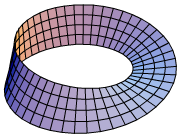
Möbius strip joke

I was at Claymakers last week, gently chiseling bisqued clay goobers out of the holes of one of my Klein bottles before glazing it, when a gentleman asked me what a Klein bottle was. I explained that it is basically what you get when you sew two Möbius strips together.

After we talked topology, he said:

"Why did the chicken cross the Möbius strip?"*

I thought the best answer was "KABLOOIE!" (the sound of a brain self-destructing when faced with the oxymoronic contradiction of anything getting to the other side of a Möbius strip), but he said "to get to the same side," which is almost as good.

Other interesting questions are why a chicken is on a Möbius strip in the first place, and what happens to it once it reaches the same side. According to Frederick Winsor, author of The Space Child's Mother Goose, animals don't necessarily do well in Möbius environments:

Flappity, Floppity, Flip!
The Mouse on the Möbius Strip.
The Strip revolved,
The Mouse dissolved
In a chronodimensional skip.
**

Incidentally, in Winsor's world, my high flying chicken*** might have enjoyed a happier ending:

Humpty Dumpty sat on a wall.
At three o'clock, he had his great fall.
The King set the Time Machine back to two.
Now Humpty's unscrambled and good as new.**

*And to think that we hadn't talked about chickens at all!

**The Space Child's Mother Goose, verses by Frederick Winsor, illustrations by Marian Parry (1958; first paperback edition, 1963).

***Consider the amazing power of punctuation: compare a high, flying chicken to a high-flying one. You won't find this example in Eats, Shoots & Leaves: The Zero Tolerance Approach to Punctuation by Lynne Truss (2004).

Thursday, May 20, 2010

A new style for A Long-expected Party

Given that my childhood experience with Tolkien began with The Hobbit, I now understand, as an adult, why it also ended there. Nonetheless, tonight our quest for cultural literacy entered new territory as E and I commenced The Fellowship of the Rings. Happily, we can already tell this book differs considerably from its predecessor. Indeed, a mere five pages into the tale, we came upon this remarkable sentence:

"The flowers glowed red and golden: snap-dragons and sunflowers, and nasturtians* trailing all over the turf walls and peeping in at the round windows."

Yes folks, there's a colon in that sentence--the first of several in just the opening chapter alone! And semicolons abound in the book, not to mention commas and all other variety of punctuation. And there are italics and ALL CAPS to add emphasis and clarify meaning, and verbs and subjects enjoying intimate proximity, and pronouns pointing to clear antecedents. Just as Bilbo provides a rich abundance of foods for his birthday feast in Hobbiton, so Tolkien provides a rich abundance of linguistic cues in his prose, contributing greatly to the ease of reading out loud and, consequently, to our overall conviviality. Let the next adventure begin!

*According to the OED, "nasturtiums" predates "nasturtians," but it is nasturtians that grow in Middle Earth.

Saturday, May 15, 2010

Grammar in Esgaroth

My friend Susan, who is well versed in religious and epic texts in assorted languages of old, insists I would appreciate Tolkien's prose more if I were better read in Middle English and Icelandic. Every sentence I threw at her, she read smoothly, without batting an eye or stumbling over a single missing comma.

So I decided to continue on with open mind after the death of Smaug in Esgaroth by Bard's last and best-aimed arrow [<--see what I in the narrative, that unfolds within the improvisational mind, have learned about strings of prepositional phrases!]. Full on the next paragraph I fell, and read aloud with epic voice these sentences: [<--apologies for the colon, I'm new at this]

"[The wind] twisted the white fog into bending pillars and hurrying clouds and drove it off to the West to scatter in tattered shreds over the marshes before Mirkwood. Then the many boats could be seen dotted dark on the surface of the lake, and down the wind came...No, dagnabbit. Wait a sec...and down the wind came...and down the...Ah, got it...and down the wind...came the voices of the people of Esgaroth lamenting their lost town and goods and ruined houses."

Reading with the epic voice helps.

Thursday, May 13, 2010

Grammar at Bag-End

A geek's confession: I have never read The Lord of the Rings, and I only know The Hobbit because my fifth grade teacher read it out loud over several weeks of "quiet time" in 1977.

Recently, in post-Harry Potter and Percy Jackson 2010, the eight- and nine-year-old males in my son's peer group have started carrying around assorted Tolkien books. The paperback covers are worn and tattered, mainly from falling out of perpetually unzipped backpacks, but I suspect some of the boys are actually reading the books too.

So I decided it's time for some mother-son bonding: I would nip E's potential cultural illiteracy in the bud, and (long overdue) make up for my own, by reading the books out loud to him.

We are now nearing the end of The Hobbit, and I think I've discovered the reason I never felt any affinity for it. It isn't because most of the book is about a long arduous slog, nor because the peoples of Middle Earth somehow managed to procreate (as evidenced by the existence of characters) without there being any females around. No, even the book's admittedly good moments--like Bilbo's riddle duel with Gollum--aren't enough to make up for its thoroughly annoying grammar.

I've therefore taken it upon myself to decipher some of Tolkien's rules, so that the path might be easier for other wannabe LotR fans.

Rule 1: After introductory elements only weak minds need commas.

Exhibit A: "In spite of the dangers of this far land bold men had of late been making their way back into it from the South, cutting down trees, and building themselves places to live in among the more pleasant woods in the valleys and along the river-shores."

Exhibit B: "Following him they found themselves in a wide hall with a fire-place in the middle. Though it was summer there was a wood-fire burning and the smoke was rising to the blackened rafters in search of a way out through an opening in the roof."

I suppose it doesn't make sense to say it was summer in a wide hall with a fire-place in the middle. Still, I wouldn't have had to back track from "Though it was summer there" to "Though it was summer, there" had Tolkien included a comma.

Exhibit C: "As Bilbo's sharp inquisitive eyes got used to seeing things he could catch glimpses of them whisking off the path and scuttling behind tree trunks."

Fun with back-tracking! Find your favorite introductory element:
a. "As Bilbo's sharp inquisitive eyes got used to seeing things he could catch glimpses of,"
b. "As Bilbo's sharp inquisitive eyes got used to seeing things he could catch,"
c. "As Bilbo's sharp inquisitive eyes got used to seeing things,"

Rule 2: Ambiguous pronoun references add depth to them.

Exhibit D: "Then at last they [Bilbo and the dwarves] said good-bye to their ponies and turned their heads for home. Off they trotted very gaily, seeming glad to put their tails towards the shadow of Mirkwood."

E and I suspected something was amiss when Bilbo's party headed in the wrong direction, and we confirmed it when the hobbits and dwarves sprouted tails.

Rule 3: Separating subjects and verbs over as vast a distance as possible, and recalling thus certain tape-worm-like sentence structures composed by authors in the German language and also sometimes apparently even in English, gets readers' attention.

Exhibit E: "Occasionally a slender beam of sun that had the luck to slip in through some opening in the leaves far above, and still more luck in not being caught in the tangled boughs and matted twigs beneath, stabbed down thin and bright before them."

Rule 4: Remember this, colons are bad.

Exhibit F: "All the time they ate, Beorn in his deep rolling voice told tales of the wild lands on this side of the mountains, and especially of the dark and dangerous wood, that lay outstretched far to the North and South a day's ride before them, barring their way to the East, the terrible forest of Mirkwood."

This is a nifty example because it deals with several of the rules and their exceptions: "All the time they ate, [surprise comma!] Beorn in his deep rolling voice [observe delay of verb] told tales of the wild lands on this side of the mountains, and especially of the dark and dangerous wood, [this unnecessary comma confounds the reader] that lay outstretched far to the North and South a day's ride before them, barring their way to the East, [colons are bad, but a colon would be helpful here] the terrible forest of Mirkwood."

Rule 5: Because an idle mind is the devil's workshop to figure out your meaning, make your readers struggle.

Exhibit G: "The barrels now all lashed together creaked and fretted."

You choose the error: is it (a) lack of commas separating items in a list ("The barrels now all lashed together, creaked, and fretted"), or (b) missing commas around a participial phrase ("The barrels, now all lashed together, creaked and fretted")? (Ooh, ooh, choose (b)!)

Exhibit G occurs about two thirds of the way through The Hobbit, by which point you are no longer likely to be surprised by such comma-less constructions.