Monday, April 1, 2024
The Rules of Condiments
Tuesday, February 27, 2024
Where things stand re. single use plastics
Here we are at the end of February. Has our single-use plastic consumption declined? Yeah, but...
We've only been at this for two months, but we're concluding that a life without single-use plastic is pretty darned near impossible in the U.S. without massively adjusting what we eat. Is it possible to eat 100% locally sourced foods? Probably. Are we going to try hard enough to do that? Jury's still out on that. No coffee, no chocolate, no lemons, no pears, no sugar, no lots of stuff. Maybe we can dedicate a week or two to trying this later this spring, to see how it goes...
We've made some changes that we like:
* We're much better about remembering to bring bags with us to shop at the Farmers' Market and the food co-op, and going without bags if we forget them, knowing our backpacks can handle loose radicchio, kohlrabi, and other seasonal veggies until we get them home.
* We're much better about re-using plastic bags that we might not have re-used previously, because by trying to forego plastic bags, we're realizing what a luxury a good plastic bag is.
* We're re-using glass jars to store bulk foods, and enjoying the ease of use, the visual appeal, and (hopefully) the reduction in off-gassing from plastic containers into food for long-term storage. We now use plastic mainly for storing leftovers.
* We're eating more locally-grown, seasonal foods--easy to do as spring ramps up, probably harder to do once we hit fall.
* We're eating more vegan meals. Locally, there's no way to get lactose-free milk in glass bottles, and there's no way to get dairy-free milk substitutes that aren't in plasticized containers. Going milk-free has also been abetted by a video that social media thrust at me, showing an adult cow clearly upset as a calf is being carted off in a trailer. Who knows what the cow and calf are thinking, but they're clearly thinking. As you can't get milk from cows without cows birthing calves, I'm trying to go without for now. Eggs then follow, logically. I've been a vegetarian since 1986, so it's beyond time that I try going this extra step.
We've found some recipes worth remembering: this apple cinnamon cake (the recipe calls it "bread"--yeah, right), subbing 1/2 c. applesauce for the eggs, and 1/4 c. vegan butter substitute for the 1/2 c. butter (since applesauce is also a butter substitute). And chickpeas with broccolini (saute a good amount of sliced garlic, 2 crushed small bright red hot peppers from the stash your sister-in-law brought you from Mexico, smoked paprika, and fennel seeds in EVOO, add 1 can drained chickpeas, stir for a bit, then add a bunch of broccolini and saute until wilted. So so good. Save the chickpea water--a.k.a. aquafaba--to make coconut macaroons; these are less cloyingly sweet than the non-vegan variety.
As for making homemade vanilla extract, the most inefficient adventure imaginable to reduce single-use plastics... What was I thinking? The local bulk-foods store, Part & Parcel, was out of vanilla beans, with no anticipated back-in-stock date, so I ordered beans online. Of course they came vacuum-wrapped in huge sheets of plastic, as must all bulk vanilla beans in the U.S. Doh. But I have 24 beans soaking in a good 4 cups of vodka; shake shakety shake shake. The extract should be ready for use in about 6 months.
Tuesday, January 16, 2024
Durham Farmers' Market plastic-free scouting
On Saturday, we walked to the Durham Farmers' Market to scout out veggies not prewrapped in plastic, and we ended up signing up for a year with The ReCollective. The ReCollective collects "hard-to-recycle items (the stuff that can’t go in your curbside bin) that would otherwise be landfill-bound right from your doorstep and ensure they are reused or recycled in transparent and responsible ways." This includes sheet plastics, plastic wrappers, and plastic wrapping materials*--so even if we can't eliminate these from our food purchases, at least we can direct them more intentionally toward re-use and recycling. We'd heard about this business from friends who subscribe, and appreciated the opportunity on Saturday to ask questions in person.
We then stopped by the fabulous BoxCarr Handmade Cheese stand. Their cream cheeses come in plastic containers that we can re-use; their gooey brie-like cheese are wrapped in plasticized paper; and their hard cheeses are vaccum-wrapped in plastic. I mentioned my goal of reducing my single-use plastic footprint, and asked whether they could ever wrap some of their hard cheeses in plasticized paper for us if we pre-ordered. They were very friendly about it and said they'd do it--but after chatting about it, it was clear the main impact would be more work for them with minimal environmental impact, so we probably won't end up asking them for that. The main takeaway: given the effort that goes into making a living producing cheese on a small scale, plastic wraps are essential for preventing spoilage.
We know alternatives are possible. Cheese vendors at German markets, for example, bring large rounds of cheeses to market, cut pieces to order, and wrap them in paper for each individual customer, rather than selling pre-packaged cheese. Perhaps we can find this process at Whole Foods or Harris Teeter.
*Stefan has insisted on collecting these plastics for years, even though our city recycling service won't accept them. In theory, we can drop them off at grocery stores; in practice, we store them in large plastic trash bags in our pantry or car trunk, for months and months, before remembering to drop them off at a store. Once they're dropped off, we suspect they're simply incinerated rather than recycled. The ReCollective is more specific about where they direct the materials they collect.
Wednesday, January 10, 2024
Avoiding single use plastic is hard to do
As 2023 headed to a close, I decided 2024 would be a good time for me to make a major effort to avoid single-use plastic.
Ten days in, I haven't gotten very far.
Here are some things that come in plastic:
* Milk (specifically Lactaid, because I've become less tolerant of lactose in my dotage). I could buy it by the cardboard-carton quart instead of by the plastic-jug gallon, but cartons also contain plastic. Or I could buy milk in glass bottles and use lactase drops to break down the lactose, a more expensive option than buying milk in larger quantities at Costco. Or I could quit consuming dairy products. As an ovo-lacto vegetarian since 1986, I've thought on and off about going vegan. If the numerous ethical and environmental animal-husbandry reasons to do so aren't sufficient motivation, perhaps rejecting single-use plastic is?
* Cheese. Maybe I need to buy this at a grocery store deli counter instead of out of a refrigerator. I might be able to persuade one of the local cheese vendors at the Durham Farmers' Market to wrap some cheeses for me in paper instead of plastic, but there's a big monetary difference between locally made cheese and Costco's imported selection. Maybe cheese needs to become a rare treat instead of a frequent food.
* Tofu. The Co-op has dozens of plastic boxes of tofu in the refrigerator section. Perhaps I can find tofu in bulk somewhere local (and here, the walkaholic notes that this will necessitate driving; the four-mile RT walk to the co-op is more manageable than the 15-mile RT walk to the Asian food store)... Do I want to try making tofu from scratch?
* Vegan imitation animal flesh. 100% packaged in plastic. Fine, I'll stick with beans and grains and eggs.
* Cauliflower and spinach. These come pre-wrapped in plastic at the Co-op, Whole Foods, and Harris Teeter. I could buy broccoli and kale instead, or purchase cauliflower and spinach seasonally at the Farmers' Market. Eating seasonally and locally is probably the more interesting way to go.
* Coffee beans. Caffeine and I do not get along, so I've been drinking only decaf since 1986--but I do enjoy the decaf lattes S makes me for breakfast. I guess I could switch to tea...
* Tea. My most recent box of peppermint tea came wrapped in plastic, but herbal tea--and mint in particular--is easy enough to find in bulk.
---
Here's the plastic inventory for last night's dinner (cauliflower cheese pie with grated-potato crust [based on the recipe from the Moosewood Cookbook], green leafy salad, and chocolate pudding):
I bought the potatoes in bulk, so no plastic.
The onion was the last onion from a 3-lb. bag; the bag was made of plastic netting with a plasticized label. Next time, I can buy individual unbagged onions--and pay more for the privilege.
The cauliflower came in a plastic bag that I figured I could re-use for other veggies--but the bag turned out to have slits cut into it so the cauliflower could breathe.
The eggs came in a cardboard egg carton, but the milk and cheese came in plastic. Salt, pepper, thyme--the seasonings all came in re-fillable glass containers.
S made the salad. The lettuce came from a plastic bag of five heads, from Costco, but locally grown lettuce is easy enough to purchase unbagged. Next time.
Vinegar and olive oil came from glass bottles, but honey and stone-ground mustard both came in plastic bottles. I don't know of any bulk sources for stone-ground mustard (although last year I tried, and failed, to make whole-seed mustard from scratch), but we can switch to glass-jarred brands. Likewise honey, or I can find a source for bulk honey and re-use the bear-shaped plastic bottles.
Dessert was chocolate pudding from scratch. Milk from a plastic jug. Organic sugar from a plastic bag; we can buy sugar in a paper sack next time. The cornstarch, cocoa powder, butter, and chocolate came from non-plastic containers, although the cornstarch container has a plastic lid. Next time I can buy cornstarch in a cardboard box. Vanilla came from a plastic bottle from Costco. Homemade vanilla extract sounds like a worthwhile project.
---
Sometime in the next week, I will walk over to Part and Parcel to check out their bulk offerings. I'll report back...
Sunday, July 28, 2019
Safeway treasures
We don't have Safeways in Durham, so it's hard to tell if the items we saw today are particular to Safeways or particular to California. Among the most interesting:
1. Individually wrapped prunes. I guess this is a "value pack" because it includes multiple individually-wrapped prunes, sold at an equal or lower cost compared to the same quantity prunes cavalierly tossed into a single container without plastic film preventing them from touching one another. Or maybe they're individually wrapped because prunes are what Californians like to give to trick-or-treaters on Hallowe'en. Or perhaps the plastic sheaths discourage calorie-conscious consumers from indulging in more than one prune at a time.*
2. Potato chips that were packed at ~150' elevation and then trucked up to ~5,820' elevation. Assuming the temperature in the Salem, Oregon, potato-chip packing plant is about the same as the temperature in the Truckee Safeway, this poofed up bag demonstrates that the air pressure in Truckee is lower than the air pressure in Salem. This has me wondering whether the bag would burst on top of Mt. Whitney, the highest point in the continental U.S. at 14,505', although the temperature up there is probably significantly colder than at the packing plant. (S asks who would carry a bag of Kettle chips up to the top of Mount Whitney. I suppose the answer now must be "I would," were I ever to climb Mount Whitney.)
3. Gluten-free butter. Butter in North Carolina is gluten-free too, as is butter in every other place in the world, but in North Carolina we don't boast about it.
4. Recreational weed is legal now in California, although it does not appear to be sold at Safeway, at least not anywhere obvious to folks who aren't looking for it (like the butt rub and slop mop at King's Red and White). But apparently there's some work to do to get certain demographics to purchase it, as indicated by the copies of Women & Weed in the impulse-purchase magazine rack next to the checkout aisles. You can tell this magazine is for women because the cover is pink. It works for guns, so why not weed magazines? We were unable to locate any copies of GPQ on the racks (Gentlemen's Pot Quarterly).
*Update: The idea of individually wrapped prunes really bothered me, given that the plastic packaging is unnecessary, excessive, and non-recyclable, so I turned to the interwebs seeking an explanation. Here it is: https://www.packworld.com/article/package-feature/safety/tamper-evidence/sunsweets-ones-kind-prunes. Sunsweet has been doing this since 2007, because wrapping individual prunes in 48-ga PET/80-ga oriented polypropylene film "helps consumers overcome the stigma of eating prunes." What about the stigma of trashing the environment?
Saturday, September 3, 2016
Banana bread recipe revised
Champion Banana Bread
Preheat the oven to 350°F (175°C), and butter a 4x8-inch loaf pan. [Or use muffin tins, or a glass baking dish, or whatever. You have enough baking experience that you don't need to feel bound to the 4x8-inch size.]
Mash:
3-4 very ripe bananas, peeled [The recipe actually specifies "peeled." I haven't ever tried it with unpeeled bananas.]
Mix in:
1/3 cup melted butter [Hooray for melted butter. This is what makes this recipe is so easy.]
Mix in:
1 teaspoon baking soda [Seems like a strange order, but it works.]
Pinch of salt
1 egg, beaten
1 teaspoon vanilla extract
Mix in:
1 1/2 cups of all-purpose flour
Optional:
1/3 cup semi-sweet chocolate chips and/or
1/3 cup pecans, shelled [I wrote "shelled" to keep the "peeled" bananas company]
Bake 45-50 minutes or until done.
Monday, February 15, 2016
Mexico Day 3: Teotihuacan
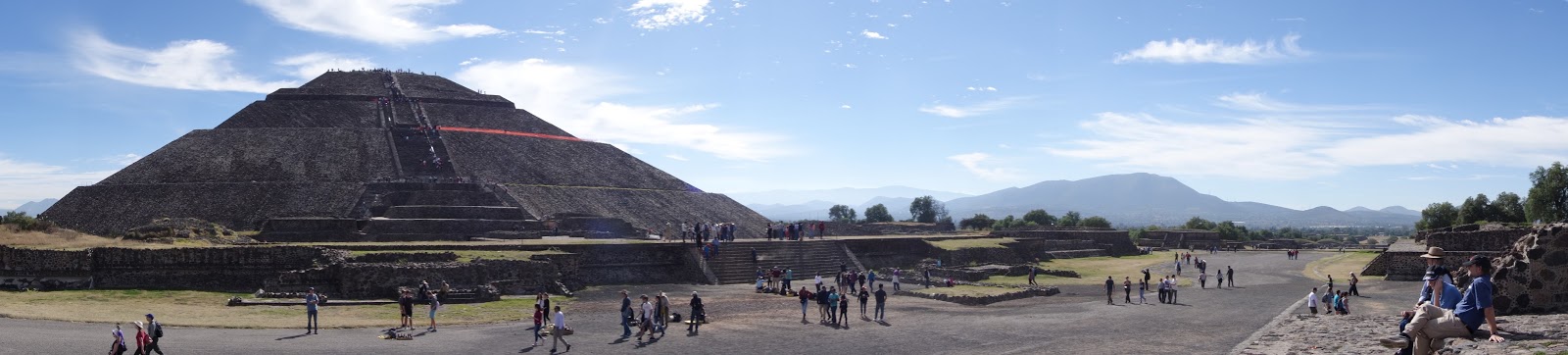
On our third day visiting P in Mexico, we went to Teotihuacan.
We began just outside the perimeter of the site. Only about 10% of Teotihuacan has been excavated, so saying "just outside the perimeter" still means in the middle of the ancient city.
Our first stop was at the palace of Tepantitla, where we admired the frescoes known as the "Paradise of Tlaloc"; P called them "Tlaloc's Water Park." Tlaloc was the Aztec god of water and agriculture.
| Tlaloc, with his characteristic circular eyes. He's holding Tlaloc pots in his hands. |
| Tlaloc's paradise? Or a mountain being fed with human sacrifices? |
| These folks had much to say, maybe about the fish, crabs, and butterflies |
Because I was not paying attention, or because the butterflies, crabs, and gamboling humans were so engrossing, I completely neglected to photograph the fresco of the Great Goddess of Teotihuacan just above Tlaloc's water park. Here's an image of a reconstruction located at the National Museum of Anthropology:
| By Thomas Aleto from Riverside, PA - Tepantitla Mural, CC BY 2.0, https://commons.wikimedia.org/w/index.php?curid=2781356 |
| Press molds! |
From the museum, we walked to the Temple of the Sun. Although the pyramid is not as steep as those in Egypt, the steps are tall and shallow. It's relatively easy climbing up, but difficult climbing down--especially for the acrophobe, who prefers to see what's below before stepping off each narrow ledge.
| Temple of the Sun |
| E looking for P down below |
| Looking north toward the Temple of the Moon |
| E and P, waiting. E virtually flew down the stairs. S held my hand and coaxed me down without ever making fun of me. |
From there, it was on to the Temple of the Feathered Serpent, also called the Temple of Quetzalcoatl.
| The Temple of Quetzalcoatl, viewed from the Temple of the Sun |
| Tlaloc |
| Feathered serpent. These look like lions to me... |
After a few hours, we had only covered about half of the site. With places to go and things to do, we finished off by visiting two compounds outside the main archaeological site: Tetitla and Atetelco. At Tetitla, P enthusiastically showed us the frescoes of "priests with painted fingernails." Surfing the interwebs, one finds numerous photos of these priests--but shown just one at a time rather than in a pair. They're generally described as representations of the Great Goddess of Teotihuacan--but comparing these to the photo of the National Museum of Anthropology reconstruction of the Goddess fresco from Tepantitla, one sees that that goddess just has the eagle head, without the big-eared human heads underneath. Plus P knows who's who and what's what at Teotihuacan. With that said, here are the priests with painted fingernails:
| Here's the reconstructed goddess again, for comparison's sake. The guys to the right and left are priests. |
Monday, February 1, 2016
Mexico Day 1
| A 55 kg vision in pink |
| 110 kg in blues and greens |
| The cake in the window that drew us in |
| We were greeted at the museum by this snake... |
| ...with more papier mâché inside. |
| Coyote by Angelico Jimenez of Oaxaca |
| Judas effigies. Missionaries introduced the practice of burning them on the Saturday of Holy Week. The signage said the effigy burnings "helped capture the attention of the newly converted." |
| Clay flutes and ocarinas |
| "Purgatory mask" by Zenaida Rafael Julian of Michoacan |
| Mask detail; devil is getting ready to chow down. He reminds me of the Blue Meanies in The Yellow Submarine. |
| My photo-processing software wanted me to tag the faces in this image |
| Winged bearded bicycling skeleton |
| The clay pieces were stunningly dainty and detailed |
| This skull was in the gift shop |
| Life-sized revelers |
| Offerings at an Aztec restaurant. When you live on man-made islands on a marshy lake, you eat whatever protein you can find. |
| This spice shop is next door to a mole grindery. You can buy your spice combos here and take them next door to have them mixed together into mole paste, or go home and grind everything yourself. |
| Asian veggies |
| E' says "say cheese!" |
| P buying her favorite mole from her favorite mole maker |
| My chickens would be aghast |
| Bambi |
| Zzzzz |
P lives on the top floor of a 1940s apartment building. Her balcony is covered with happy tropical plants.
| ...and a skeleton |
| Dried flowers inside by the balcony door |
| Mezcal flasks hanging in front of the bar (not my cup of tea) |