Same men in same Lederhosen, 27 months later.
*Note that men have slept, eaten, showered, attended work/school, changed clothes, and otherwise gone on with their lives between photo sessions.
Thursday, March 21, 2013
Tuesday, February 5, 2013
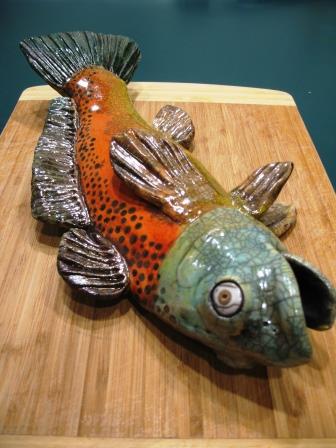
Big Fish
One of the lessons I learned through my Penland experience last summer was to take advantage of the clay workshops offered closer to home--cheaper, faster, and easier to access (albeit not as scenic, and without the great food). I've taken three excellent workshops at Claymakers since then: one with Susan Feagin on screen printing and slip transfer, one with Kent McLaughlin on hand-making brushes (lovely brushes with bamboo handles and--oy--bristles cut from sanitized, neon-dyed deer tails from tackle shops; no matter how well cleaned or fluorescently colored, deer tails still feel and smell like deer tails and probably would have benefited the deer more than me); and one this past weekend with Alan Bennett on sculpting and raku-firing fish.
In about 30 hours, Alan took us from wet clammy clay to finished fired fish. We sculpted fish Saturday morning into early afternoon, encouraged them to dry in front of fans while Alan demoed glazing, and then gutted the fish from behind to thin their walls. They went directly into the electric kilns to dry, were bisque fired overnight, and remarkably came out mostly whole the next morning. We glazed and raku-fired Sunday afternoon, and everyone left with finished work by early evening. My main take-aways: how to make eyeballs and eyelids; how to sculpt a fish in under two hours; how to gut a solid form; and the knowledge that fish have eyelids, nostrils, lips, and ears. (As my friend N commented, "imagine that--it's like they have entire FACES!"; yet even with a tank full of fish at home, I'd never looked closely enough to notice anything but the lips. I now notice their nostrils, but remain unconvinced that they have eyelids.)
One of my fish--the last one I made, so the wettest on Saturday evening--cracked widthwise, from the dorsal fin through the tail and into the belly. He became my glaze test tile. I think the colors look a little too paint-by-numbers-ish, although friends in the workshop pulled out photographs of fish that have similarly discrete color transitions.
I saved the largest fish for last. It was the first one I made on Saturday and consequently had enough time to dry prior to bisquing that it didn't crack. I worked harder at blending the colors on this guy. It's hard to see in the photo, but there's a lovely fluid transition on the body from red to yellow to vaguely green, with no crackle on the spots and lots of crackle on the belly. The head merges from blue at the nose to greenish with hints of red and yellow at the gills.
In about 30 hours, Alan took us from wet clammy clay to finished fired fish. We sculpted fish Saturday morning into early afternoon, encouraged them to dry in front of fans while Alan demoed glazing, and then gutted the fish from behind to thin their walls. They went directly into the electric kilns to dry, were bisque fired overnight, and remarkably came out mostly whole the next morning. We glazed and raku-fired Sunday afternoon, and everyone left with finished work by early evening. My main take-aways: how to make eyeballs and eyelids; how to sculpt a fish in under two hours; how to gut a solid form; and the knowledge that fish have eyelids, nostrils, lips, and ears. (As my friend N commented, "imagine that--it's like they have entire FACES!"; yet even with a tank full of fish at home, I'd never looked closely enough to notice anything but the lips. I now notice their nostrils, but remain unconvinced that they have eyelids.)
One of my fish--the last one I made, so the wettest on Saturday evening--cracked widthwise, from the dorsal fin through the tail and into the belly. He became my glaze test tile. I think the colors look a little too paint-by-numbers-ish, although friends in the workshop pulled out photographs of fish that have similarly discrete color transitions.
Fish two was a quick expendable extra--a whistle, to see how whistles make it through raku. The unglazed portions of clay blackened as the piece cooled outside the kiln in sawdust (when the sawdust burns, it creates a reduction atmosphere around the clay). The eyeball whites and the fangs, made from porcelain, were brushed with a solution of gerstley borate to keep them from blackening.
I saved the largest fish for last. It was the first one I made on Saturday and consequently had enough time to dry prior to bisquing that it didn't crack. I worked harder at blending the colors on this guy. It's hard to see in the photo, but there's a lovely fluid transition on the body from red to yellow to vaguely green, with no crackle on the spots and lots of crackle on the belly. The head merges from blue at the nose to greenish with hints of red and yellow at the gills.
Thursday, January 31, 2013
Pipes, pots, and espionage
Almost every weekday from 12:30-1:30pm, an organist is in Duke Chapel playing a demonstration recital on the Flentrop, Aeolian, or Brombaugh organ. A friend and I are privileged to share the Tuesday organ demo slot; each week, we trade off who plays and who turns pages/pulls stops.
This past Tuesday, my friend played was Bach's 5-part fugue, "Kyrie, Gott heiliger Geist," BWV 671. That was the first piece I ever played on the Flentrop some six or so years ago; my organ teacher had decided I needed to feel the weight of the piece on a large tracker organ rather than on the humble 8-stop Walker I play at work. Hearing the piece again on Tuesday made me sentimental for the exhilaration of that first ride.
It turned out that the Wednesday organist couldn't play this week, so I took the subbing opportunity and played the Kyrie. I brought my flip camera to see if it would capture the immensity of the sound. It did a decent job under the circumstances (under the manuals, on the floor), though the massive pedal pipes don't shine through the mush at all. For the record, I get nervous when I know I'm being watched, even if it's only by a camera aimed at my feet; this comes through in the performance, yet given how tense my ankles were, my feet look surprisingly boring (spiffy striped socks excluded).
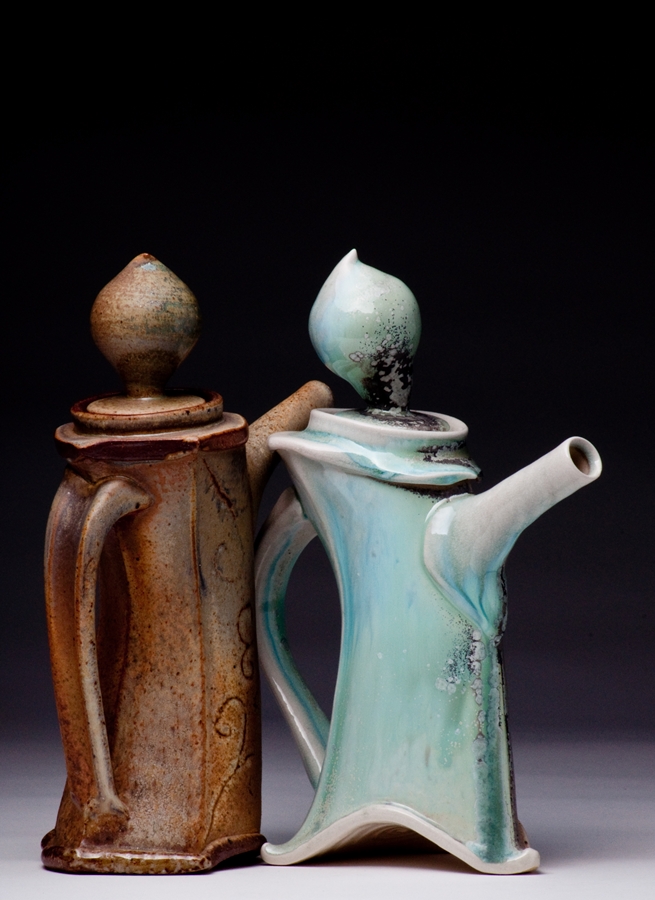
In pottery news, I'm delighted that a photo of one of my teapots was accepted for Lark's second volume of 500 Teapots, due out in August 2013. I actually don't know which teapot, since I submitted two with the same mellifluous title ("Untitled, 2009"), but it'll be one of these two:
In other news, we took a trip to Washington, D.C., over winter break. One of the many museums we visited was the International Spy Museum, where the signs admonished us not to take photographs. At the same time, the exhibits featured multiple real-life spy cameras that had enabled undercover agents to discretely capture intelligence on film. Rebel that I am, I was consequently inspired to snap some illicit photos inside the museum. Of course, I can probably say farewell to a career in espionage after posting the images here, but so it goes.
This past Tuesday, my friend played was Bach's 5-part fugue, "Kyrie, Gott heiliger Geist," BWV 671. That was the first piece I ever played on the Flentrop some six or so years ago; my organ teacher had decided I needed to feel the weight of the piece on a large tracker organ rather than on the humble 8-stop Walker I play at work. Hearing the piece again on Tuesday made me sentimental for the exhilaration of that first ride.
It turned out that the Wednesday organist couldn't play this week, so I took the subbing opportunity and played the Kyrie. I brought my flip camera to see if it would capture the immensity of the sound. It did a decent job under the circumstances (under the manuals, on the floor), though the massive pedal pipes don't shine through the mush at all. For the record, I get nervous when I know I'm being watched, even if it's only by a camera aimed at my feet; this comes through in the performance, yet given how tense my ankles were, my feet look surprisingly boring (spiffy striped socks excluded).
In pottery news, I'm delighted that a photo of one of my teapots was accepted for Lark's second volume of 500 Teapots, due out in August 2013. I actually don't know which teapot, since I submitted two with the same mellifluous title ("Untitled, 2009"), but it'll be one of these two:
In other news, we took a trip to Washington, D.C., over winter break. One of the many museums we visited was the International Spy Museum, where the signs admonished us not to take photographs. At the same time, the exhibits featured multiple real-life spy cameras that had enabled undercover agents to discretely capture intelligence on film. Rebel that I am, I was consequently inspired to snap some illicit photos inside the museum. Of course, I can probably say farewell to a career in espionage after posting the images here, but so it goes.
Monday, December 31, 2012
New Year's Resolutions
I'm not great about keeping New Years' Resolutions. Two years ago, I resolved to:
This year, I made just one resolution: to be more like my Schroeder. This means:
- start an Etsy store
- come up with a way to take decent photos of my work
- build a gas or soda kiln in the back yard
- learn to repair plaster walls, and
- devise a more practical winter studio.
This year, I made just one resolution: to be more like my Schroeder. This means:
- Be active. Schroeder plays a few rounds of fetch up and down the stairs every morning. I hope to run a 10-mile race or a half-marathon.
- Play games with the boy. Schroeder and E play fetch. E and I play board games, card games, and catch.
- Strive for excellence.When someone tosses a knit carrot your way, why simply catch it when you could drop it in or behind a laundry basket and practice tugging it through the mesh holes? I will strive more often for good rather than settling for good enough.
- Remain positive. Perhaps someday Schroeder will finally paw his way through the glass walls of the aquarium and eat the fish. Perhaps someday I will finally repair plaster.
- Be curious. Schroeder needs look no further than an empty box to find wonder and delight. What empty boxes await me?
Solstice lights
At sundown on December 21, E solemnly lit the Solstice Elk. In a minor key, with a meandering melody and awkward phrase length that evoked the awkwardness of our inquisitive meandering forebears, we improvised a new song: "Solstice Elk, O Solstice Elk, we welcome your presen[ce/ts] and the return of the light."
The Solstice Elk is a practical beast and an evolving metaphor. He has a key to the house and uses the front door; no chimney entries for him. (This was all news to my mom, who was joining us for Solstice for the first time.)
The Solstice Elk was generous this year. Among the treasures he left between the fish tank and the fireplace were a big box of Space Chips...
...and a joyful re-purposing of otherwise unused ear plugs.
AND...E and S both built me spray booths! (At first, I thought S's was a gas kiln; you can imagine my surprise when I unwrapped it.)
Having maxed out on our traditional arbitrary Solstice menus (most recently, homemade noodles for, um, longevity; previously, veggie sushi and hybrid cousin cake for, um, health and nuts), we started a new tradition: tomato bisque with homemade pesto, reduced saffron cream, and warm crostini (for, um, vibrancy and contentment). S, who has lived in the U.S. for 23 years, finally suffered such strong German Christmas cookie withdrawal symptoms this fall that he went into a baking frenzy and made 150 Plätzchen in four varieties, so we ate some of those for dessert.
Three days later, on Christmas Eve, our Solstice lights reignited on a grand scale when our backyard compost pile went up in flames. We're grateful for alert neighbors who saw the fire before we did and came banging on the door, and we thank Durham's finest for putting out the fire; they said they could see the smoke plume all the way from King's Sandwich Shop downtown. On the bright side, no one was hurt, no buildings were damaged, and we had been intending to replace the fence eventually anyway. On the down side, even though the event provided some good visceral excitement, I can't, in good conscience, recommend trying this at home.
The Solstice Elk is a practical beast and an evolving metaphor. He has a key to the house and uses the front door; no chimney entries for him. (This was all news to my mom, who was joining us for Solstice for the first time.)
![]() |
| Solstice Elk with antlers ablaze |
The Solstice Elk was generous this year. Among the treasures he left between the fish tank and the fireplace were a big box of Space Chips...
![]() |
| Solstice loot light |
AND...E and S both built me spray booths! (At first, I thought S's was a gas kiln; you can imagine my surprise when I unwrapped it.)
Having maxed out on our traditional arbitrary Solstice menus (most recently, homemade noodles for, um, longevity; previously, veggie sushi and hybrid cousin cake for, um, health and nuts), we started a new tradition: tomato bisque with homemade pesto, reduced saffron cream, and warm crostini (for, um, vibrancy and contentment). S, who has lived in the U.S. for 23 years, finally suffered such strong German Christmas cookie withdrawal symptoms this fall that he went into a baking frenzy and made 150 Plätzchen in four varieties, so we ate some of those for dessert.
Three days later, on Christmas Eve, our Solstice lights reignited on a grand scale when our backyard compost pile went up in flames. We're grateful for alert neighbors who saw the fire before we did and came banging on the door, and we thank Durham's finest for putting out the fire; they said they could see the smoke plume all the way from King's Sandwich Shop downtown. On the bright side, no one was hurt, no buildings were damaged, and we had been intending to replace the fence eventually anyway. On the down side, even though the event provided some good visceral excitement, I can't, in good conscience, recommend trying this at home.
![]() |
| Generally not what you expect to see in front of your house |
![]() |
| Generally not who you expect to see turning your compost pile |
![]() |
| The ghost of fences past |
Sunday, December 23, 2012
Summer recaps finished: Penland and flutes
Warm November flew away, and barely-cold December is also on its way out, so here's my last summer catch-up blog. I'm sure I'll never catch up with autumn blogging, so I'll spill the highlights right away: (1) our determined angel fish laid new eggs every 2-3 weeks and the young fry got eaten by their carnivorous tank-mates and parents every darned time; and (2) Schroeder lost his carrot, causing distress and consternation, but my mom knitted him a new one and everyone is content once more. Ooh, and (3) I worked towards coming to terms with glazes fired in oxidation, attempting to mimic the variation of reduction-fired surfaces by spraying layers of different Claymakers' studio glazes à le Steven Hill, and it's going well enough that I recently bought a used compressor and spray gun, with hopes of building (and, by extension, finding room for) a spray booth for my home studio; but that's a story that lacks photos and will have to wait until 2013 for blog development.
So back to the summer. I spent the last two weeks of August at the Penland School of Crafts, taking a class entitled "Shape Shift: The Pot," taught by Jim Lawton. I had been meaning to take a Penland class for almost a decade, and the stars had finally aligned between a class I was very interested in, two unencumbered weeks, and manageable kidcare. At Penland, I learned a lot about darting, making holes, and assembling well-proportioned altered pots, worked intensely from morning to night, met a lot of interesting and talented people, ate super duper well, and happily jogged almost daily along beautiful mountain roads (only getting lost once, when what I thought was a 180o-sum turn on curvy roads turned out to be only about 85o, and a 3-mile trip turned into 7 miles, so that I missed breakfast on the last day).
One of my Penland classmates, Joe, is a glass artist who was honing his clay skills. We had a shared interest in clay instruments; I showed him how to make ocarinas, and he showed me how to make a flute. It took until late this fall for me to finally attempt making a flute; the initial results are played below, with a chickarina for comparison (apologies to Beethoven for the flubs). Ocarinas are easier to play, although the tone quality and range aren't as good. Both flutes were tuned by ear; maybe next time I'll pull out my tuner. As with the chickarina, some pitches +/- can be replicated with multiple fingerings, which helps some with the tuning. It would probably help too if I actually knew how to play the flute. As it is, I feel disturbingly light-headed after playing these things. I'm sure good tone quality and hyperventilating don't always have to go hand-in-hand.
There are assorted online guides to making clay, wood, and PVC-tubing flutes. Handouts for assorted college-level acoustics labs tend to go into more precise detail than I was interested in, so I followed the suggested measurements in Barry Hall's book, From Mud to Music, which offers the same hole-positioning advice as this website by Mark Shepard. The detail that can't be stressed enough is that hole size hugely affects the tuning. After some trial and error, I abandoned the distance-of-finger-hole-from-mouthpiece measurements and relied on hole size to enable comfortable finger placements. But maybe that's part of why I have to hyperventilate when I play.
Another lesson I took away from Penland was to register for more workshops at Claymakers--way cheaper and way more convenient to get to than Penland (although the food and scenery, of course, can't compare). Thus I enjoyed a late-summer workshop with Susan Feagin (Penland's clay studio manager) and a mid-autumn brush-making workshop with Kent McLaughlin.
And now for some pastoral Beethoven...
So back to the summer. I spent the last two weeks of August at the Penland School of Crafts, taking a class entitled "Shape Shift: The Pot," taught by Jim Lawton. I had been meaning to take a Penland class for almost a decade, and the stars had finally aligned between a class I was very interested in, two unencumbered weeks, and manageable kidcare. At Penland, I learned a lot about darting, making holes, and assembling well-proportioned altered pots, worked intensely from morning to night, met a lot of interesting and talented people, ate super duper well, and happily jogged almost daily along beautiful mountain roads (only getting lost once, when what I thought was a 180o-sum turn on curvy roads turned out to be only about 85o, and a 3-mile trip turned into 7 miles, so that I missed breakfast on the last day).
One of my Penland classmates, Joe, is a glass artist who was honing his clay skills. We had a shared interest in clay instruments; I showed him how to make ocarinas, and he showed me how to make a flute. It took until late this fall for me to finally attempt making a flute; the initial results are played below, with a chickarina for comparison (apologies to Beethoven for the flubs). Ocarinas are easier to play, although the tone quality and range aren't as good. Both flutes were tuned by ear; maybe next time I'll pull out my tuner. As with the chickarina, some pitches +/- can be replicated with multiple fingerings, which helps some with the tuning. It would probably help too if I actually knew how to play the flute. As it is, I feel disturbingly light-headed after playing these things. I'm sure good tone quality and hyperventilating don't always have to go hand-in-hand.
There are assorted online guides to making clay, wood, and PVC-tubing flutes. Handouts for assorted college-level acoustics labs tend to go into more precise detail than I was interested in, so I followed the suggested measurements in Barry Hall's book, From Mud to Music, which offers the same hole-positioning advice as this website by Mark Shepard. The detail that can't be stressed enough is that hole size hugely affects the tuning. After some trial and error, I abandoned the distance-of-finger-hole-from-mouthpiece measurements and relied on hole size to enable comfortable finger placements. But maybe that's part of why I have to hyperventilate when I play.
Another lesson I took away from Penland was to register for more workshops at Claymakers--way cheaper and way more convenient to get to than Penland (although the food and scenery, of course, can't compare). Thus I enjoyed a late-summer workshop with Susan Feagin (Penland's clay studio manager) and a mid-autumn brush-making workshop with Kent McLaughlin.
And now for some pastoral Beethoven...
Monday, October 1, 2012
Summer recap almost done: Bahston
E, my mom, and I went to Boston in early August to visit my aunt
and two of my three cousins on my dad's side. Much time was spent
clarifying cousin ordinality and removedness,
as E got to know multiple generations of relatives. My cousins are just
enough older than me that when I was a kid, I recognized their TOTAL
TEENAGE COOLNESS and wished I could be just like them. I'm pretty happy
with being me these days, but they're still totally cool, as are their
kids.
Last spring, E had a long unit in school on the American Revolution, so our touristy side-trips all had a revolutionary focus. My aunt lives in Lexington, so we visited the Lexington battle green, where the first shots of the revolution were fired on April 19, 1775, and also toured Lexington's historic Buckman Tavern, Munroe Tavern, and Hancock-Clarke House. We saw the reconstructed North Bridge in Concord, and later walked the Freedom Trail from Boston Commons to the USS Constitution (we didn't quite make it to Bunker Hill; next time).
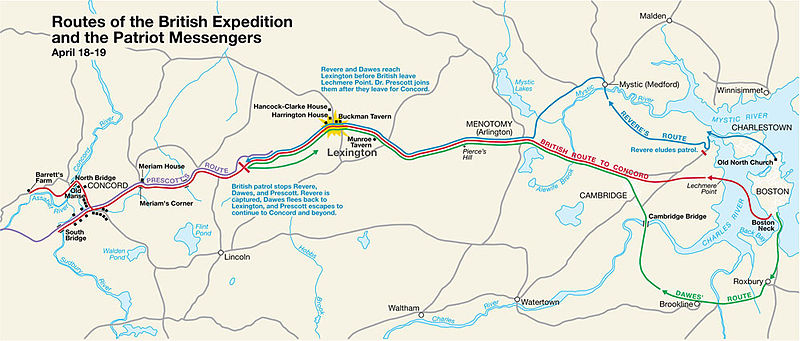
It's impressive how quickly one learns local history when one crams multiple historic sites into three days--and equally impressive how all the details trickle out of one's brain when one doesn't take any notes and then waits almost two months to write about it. Fortunately, the war has been well documented elsewhere, so instead of feeling embarrassed about the lack of detail here, I'll simply insert a handy summary map below, courtesy of the U.S. National Park Service, and hope it sufficiently jogs my memory when I look back at it a few years from now. I did learn that, prescriptive rule-follower that I am, I probably would have been a loyalist rather than a patriot. (Indeed, my inner loyalist saw some worrisome parallels between the so-called patriots of 1775 and those of 2010.) I also learned that it's a bad idea to try to march a militia of 700 sleep-deprived soldiers some 40 miles from Boston to Cambridge overnight. Oh--and that it's difficult to paint arms and legs, so portraits are more expensive if you want those body parts included, i.e. it costs an arm and a leg. (Thanks, swell high school intern tour guide at the Massachusetts State House!)
I didn't take a lot of pix, but here's the cream of the crop. Check out the double and triple exclamation points in this monument from 1799!!! It stands at the side of the Lexington Battle Green!! It reflects the righteous joy of a new nation at having cast off the yoke of British tyranny!!! I love the proud expansiveness of the text ("Built in the year 1799"--how about just "Built in 1799"?), and how divine intervention is implied to have played a role in American victory but not in monument carving (compare "the ever memorable Nineteenth of April, An. Dom. 1775" to "Built in the year 1799"), and how the rules of capitalization clearly hadn't been worked out yet ("The Die was cast!!!"), and how sometimes letters are replaced by apostrophes even when there's enough space to spell everything out ("They nobly dar'd to be free!!")!!!
This spiffy window is in the ceiling at the Massachusetts State House--a gorgeous building worthy of triple exclamation points, though we didn't see any there.
Here's my beloved child and my beloved mom. Don't they look great?!!
Last spring, E had a long unit in school on the American Revolution, so our touristy side-trips all had a revolutionary focus. My aunt lives in Lexington, so we visited the Lexington battle green, where the first shots of the revolution were fired on April 19, 1775, and also toured Lexington's historic Buckman Tavern, Munroe Tavern, and Hancock-Clarke House. We saw the reconstructed North Bridge in Concord, and later walked the Freedom Trail from Boston Commons to the USS Constitution (we didn't quite make it to Bunker Hill; next time).
It's impressive how quickly one learns local history when one crams multiple historic sites into three days--and equally impressive how all the details trickle out of one's brain when one doesn't take any notes and then waits almost two months to write about it. Fortunately, the war has been well documented elsewhere, so instead of feeling embarrassed about the lack of detail here, I'll simply insert a handy summary map below, courtesy of the U.S. National Park Service, and hope it sufficiently jogs my memory when I look back at it a few years from now. I did learn that, prescriptive rule-follower that I am, I probably would have been a loyalist rather than a patriot. (Indeed, my inner loyalist saw some worrisome parallels between the so-called patriots of 1775 and those of 2010.) I also learned that it's a bad idea to try to march a militia of 700 sleep-deprived soldiers some 40 miles from Boston to Cambridge overnight. Oh--and that it's difficult to paint arms and legs, so portraits are more expensive if you want those body parts included, i.e. it costs an arm and a leg. (Thanks, swell high school intern tour guide at the Massachusetts State House!)
I didn't take a lot of pix, but here's the cream of the crop. Check out the double and triple exclamation points in this monument from 1799!!! It stands at the side of the Lexington Battle Green!! It reflects the righteous joy of a new nation at having cast off the yoke of British tyranny!!! I love the proud expansiveness of the text ("Built in the year 1799"--how about just "Built in 1799"?), and how divine intervention is implied to have played a role in American victory but not in monument carving (compare "the ever memorable Nineteenth of April, An. Dom. 1775" to "Built in the year 1799"), and how the rules of capitalization clearly hadn't been worked out yet ("The Die was cast!!!"), and how sometimes letters are replaced by apostrophes even when there's enough space to spell everything out ("They nobly dar'd to be free!!")!!!
This spiffy window is in the ceiling at the Massachusetts State House--a gorgeous building worthy of triple exclamation points, though we didn't see any there.
Here's my beloved child and my beloved mom. Don't they look great?!!
Labels:
beloved child,
history,
museums,
parents,
travel
Subscribe to:
Posts (Atom)