Tuesday, June 18, 2013
A blogger abroad
An annual combination of business and pleasure brings us once again to Germany and my old blog
stomping grounds: wadlstrumpf.blogspot.com.

Saturday, June 15, 2013
The NC Maker Faire and the easiest fipple in the world
Today E, S, and I went to the NC Maker Faire--our first Maker Faire experience.

E's highpoint was learning to solder:

He made his very own blinky Make LED robot pin:
When he came home, he added a piece of paper to the back to interrupt the circuit; otherwise the LEDs would blink until the battery ran out.
S's highpoint was seeing the robotic bugs by the folks at www.sheekgeek.com, although I suspect he also enjoyed showing off his biking finesse by zipping his way through SPARKcon's stationary bike race. S handily won the first race; E came from behind to win the second.

My highpoint was learning how to make the least fickle fipple in the world from wood artist Hal Papan. I was drawn to his table of wood whistles when I looked up to see a hands-on wood-whistle-finishing demo in progress. Hal kindly talked to me about fipples and let me finish a whistle too. He had prepared a bunch of nearly-finished whistles, having already carved the bores and cut the bevels and fipple plugs; my task was simply to orient the plug properly and insert it far enough into the bore that it lined up with the vertex of the bevel cut. He had to help me force the plug in far enough, since it was a tight fit, but the nudge-check-nudge-check process was helpful since I could easily hear the difference between the not-quite-there-yet sound and the loud tweet of the aligned plug. It's a very pretty whistle, with lovely knots and curves.

Of course, when I got home, I tried making one out of clay. It was quick work to roll a coil, push a dowel in, and make a plug for the open end. I was too impatient to wait for the tube to stiffen up, so I went ahead and used a wire cheese slicer to cut the bevel. A little bevel tidying and voila--a sounding whistle, with a remarkably straightforward fipple.

My first attempt was a little too big to put my lips around (which I was doing with a conflicted mixture of enthusiasm for the sound and worry that my bag of clay scraps had been growing bacteria for three months on my porch and I really shouldn't be putting the clay anywhere near my mouth), so I smushed the first iteration and tried again with half as much clay--and voila again
The result is a plain can-I-do-it experiment (yes! I can!), but there's clearly room for further experimenting to discover what kind of sound(s) I can get out of these sorts of whistles, to learn how they can be visually beautified (Joe is back at Penland making far more beautiful ones), and to find out whether there's any chicken potential. Tweet tweet.

E's highpoint was learning to solder:

He made his very own blinky Make LED robot pin:
When he came home, he added a piece of paper to the back to interrupt the circuit; otherwise the LEDs would blink until the battery ran out.
S's highpoint was seeing the robotic bugs by the folks at www.sheekgeek.com, although I suspect he also enjoyed showing off his biking finesse by zipping his way through SPARKcon's stationary bike race. S handily won the first race; E came from behind to win the second.

My highpoint was learning how to make the least fickle fipple in the world from wood artist Hal Papan. I was drawn to his table of wood whistles when I looked up to see a hands-on wood-whistle-finishing demo in progress. Hal kindly talked to me about fipples and let me finish a whistle too. He had prepared a bunch of nearly-finished whistles, having already carved the bores and cut the bevels and fipple plugs; my task was simply to orient the plug properly and insert it far enough into the bore that it lined up with the vertex of the bevel cut. He had to help me force the plug in far enough, since it was a tight fit, but the nudge-check-nudge-check process was helpful since I could easily hear the difference between the not-quite-there-yet sound and the loud tweet of the aligned plug. It's a very pretty whistle, with lovely knots and curves.

Of course, when I got home, I tried making one out of clay. It was quick work to roll a coil, push a dowel in, and make a plug for the open end. I was too impatient to wait for the tube to stiffen up, so I went ahead and used a wire cheese slicer to cut the bevel. A little bevel tidying and voila--a sounding whistle, with a remarkably straightforward fipple.

My first attempt was a little too big to put my lips around (which I was doing with a conflicted mixture of enthusiasm for the sound and worry that my bag of clay scraps had been growing bacteria for three months on my porch and I really shouldn't be putting the clay anywhere near my mouth), so I smushed the first iteration and tried again with half as much clay--and voila again
The result is a plain can-I-do-it experiment (yes! I can!), but there's clearly room for further experimenting to discover what kind of sound(s) I can get out of these sorts of whistles, to learn how they can be visually beautified (Joe is back at Penland making far more beautiful ones), and to find out whether there's any chicken potential. Tweet tweet.
Wednesday, June 12, 2013
Morning routine
Four exciting minutes of Schroeder playing fetch with the carrot my mom knitted for him.
Saturday, June 8, 2013
Odyssey check point
The experiment continues.
After finishing The Scarlet Letter, I took a hard-earned romp through some creative nonfiction with David Sedaris' latest book, Let's Explore Diabetes with Owls. It lasted but the blink of an eye, but what a good blink it was. I wonder what the world would be like if U.S. high schoolers had to read Sedaris instead of Hawthorne. Would today's teens relate any better to OCD and colonoscopies than they do to Puritanism and adultery?
And now, boldly forward to what the Muse spoke to Homer of the adventurous man Odysseus. I'm a little more than a third of the way into The Odyssey, having read 9 of the 24 chapters. I'm sure I failed to appreciate, the first time around, that The Odyssey is more than just a story: it's a fascinating guide to geography, family trees, hospitality, manners, recipes, entertainment, deities, monsters, marriage, honor, games, and supplication etiquette.
I started to notice this in chapter 3. Chapters 1 and 2 had been relatively breezy (at least in comparison to The Scarlet Letter), but 3 got bogged down with lineage and places--things like "royal Onomatopoeius, son of Anacoluthon, fleet-footed king of Litotes, set sail on the seventh morning, and spurred by fair winds, returned a victor from war only to be slayed by his plotting uncle Anastrophe of Chiasmus, Anacoluthon's brother, who had, after much effort and with supplications to the deity of extra-marital affairs, successfully seduced Ecphonesis's wife Homiologia," etc. Dear reader(s), if your eyes didn't glaze over and you actually read every word of that, may the deities bless you.
Mixed into this came an excellent lesson on how to properly sacrifice a young heifer to Athene--information that clearly begged to be written down some 2800 years ago because it's something that frankly everyone needs to know. I really related to this part of the book because its how-to-itiveness reminded me of another, more contemporary household companion. Compare the following texts, the ancient and the modern (pardon the genealogy in the former):
How to select husband material for (a) yourself or (b) your daughter:
(a) If Athene comes to you in a dream and reminds you that you're of marriageable age so wouldn't it be a good idea to go do laundry tomorrow morning lest your family's dirty clothes cause embarrassment, and a hungry naked guy washes up on the beach and you discover him in the shrubbery while you're playing catch while waiting for the laundry to dry, but it turns out he cleans up real nice, then declare admiringly, "Hearken, my white-armed women, while I speak. Not without purpose on the part of all the gods that hold Olympus is this man's meeting with the godlike Phaeacians. A while ago, he really seemed to me ill-looking, but now he is like the gods who hold the open sky. Ah, might a man like this be called my husband, having his home here, and content to stay!" (Chapter 6, p. 59)
(b) When you meet the shipwrecked stranger to whom your virtuous virgin daughter gave directions to your house, size up his noble dudeness, and then, even though you recognize it's a long shot, offer him your daughter and your wealth: "O father Zeus, Athene, and Apollo, that such a man as you, so like in mind to me, might take my child, be called my son-in-law, and here abide! For I would give you house and goods if you would like to stay." (Chapter 7, p. 68)
How to poke out the eye of a Cyclops with a stake: This is a real gross-out paragraph, not only for the graphic description of the deed itself, but also because the Cyclops, passed out drunk, vomits wine and bits of chewed up humans (whose brains, incidentally, had already been splattered on the cave floor once before, when Polyphemus slaughtered a pair of men for dinner the night before and another pair for breakfast. There's probably a rhetorical term for this sort of recapitulation, given that skull bashing and vomiting are both variations on the theme of How to Spread Human Brains on Cave Floors). I expect this level of goriness would appeal to pretty much any adolescent in any century; no wonder The Odyssey remains on high school reading lists. In the following excerpt, notice also the handy references to wooden ship building and tempering steel:
How to remind your audience to give you a big tip: Remember, you are da Bard. Whether the Muse motivates you to tell tangential tales about cuckolded deities or to provide brief recaps of the story so far, mention that there's nothing more satisfying than having a good bard around. Use adjectives like "sacred," "honored," "famous," "wondrous," and "noble" to describe folks in your profession, and have your hero compare you to deities thusly:
After finishing The Scarlet Letter, I took a hard-earned romp through some creative nonfiction with David Sedaris' latest book, Let's Explore Diabetes with Owls. It lasted but the blink of an eye, but what a good blink it was. I wonder what the world would be like if U.S. high schoolers had to read Sedaris instead of Hawthorne. Would today's teens relate any better to OCD and colonoscopies than they do to Puritanism and adultery?
And now, boldly forward to what the Muse spoke to Homer of the adventurous man Odysseus. I'm a little more than a third of the way into The Odyssey, having read 9 of the 24 chapters. I'm sure I failed to appreciate, the first time around, that The Odyssey is more than just a story: it's a fascinating guide to geography, family trees, hospitality, manners, recipes, entertainment, deities, monsters, marriage, honor, games, and supplication etiquette.
I started to notice this in chapter 3. Chapters 1 and 2 had been relatively breezy (at least in comparison to The Scarlet Letter), but 3 got bogged down with lineage and places--things like "royal Onomatopoeius, son of Anacoluthon, fleet-footed king of Litotes, set sail on the seventh morning, and spurred by fair winds, returned a victor from war only to be slayed by his plotting uncle Anastrophe of Chiasmus, Anacoluthon's brother, who had, after much effort and with supplications to the deity of extra-marital affairs, successfully seduced Ecphonesis's wife Homiologia," etc. Dear reader(s), if your eyes didn't glaze over and you actually read every word of that, may the deities bless you.
Mixed into this came an excellent lesson on how to properly sacrifice a young heifer to Athene--information that clearly begged to be written down some 2800 years ago because it's something that frankly everyone needs to know. I really related to this part of the book because its how-to-itiveness reminded me of another, more contemporary household companion. Compare the following texts, the ancient and the modern (pardon the genealogy in the former):
Ancient: So after they had prayed and strewn the barley-meal, forthwith the son of Nestor, ardent Thrasymedes, drew near and dealt the blow. The axe cut through the sinews of the neck and broke the heifer's power. A cry went up from the daughters of Nestor, the sons' wives, and his own honored wife, Eurydice, the eldest of the daughters of Clyenus. The sons then raised the beast up from the trodden earth and held her so, the while Peisistratus, ever the foremost, cut the throat. And after the black blood had flowed and life had left the carcase, they straightaway laid it open, quickly cut out the thighs, all in due order, wrapped them in fat in double layers and placed raw flesh thereon. On billets of wood the old man burned them, and poured upon them sparkling wine, while young men by his side held five-pronged forks. So after the thighs were burned and the inward parts were tasted, they sliced the rest, and stuck it on the forks, and roasted all, holding the pointed forks in hand. (Homer, The Odyssey, ca. 8th c. BCE, trans. George Herbert Palmer, 1891, rev. 1912; Dover Thrift Editions: 1999, Chapter 3, p. 27.)
Modern: If possible, trapOther how-to standouts in The Odyssey include:heifer'possum and feed it on milk andbarleycereals for 10 days beforesacrificing to Athenekilling.Gild hornsClean, but do not skin. Treat as for pig by immersing the unskinnedheiferanimal insparkling winewater just below the boiling point. Test frequentlywith pointed five-pronged forksby plucking at the hair. When it slips out regularly, remove theheiferopossum fromsparkling winewater and scrape. While scraping repeatedly, pour coolsparkling winewater over the surface of theheiferanimal. Removeinward partssmall red glands in small of the back and under eachthighforeleg between shoulder and ribs.RoastParblanch about 20 minutes each, in two or three changes ofsparkling winewater, then roast as for pork...Serve with turnip greens. (Irma S. Rombauer and Marion Rombauer Becker, The Joy of Cooking, Bobbs-Merrill Company: 1975, rev. and exp. 1983, "Opossum," p. 515.)
How to select husband material for (a) yourself or (b) your daughter:
(a) If Athene comes to you in a dream and reminds you that you're of marriageable age so wouldn't it be a good idea to go do laundry tomorrow morning lest your family's dirty clothes cause embarrassment, and a hungry naked guy washes up on the beach and you discover him in the shrubbery while you're playing catch while waiting for the laundry to dry, but it turns out he cleans up real nice, then declare admiringly, "Hearken, my white-armed women, while I speak. Not without purpose on the part of all the gods that hold Olympus is this man's meeting with the godlike Phaeacians. A while ago, he really seemed to me ill-looking, but now he is like the gods who hold the open sky. Ah, might a man like this be called my husband, having his home here, and content to stay!" (Chapter 6, p. 59)
(b) When you meet the shipwrecked stranger to whom your virtuous virgin daughter gave directions to your house, size up his noble dudeness, and then, even though you recognize it's a long shot, offer him your daughter and your wealth: "O father Zeus, Athene, and Apollo, that such a man as you, so like in mind to me, might take my child, be called my son-in-law, and here abide! For I would give you house and goods if you would like to stay." (Chapter 7, p. 68)
How to poke out the eye of a Cyclops with a stake: This is a real gross-out paragraph, not only for the graphic description of the deed itself, but also because the Cyclops, passed out drunk, vomits wine and bits of chewed up humans (whose brains, incidentally, had already been splattered on the cave floor once before, when Polyphemus slaughtered a pair of men for dinner the night before and another pair for breakfast. There's probably a rhetorical term for this sort of recapitulation, given that skull bashing and vomiting are both variations on the theme of How to Spread Human Brains on Cave Floors). I expect this level of goriness would appeal to pretty much any adolescent in any century; no wonder The Odyssey remains on high school reading lists. In the following excerpt, notice also the handy references to wooden ship building and tempering steel:
Out of his throat poured wine and scraps of human flesh; heavy with wine, he spewed it forth. And now it was I drove the stake under a heap of ashes, to bring it to a heat, and with my words emboldened all my men, that none might flinch through fear. Then when the olive stake, green though it was, was ready to take fire, and through and through was all aglow, I snatched it from the fire, while my men stood around and Heaven inspired us with great courage. Seizing the olive stake, sharp at the tip, they plunged it in his eye, and I, perched up above, whirled it around. As when a man bores ship-beams with a drill, and those below keep it in motion with a strap held by the ends, and steadily it runs; even so we seized the fire-pointed stake and whirled it in his eye. Blood bubbled round the heated thing. The vapor singed off all the lids around the eye, and even the brows, as the ball burned and its roots crackled in the flame. As when a smith dips a great axe or adze into cold water, hissing loud, to temper it, — for that is strength to steel,— so hissed his eye about the olive stake. A hideous roar he raised; the rock resounded; we hurried off in terror. He wrenched the stake from out his eye, all dabbled with the blood, and flung it from his hands in frenzy.(Chapter 9, p. 87)And finally,
How to remind your audience to give you a big tip: Remember, you are da Bard. Whether the Muse motivates you to tell tangential tales about cuckolded deities or to provide brief recaps of the story so far, mention that there's nothing more satisfying than having a good bard around. Use adjectives like "sacred," "honored," "famous," "wondrous," and "noble" to describe folks in your profession, and have your hero compare you to deities thusly:
Then wise Odysseus answered him and said: "Mighty Alcinoüs, renowned of all, surely it is a pleasing thing to hear a bard like this, one who is even like the gods in voice. For more complete delight I think there cannot be than when good cheer possesses a whole people, and feasting through the houses they listen to a bard, seated in proper order, while beside them stand the tables supplied with bread and meat, and dipping wine from out the mixer the pourer bears it round and fills the cups. That is a sight most pleasing. (Chapter 9, p. 80)
Wednesday, May 29, 2013
Spring growth
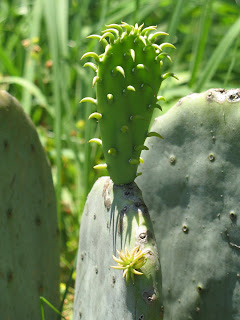
On a walk home from school a few years ago, E and I salvaged some prickly pear pads from a large plant that had been hit by a car. We planted them in the yard and tried to avoid hitting them with soccer balls or lawn mowers, but otherwise ignored them. This long, cool spring, they went into major production mode. We've counted twelve new pads, all a brilliant light green, with pudgy tender milk spines. (I don't know what botanists call them. A biologist friend says the pudgy spines wannabes will fall out to make room for spiky spines.)

In other yard activity, the hot pink lilies are in bloom, looking pretty intent on luring pollinators.


On the screened-in front porch, nondescript lumps of infinite potential are blossoming into thin-walled round things. You'd think this wouldn't surprise me anymore, but when I finished making the pot below, I marveled that homo sapiens likes to reorganize finely weathered silicate-bearing rock into globular forms.




In other yard activity, the hot pink lilies are in bloom, looking pretty intent on luring pollinators.


On the screened-in front porch, nondescript lumps of infinite potential are blossoming into thin-walled round things. You'd think this wouldn't surprise me anymore, but when I finished making the pot below, I marveled that homo sapiens likes to reorganize finely weathered silicate-bearing rock into globular forms.


Saturday, May 25, 2013
The Scarlet Letter: B

My recommendations: skip the Introductory (propose reading it as part of a possible book report project) and cut straight to the main story. Judge the Puritans harshly, forgive them if you will, and remind high schoolers to use protection when they engage in sexual intercourse if they want to avoid making babies.
=============================
1"[A simple slab of slate] bore a device, a herald's wording of which may serve for a motto and brief description of our now concluded legend; so sombre is it, and relieved only by one ever-glowing point of light gloomier than the shadow:— 'ON A FIELD, SABLE, THE LETTER A, GULES'"
2" She wondered what sort of herbs they were which the old man was so sedulous to gather."
3"Without taking overmuch upon myself my good word will go far towards gaining any strange gentleman a fair reception from yonder potentate you wot of."
4"[It] excited neither surprise nor animadversion when so reputable a citizen as old Roger Chillingworth, the physician, was seen to enter the market-place in close and familiar talk with the commander of the questionable vessel."
5"According to these highly-respectable witnesses, the minister, conscious that he was dying—conscious, also, that the reverence of the multitude placed him already among saints and angels—had desired, by yielding up his breath in the arms of that fallen woman, to express to the world how utterly nugatory is the choicest of man's own righteousness."
6"With his own ghostly voice he had exhorted me, on the sacred consideration of my filial duty and reverence towards him—who might reasonably regard himself as my official ancestor—to bring his mouldy and moth-eaten lucubrations before the public."
7"Morally, as well as materially, there was a coarser fibre in those wives and maidens of old English birth and breeding than in their fair descendants, separated from them by a series of six or seven generations; for, throughout that chain of ancestry, every successive mother had transmitted to her child a fainter bloom, a more delicate and briefer beauty, and a slighter physical frame, if not character of less force and solidity than her own. The women who were now standing about the prison-door stood within less than half a century of the period when the man-like Elizabeth had been the not altogether unsuitable representative of the sex. They were her countrywomen: and the beef and ale of their native land, with a moral diet not a whit more refined, entered largely into their composition. The bright morning sun, therefore, shone on broad shoulders and well-developed busts, and on round and ruddy cheeks, that had ripened in the far-off island, and had hardly yet grown paler or thinner in the atmosphere of New England. There was, moreover, a boldness and rotundity of speech among these matrons, as most of them seemed to be, that would startle us at the present day, whether in respect to its purport or its volume of tone."
8This sentence is only 118 words long. I don't know that I could get it up to 139, but I think I did a decent job of delaying the verb until the very end.
Thursday, May 9, 2013
The Downward-Pointing Thumb: Introductory to "The Custom-House: Introductory to 'The Scarlet Letter'"
Present-day me thinks 13-year-old me was onto something when she disliked The Scarlet Letter. I haven't made it to the main story yet, because it has taken me two weeks to slog through the 31-page opening, "The Custom-House: Introductory to 'The Scarlet Letter.'" (On the bright side, needing a break, I read the first two chapters of George Herbert Palmer's 1921 translation of The Odyssey out loud to E, and we both thought it was pretty engaging.)
About halfway through "The Custom-House," I googled "scarlet letter narrator patronizing jerk" but didn't get any useful hits. One enthusiastic video claims that contrary to initial appearances, the Introductory isn't actually boring--Really! It echoes the book, in miniature! Isn't that cool? Such forced enthusiasm suggests the Introductory is, in fact, boring to its present-day primary audience of distressed middle- and high-school readers. (One wonders how Hawthorne's depressed narrator would feel about that; he'd probably just nod his head, knowingly.)
I took notes in the margins while I read and have culled the following five themes, which I offer here to any student desperate for an essay topic:
1. You can't trust the Federal government. That vixenly American eagle looks protectively tender, but she'll claw your eyes out in a heartbeat. Customs officers rely too much on Uncle Sam.
2. Salem is drab and decaying, and the narrator would prefer to be pretty much anywhere else. He has lived in other places, but repeatedly returns to Salem, thanks in large part to the pull of the bones of his imposing Puritan ancestors, who were cruel bigwigs in Salem's early days, and compared to whom the narrator feels like an unremarkable loser. Eventually, the narrator will make a break for it, either in actuality, or through his literary imagination, or by dying. He pretends to be dead near the end of the Introductory so that he can feel like less of a jerk for having written it: "...the sketch which I am now bringing to a close [i.e. "The Custom-House"], if too autobiographical for a modest person to publish in his lifetime, will readily be excused in a gentleman who writes from beyond the grave. Peace be with all the world! My blessing on my friends! My forgiveness to my enemies! For I am in the realm of quiet!"
3. The men who work at the Custom House like to tip their chairs back against the wall, sometimes while they sleep on the job. The narrator offers this detail several times in the Introductory; perhaps he thought it was particularly funny, or so subtle that it bore repeating. To the forlorn high school student with an essay due tomorrow, I offer the following quotes and page numbers:
- p. 4, "[You would discern]...a row of venerable figures, sitting in old-fashioned chairs, which were tipped on their hind legs back against the wall. Oftentimes they were asleep."
- p. 9, "They spent a good deal of time, also, asleep in their accustomed corners, with their chairs tilted back against the wall..."
- p. 10, "...it was pleasant to hear them chatting in the back entry, a row of them all tipped against the wall, as usual..."
- p. 27, "[Might I not, like some of my loser colleagues, decide to make] the dinner-hour the nucleus of the day, and to spend the rest of it, as an old dog spends it, asleep in the sunshine or the shade?" The astute reader should conclude that in Salem, old dogs slept in chairs tipped against the wall.
4. Happy people should be mocked (or, the narrator is a patronizing jerk):
- p. 10, "Externally, the jollity of aged men has much in common with the mirth of children...In one case, however, it is real sunshine; in the other, it more resembles the phosphorescent glow of decaying wood."
- p. 12, "[The 80-year-old Head Inspector, despite outliving everyone else in his family, remained happy]....He was, in truth, a rare phenomenon: so perfect in one point of view; so shallow, so delusive, so impalpable, such a nonentity, in every other. My conclusion was that he had no soul, no heart, no mind...."
- p. 12, in which the happy Head Inspector is compared to a dog: "One point, in which he had vastly the advantage over his four-footed brethren, was his ability to recollect the good dinners which it had made no small portion of the happiness of his life to eat."
- p. 14, regarding the Collector, "Nevertheless, looking at the old warrior with affection,--for, slight as was the communication between us, my feeling towards him, like that of all bipeds and quadrupeds who knew him, might not improperly be termed so,--I could discern the main points of his portrait." Note, incidentally, the use of litotes here!
- p. 15, suggesting the General is a wuss by comparing him to females: "A trait if native elegance, seldom seen in the masculine character after childhood or early youth, was shown in the General's fondness for the sight and fragrance of flowers. An old soldier might be supposed to prize only the bloody laurel on his brow; but here was one, who seemed to have a young girl's appreciation of the floral tribe."
- p. 16, in which the narrator observes he's improving his own character by spending time with people he has criticized for being too happy, vapid, feminine, or sleepy: "It contributes greatly towards a man's moral and intellectual health to be brought into habits of companionship with individuals unlike himself, who care little for his pursuits, and whose sphere and abilities he must go out of himself to appreciate."
5. The narrator is fascinated by how a wig that was buried for 80 years has managed to hold up.
- p. 20, on how the remains of Surveyor Jonathan Pue were "recently" dug up and moved: "Nothing, if I rightly call to mind, was left of my respected predecessor, save an imperfect skeleton, and some fragments of apparel, and a wig of majestic frizzle, which, unlike the head that it once adorned, was in very satisfactory preservation."
- p. 22: "It impressed me as if the ancient Surveyor,...wearing his immortal wig—which was buried with him, but did not perish in the grave—had met me in the deserted chamber of the Custom-House."
- p. 23: "'Do this,' said the ghost of Mr. Surveyor Pue, emphatically nodding the head that looked so imposing within its memorable wig..."
One friend shared with me that she had also felt ambivalent about The Scarlet Letter in high school, but that when she re-read it a few years ago, Hawthorne struck her as a sort of punk rock feminist. I hope he will eventually strike me that way too, as I move into the main body of the book. In any case, given that the Introductory is supposed to encapsulate the story's central themes, I look forward to observing how the five themes described above unfold.
About halfway through "The Custom-House," I googled "scarlet letter narrator patronizing jerk" but didn't get any useful hits. One enthusiastic video claims that contrary to initial appearances, the Introductory isn't actually boring--Really! It echoes the book, in miniature! Isn't that cool? Such forced enthusiasm suggests the Introductory is, in fact, boring to its present-day primary audience of distressed middle- and high-school readers. (One wonders how Hawthorne's depressed narrator would feel about that; he'd probably just nod his head, knowingly.)
I took notes in the margins while I read and have culled the following five themes, which I offer here to any student desperate for an essay topic:
1. You can't trust the Federal government. That vixenly American eagle looks protectively tender, but she'll claw your eyes out in a heartbeat. Customs officers rely too much on Uncle Sam.
2. Salem is drab and decaying, and the narrator would prefer to be pretty much anywhere else. He has lived in other places, but repeatedly returns to Salem, thanks in large part to the pull of the bones of his imposing Puritan ancestors, who were cruel bigwigs in Salem's early days, and compared to whom the narrator feels like an unremarkable loser. Eventually, the narrator will make a break for it, either in actuality, or through his literary imagination, or by dying. He pretends to be dead near the end of the Introductory so that he can feel like less of a jerk for having written it: "...the sketch which I am now bringing to a close [i.e. "The Custom-House"], if too autobiographical for a modest person to publish in his lifetime, will readily be excused in a gentleman who writes from beyond the grave. Peace be with all the world! My blessing on my friends! My forgiveness to my enemies! For I am in the realm of quiet!"
3. The men who work at the Custom House like to tip their chairs back against the wall, sometimes while they sleep on the job. The narrator offers this detail several times in the Introductory; perhaps he thought it was particularly funny, or so subtle that it bore repeating. To the forlorn high school student with an essay due tomorrow, I offer the following quotes and page numbers:
- p. 4, "[You would discern]...a row of venerable figures, sitting in old-fashioned chairs, which were tipped on their hind legs back against the wall. Oftentimes they were asleep."
- p. 9, "They spent a good deal of time, also, asleep in their accustomed corners, with their chairs tilted back against the wall..."
- p. 10, "...it was pleasant to hear them chatting in the back entry, a row of them all tipped against the wall, as usual..."
- p. 27, "[Might I not, like some of my loser colleagues, decide to make] the dinner-hour the nucleus of the day, and to spend the rest of it, as an old dog spends it, asleep in the sunshine or the shade?" The astute reader should conclude that in Salem, old dogs slept in chairs tipped against the wall.
4. Happy people should be mocked (or, the narrator is a patronizing jerk):
- p. 10, "Externally, the jollity of aged men has much in common with the mirth of children...In one case, however, it is real sunshine; in the other, it more resembles the phosphorescent glow of decaying wood."
- p. 12, "[The 80-year-old Head Inspector, despite outliving everyone else in his family, remained happy]....He was, in truth, a rare phenomenon: so perfect in one point of view; so shallow, so delusive, so impalpable, such a nonentity, in every other. My conclusion was that he had no soul, no heart, no mind...."
- p. 12, in which the happy Head Inspector is compared to a dog: "One point, in which he had vastly the advantage over his four-footed brethren, was his ability to recollect the good dinners which it had made no small portion of the happiness of his life to eat."
- p. 14, regarding the Collector, "Nevertheless, looking at the old warrior with affection,--for, slight as was the communication between us, my feeling towards him, like that of all bipeds and quadrupeds who knew him, might not improperly be termed so,--I could discern the main points of his portrait." Note, incidentally, the use of litotes here!
- p. 15, suggesting the General is a wuss by comparing him to females: "A trait if native elegance, seldom seen in the masculine character after childhood or early youth, was shown in the General's fondness for the sight and fragrance of flowers. An old soldier might be supposed to prize only the bloody laurel on his brow; but here was one, who seemed to have a young girl's appreciation of the floral tribe."
- p. 16, in which the narrator observes he's improving his own character by spending time with people he has criticized for being too happy, vapid, feminine, or sleepy: "It contributes greatly towards a man's moral and intellectual health to be brought into habits of companionship with individuals unlike himself, who care little for his pursuits, and whose sphere and abilities he must go out of himself to appreciate."
5. The narrator is fascinated by how a wig that was buried for 80 years has managed to hold up.
- p. 20, on how the remains of Surveyor Jonathan Pue were "recently" dug up and moved: "Nothing, if I rightly call to mind, was left of my respected predecessor, save an imperfect skeleton, and some fragments of apparel, and a wig of majestic frizzle, which, unlike the head that it once adorned, was in very satisfactory preservation."
- p. 22: "It impressed me as if the ancient Surveyor,...wearing his immortal wig—which was buried with him, but did not perish in the grave—had met me in the deserted chamber of the Custom-House."
- p. 23: "'Do this,' said the ghost of Mr. Surveyor Pue, emphatically nodding the head that looked so imposing within its memorable wig..."
One friend shared with me that she had also felt ambivalent about The Scarlet Letter in high school, but that when she re-read it a few years ago, Hawthorne struck her as a sort of punk rock feminist. I hope he will eventually strike me that way too, as I move into the main body of the book. In any case, given that the Introductory is supposed to encapsulate the story's central themes, I look forward to observing how the five themes described above unfold.
Subscribe to:
Posts (Atom)
