Friday, March 4, 2011

Post-firing debriefing

As always, I need time to come to terms with my pots post-firing. For example, what I considered yesterday to be disturbing crusty bubbly purple stuff, I now consider (just one good night's sleep later) merely befuddling crusty bubbly purple stuff. But I'm getting ahead of myself. Good news first:

The Moebius Diatom Boxes experienced minimal warpage, and none of the parts stuck together. The photos make them look toastier and bagelier than they are in reality. I expect future MDBs will end up electric or gas fired, maybe with some stains for color, to reduce preparatory exasperation.

My four favorite pieces are square boxes (wheel thrown and altered!) that I glazed top to bottom. They responded beautifully to the soda. The tallest box is about 5" high.

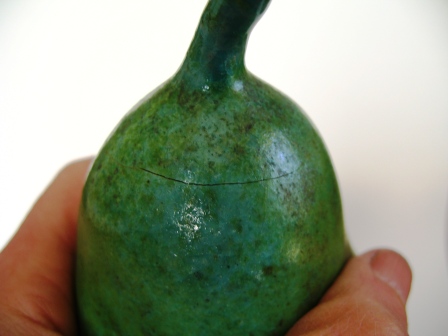
There are two fine pitchers, an excellent bottle, some lush double-walled bowls, a confident teapot, and a juicy green pear (looking artificially green in the photo; it's a little bluer in real life). I consider it a bonus that only one of the pitchers seeps, because--like every other pot I've produced in the past two years that has seeped--they're both made from Loafer's Glory clay. No more Loafer's Glory clay for me (regrettably; it's a lovely clay to work with when it's wet). I have a can of very dangerous highly toxic spray that's supposed to help seal pots, unless the can explodes or the spray poisons you in the process; I haven't tried it out yet, however, because I value functioning lungs, skin, and eyeballs more than I value my seeping pots, but maybe this spring I'll get out the goggles, gloves, and respirator and give it a whirl.


Here are some chickens mugging for the camera:

I will concede that the bubbly crusty purple stuff looks pretty good on chickens. Here's a close up of the crusty stuff on some cups, where it's less appealing (dry crusty stuff and lips don't go well together):

Upon pieces that are strictly objets d'art, the purple stuff is fine. The objet on the left is actually a vase form on its side, though I very much like the spherical look in the photo. I was planning to give up holes for a while, but I think I'm going to have to try making some hole-filled spheres.

On the Double Torus-Multiple Size Hole/Total Coverage Klein Bottle that's been patiently waiting to be fired since last summer, the purple is a little garish against the green glaze. What am I saying, the [w]hole thing is garish anyway:


I will try sanding the crusty bubbles off of pots that should be functional, such as this bowl and colander, as no one wants little bits of heavy-metal-laden glass to chip off into their noodles:

Also in the category of Pots-That-Have-Been-Waiting-Since-Last-Summer are several wheel thrown and altered oval boxes. Alas, instead of using my purple alumina hydrate wax on the lids, I wadded the lids--with the somewhat predictable result that most of the lids warped. Dang. From here on out, it's alumina hydrate wax for me.

In the Total Fail category are several pieces made from a highly recommended ^5-^8 porcelain that I purchased online. I'm used to porcelain being finicky and S-cracking in the bottoms of bowls and cups, but these pieces split in some very odd places. Several tumblers had vertical cracks down the side, often beginning well below the rim and ending well above the foot. In the photo below of the two tumblers, a long vertical crack cuts through the cup on the left, while some beads of water are leaking through a crack in the cup on the right. The salt-rock pear has a horizontal crack across the top that is, as far as I can tell, completely unrelated to the form. Homer Cat doesn't mind the cracks in the tumblers, since all he sees are People Cups, but these pieces are headed for the trash can. I bisqued all of my porcelain pots well before the outside temperatures dropped below freezing, so I'm at a loss to explain the defects. Schade.

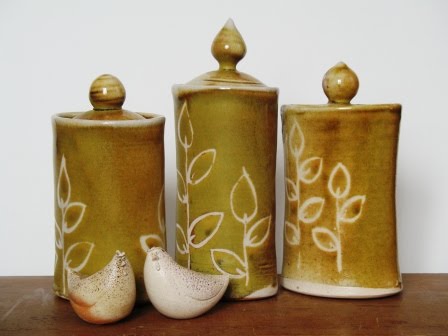
To end on a more positive note, here are some non-crusty, lid-fitting oval jars (does that count as litotes?), and a picture of a flattery* penguin chatting it up with a chicken at an office party (penguin and penguin photo by Bob F.).

*as in, "imitation is the sincerest form of..."
Thursday, March 3, 2011

Unloading

We unloaded the kiln today. Serene Wadding Buddha got a hefty dusting of black soot plus some disturbingly green mystery powder, yet still he sits contentedly on his mat with his wee bird companion and cup of tea (which is not 3/4 full of unmelted glaze). Nothing fazes him.

Here are photos of the front and back stack:

What's that, you say? It looks like something is amiss with the far end of the bag wall*? Why, you're right! It collapsed during the firing. Fortunately, it slumped sideways into the kiln wall rather than tumbling onto the loaded shelves. Casualties included just two bowls, a cup, and a chicken, none of which fell from the wall. Thanks, Serene Wadding Buddha (and to you too, Chipper Dog, of whom I have no post-firing photo)!


The pots were a little dry this time, with a bubbly purple crustiness I've never seen before. If you are less uptight than I am, or if crusty bubbly purple stuff is your thing, or if you are able to squint in just the right way, or if you are one of fifty or so clay chickens, you might be able to find such random and non-replicable surface treatments not entirely displeasing.** I'm working on it. Cedar Creek potter T.T. wondered whether the kiln might have been fuming copper or tin left over from a previous firing ("A.B. sometimes puts pretty wacky stuff in the kiln..."). Indeed, Serene Wadding Buddha's dusting of green looks suspiciously like copper carbonate. Fortunately, a few glazed gems are mixed in with the crustiness. I'll post some photos soon.

*I don't know why a kiln's bag wall is called a bag wall--OED, how could you fail me so?--other than that the bag wall protects the pots by creating a bag of air between the pots and the burning fuel. OED does offer a definition for bag from 18th-century coal-mining lingo that seems to make sense here--"a cavity filled with gas or water."

**I recently learned from a friend that the rhetorical term for these backhanded compliments is litotes.

Tuesday, March 1, 2011

Sneak peek

I went over to Cedar Creek and took photos through the peeps. No puddles of melted clay, no sand-papery unmelted glaze: I shall sleep well tonight.

It's hard to see in the first photo, but I can tell you that the chicken sure has some fine ash on her...


Monday, February 28, 2011

Instruction:

Instruction:: A Found Poem from the Tag of S's New Bike Saddle

Instruction:

The saddle makes different conditions
that depend on the weather and ridders
weight by using


The new saddle will be quite stiff,
after ridding 500-800 kms, it will
become more supple and as like your hip


The leather saddle should be
maintained by leather grease
when it be exposed to the sunshine
and rain


Or it is advised to regular
application leather grease about
once a month after ridding so
that can extend saddle's life


please use a waterproof cover to
protect it when the saddle is not using

Cone 6 Wood Firing

This weekend, a group of friends and I loaded and fired the wood kiln at Cedar Creek. For past firings, we've fired to ~cone 9 (^9, ~2300°F). This time, we decided for several reasons to fire to ^6 (~2240°F). First, wood firing is strenuous work: we stoke the kiln and stir the coals pretty steadily for several hours. Past firings have generally taken 12-17 hours, with the kiln typically stalling out around ^7 or 8. We figured it should be relatively easy and significantly faster to make it to ^6. Second, the lower we fire, the less fuel we use. Burning old pine pallets is one way to recycle, but it isn't exactly environmentally friendly. We hoped that skipping the long stall before ^9 would make a positive dent in the total amount of wood needed. Finally, this past year, Claymakers shifted their reduction firing option from ^9 to ^6. Thus many of the folks in our wood firing group were already using ^6 clay bodies and had easy access to reliable ^6 reduction glazes.

Wood firing is thrilling, but it brings out assorted anxieties in me because, well, I'm generally an anxious person.

Pre-firing organizational anxiety. Is everyone making pots? Will we have too few pots to fill the kiln? Too many pots? Too few? Too many? Waffle waffle, nudge nudge.

Glazing anxiety. So much blank bisqueware, so many decorative decisions. I thank my glazing support group, Rob & Di, for putting up with my anxious chatter during our glazing fest on Friday.

Packing anxiety. All participants are gathered around the kiln, with all pots wadded: do we have too many pots? Too few? Too many short pots, not enough tall? Too many wide pots, not enough narrow? How will we get all those pots into the kiln?

Despite the anxieties, there are few projects I enjoy more than wood firing. We wadded pots Saturday morning (thanks, Charlie, Blanka, Jo, Jessie, & Bob, for the extra wadding help!), and started loading around noon. There's something pleasurably artful about packing a kiln efficiently, fitting all the puzzle pieces together neatly. That pleasure, combined with a dose of packing anxiety, leads to a tendency to pack the back of the kiln tightly (when we're concerned about fitting everything in efficiently) and to pack the front loosely (when we start running out of pots because we packed the back so beautifully). I think we found a good balance this time.

Despite early projections, it turned out we had room to spare. We were short on tall pots, so we had to leave some gaps toward the top of the kiln. Still, it was the most elegantly loaded kiln I've ever had the pleasure of sharing, with a lovely assortment of pots. Two wadding kiln gods went into the kiln for good luck (thanks, Charlie & Di!). Serene Wadding Buddha and Chipper Dog remind me to chill.

We fired on Sunday. Rob and Blanka started the kiln at 7am. By 1pm, we still had some 1200 degrees left to go. Stoke, stir, stoke, stir. A smaller amount of clay requires less time to heat than a larger amount of clay, and we had twice as many pots on the bottom of the kiln as on the top, so we had a hard time heating the bottom of the kiln. The back stack also heated more slowly than the front. Consequently, as the pyrometric cones at the front middle and top of the kiln started arriving at ^6 and ^7, the ^5 cones at the bottom and back of the kiln remained stalwartly upright.

Had we been firing to ^9, we could have plowed right through that unevenness. Instead, just as we would have with a ^9 firing, we spent the final couple of firing hours trying to even out the temperature throughout the kiln, attempting to hold the top of the kiln at ^6 while heating the bottom and back. Thus Zeno's dichotomy paradox applies during firings! (If Zeno wants to buy a peach, he knows that he can't just walk to the farmer's market: he needs to walk a block further than the farmer's market and stop at the peach stand en route. Silly us, we though we could get away with just walking to the farmer's market.)

Eventually, we got the cool parts of the kiln up to a passable ^5-^6, with the middle and top of the kiln at ^7, and we sprayed in the soda ash. Because soda acts as a flux, it makes the pyrometric cones melt more; by the time we were done spraying (~8pm), all of the ^7 cones were totally obliterated.

The last anxiety mode is until-we-unload anxiety, which I didn't realize was on my list until I started dreaming last night:

Some of us (I'm not sure who) sneak over to Cedar Creek to open the kiln--too soon, too soon!--in the pale pink-blue-gold-gray light of early dawn. Other faceless people--strangers--are present on the roof, but we don't want them to see us because we're not really supposed to be there before the gallery opens (liability concerns), plus they'll see us opening the kiln too soon. They don't appear interested in us, however, because they are busy watching the festive fireworks going off over the distant horizon. In a rustic barn, where we bring the surreptitiously unloaded pots (we know we may look at the pots in the kiln, but we aren't supposed to move them until the whole group is gathered on Thursday; but it's always so hard to resist!), we see that everything is underfired; somehow, even the pots that are overfired are underfired. The sand-papery glazed surfaces have rectangular bits of some unmelted glaze chemical all over them. I forget to check how the slipped surfaces have fared because I am so distracted by the glaze defects. Apparently we also forgot to empty some of the pots when we put in the liner glazes: some of the cups are 3/4 full of unmelted glaze. We can tell, looking down at the pots from our vantage point near the kiln roof (we don't want to climb all the way up onto the roof, lest the fireworks-gazers get suspicious), that the whole load is like that, but because of the cups full of glaze, refiring isn't an option, even though we know no one else will be using the kiln this coming weekend. I am foggily aware that there are a logical inconsistencies in all of this, which causes me to wake up.

I might just have to go pull a peep brick on Tuesday to make sure everything looks OK. We unload the kiln on Thursday.

Friday, February 25, 2011

Lessons learned

Friends and I are firing pots in the wood kiln at Cedar Creek this weekend, which means I'm up late tonight organizing and prepping pots. Near the end of the firing, we will spray into the kiln a solution of soda ash that has been dissolved in boiling water. The sodium in the soda ash will react with silica in the clay bodies, creating sodium silicate (glass), effectively glazing the pots. Soda ash is a flux, so it will also lower the melting point of any glazes that we might use to decorate the pots, hopefully creating beautiful glaze effects.

To prevent the pots from glass-fusing to the kiln shelves, we will glue little balls of wadding under the pots. Wadding is a mixture of kaolin (clay), alumina hydrate, and grog (ground bisqued clay); it doesn't react to soda ash. We also use wadding to keep lids from fusing to pots--and depending on how we stack things, also to keep pots from fusing to pots.

Enter my four prototype Moebius Diatom Boxes. I can't separate the two Moebius strips with wadding because there's no way to prop either up on wadding without impractical and precarious balancing acts. Moreover, if the two strips end up touching one another, they'll likely fuse together at the contact point.

So I surfed the internets and found a strategy: coat the edges of the two Moebius strips with wax that has alumina hydrate dissolved in it. After the wax burns off, the remaining thin layer of alumina hydrate will protect the clay from the soda ash. I found assorted recipes for this special wax, most of which can be summarized as follows: "use, oh, a spoonful or so alumina hydrate in, oh, half a pint or so of thinned wax."

So I bought a little container of wax and added some red food coloring to distinguish it from my unadultered wax, and then I added two teaspoons of alumina hydrate. Turns out alumina hydrate doesn't dissolve in cold un-thinned wax, so I had to give the container a nice warm bath this evening. Also turns out that pink wax is next to impossible to see on pink bisque ware. I subsequently added some blue food coloring, but it turns out that purple wax is also next to impossible to see. It also turns out that it's next to impossible for one person alone to wax the rims of two clay Moebius strips without the patient assistance of a Moebius-Strip Bearer (a.k.a. S), for if the wet wax on one strip touches the surface of the other strip, it will (in theory) leave a deposit of alumina hydrate on the pot, preventing soda from reacting with the clay in that spot.

Anyway, it was a pain in the patootie to wax the things, which suggests they will remain very rare items indeed. Now I'm going to bed.

Thursday, February 17, 2011

Avoid Nominalizations

My series of writing workshops for engineering students ended this afternoon. If the enthusiastic writers who attended remember just one tidbit of information from our time together (other than how much fun we had, of course), I hope it is this: avoid nominalizations. Because it is such a great tidbit, I'm proselytizing to you too, gentle reader(s).

Avoid nominalizations.

Perhaps additional repetition will help you remember to avoid nominalizations.

I didn't learn the word nominalizations until 2004, some six years after I finished my doctoral dissertation, so it's not as though a person can't get through written life without avoiding them. (Another helpful writing tidbit is avoid double negatives; see the previous sentence if you need proof. But on an egregiousness scale of 1 to 10, where 1 is least egregious and 10 is most egregious, double negatives hover around 0.5, while excessive nominalizations score a hefty 11.6.)

A nominalization is an action that resides in a word other than a verb. Nominalization, for example, is a nominalization (a noun-ification) of the verb to nominalize (to noun-ify). Most (but not all) -tion and -sion words are nominalizations. Remediation, infatuation, solicitation, elucidation, radiation, multiplication--these are all actions that could be expressed as verbs (remediate, infatuate, solicit, elucidate, radiate, multiply) but are instead nouns. (Words like nation and sedition are a little trickier. They were perhaps verbs at one point, before settling into permanent English noundom. At the root of nation is the past participle of nāscī, "to be born"; and sedition comes from seditio, which combines the prefix se- [apart] with the verb ire [to go]. But I digress.) Many nominalizations skip happily past -tion/-sion suffixes altogether: the influence, the score, the report, the failure...you get the idea.

In English, we like our actions in verbs. We like verbs so much that when they are delayed by intervening words, we get antsy. That's why languages like German can throw native English speakers for a loop:
German lets you postpone verbs for miles and miles. (For remarkable examples, see Mark Twain's essay, The Awful German Language.)

So we English speakers like actions in verbs, and we like our verbs up front. When an excessive number of actions appear in nouns, we get confused, annoyed, or both. Consider:

The cause of the impartment of obfuscation on meaning is the unnecessary placement of actions in nouns.

(Translation: We obscure meaning when we
unnecessarily place actions in nouns.)

Hey, I hear all of you out there in internet space, saying to yourselves, "sure, the understanding of the cause of challenges from the putting of actions into nouns is important, but what about the influence of the ordering of words on the meaning of a sentence?" To which I would simply reply, "verbs and cohesion walk hand in hand. Put your actions into verbs, and you shall not regret it."