Saturday, June 11, 2011

Race for the Cure 2011

Here are JM and I in our sweaty post-race glory. On our team of 20, we were the sole competitive 5Kers this morning at the Raleigh Race for the Cure. Other Team Amazing Us members did the recreational 5K or the Sleep-In-for-the-Cure. J didn't beat her personal best, but she did manage to sleep until a respectable 9:30am, while L stayed in bed until an impressive 10:30am.

The advantage of doing the competitive 5K is the same as the disadvantage: it starts at 7am. Starting early means cooler temps, no lines for parking, no lines for the shuttle bus, and being surrounded by a sea of runners rather than walkers; but it also means leaving Durham around 5:45am.

Next year, I plan to organize an environmentally-friendly Durham satellite team: rather than getting up pre-dawn and converting gasoline into exhaust by driving all the way to Raleigh, we'll get up with the sun and go for a 5K run/walk on a local trail. Alas, we won't bond with 25,000 other runners/walkers, but we'll bond with one another. And planning a year in advance to stay local, as opposed to wearily suggesting it the night before, will mean we're being intentional about it rather than bailing at the last minute.

Our team raised $2,700 this year, thanks to numerous generous donors, and 33 chickens found new homes.

Unfortunately, the list of friends for whom I run grows longer every year. This morning's run was in honor of CB, BC, TS, LF, JdM, JK, FO, CL, LC, and JF.

Thursday, June 9, 2011

Radiolarians

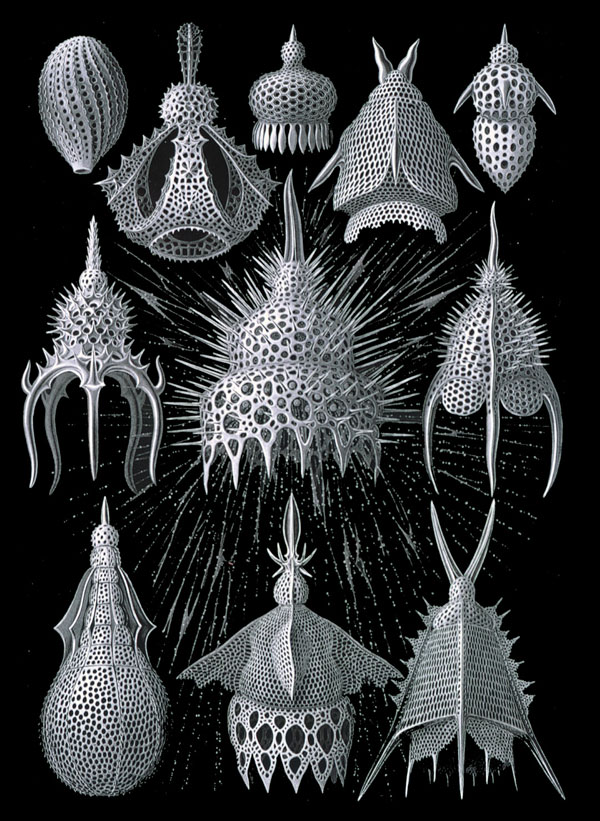
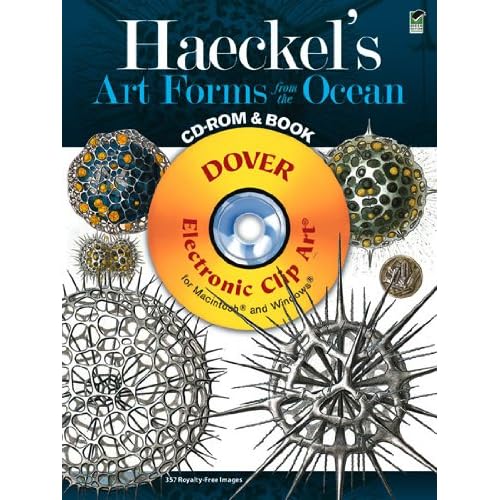
I belatedly learned about diatoms over a year ago, but it wasn't until just the other week that I learned about radiolarians. I was leafing through some junk mail--the Dover catalog of children's books--when I came across Haeckel's Art Forms from the Ocean.* Thank you, junk mail! The Dover blurb states, "The tiny single-celled organisms known as radiolarians (or radiolaria) develop beautiful, intricate mineral skeletons that cover ocean floors throughout the world." Radiolarians? Spherical skeletons with lacy holes and spikes? Whoowee! Diatoms gone wild!

Naturally, I googled "radolaria[ns]" and found a wealth of swell images (most of which are copyrighted, of course, so, ya know, click on the ones below to see the original sources):

I also googled Haeckel and learned that he faked illustrations of embryos in order to support his ideas about evolution, and that those fake illustrations have made their way into assorted contemporary biology textbooks. Perhaps he faked a few radiolarians as well; indeed, it's hard to believe he had real life sources for such fantastic microscopic skeletal remains as these:


Anyway, you know what I gushed about on the last day of Pottery for Geeks.**

While much radiolarian art on the interwebs is created using 3D printing (which, I dunno, kinda seems like cheating), one Bavarian ceramicist, Gerhard Lutz, hand builds exquisitely delicate porcelain radiolarians that put my wheel-thrown ones to shame.

*I'm not quite sure how a CD-ROM of an 1862 atlas of microscopic oceanic lifeforms got mixed in with Dover's At the Beach Fun Kit and Something's Fishy! Undersea Designs to Color, but I'm glad it did.

**I also gushed about the Pythagorean Cup, a.k.a. the Cup of Tantalus, a classical Greek wine goblet that punishes gluttony by siphoning out its entire contents when overfilled. It turned out no one in the class felt a need for an anti-gluttony cup, so we didn't try making any.

Tuesday, May 31, 2011

The Tooth Fairy corresponds again

tooth fairy,

i've Lost another tooth the topmolar
and I broke my arm
Please send me something usefull

E

------------

5/30/11
Dear E,

goodness gracious, what do you mean, you broke your arm? I hope it did not hurt too much and that you are on the mend. I myself have never broken any bones, although as you can imagine, I encounter chipped teeth more often than I would like. Fortunately, the tooth under your pillow tonight appears to be in excellent shape--just the sort of deciduous first molar we tooth fairies like to see.

You requested something useful (what a practical boy you are!). I looked in my bag and found all sorts of useful things: rubberbands, shoelaces, sponges, a field guide to reptilian teeth, floss, nail clippers, emergency flares, fruit bat homing beacons, staples, washcloths, spare buttons, band-aids, noodles (no, no, silly, not the kind you swim with, but the kind you eat!), clean underwear, soap, calculators, an abacus, paperclips, plastic monkeys (sometimes my friend the fruit bat needs to relax after a stressful night at work), inflatable rubber raft, shooting stars, pixie dust, etc. etc. Oh, and this 10 euro bill. If I know you, you're likely to find yourself in Germany this year. Spend it well. It's a little more than the going rate for a molar, but given your broken arm, you can probably use some extra TLC.

Keep on brushing, and don't forget to FLOSS!

Love,
The Tooth Fairy
XOXOXO

Monday, May 23, 2011

Melodious chickens

What with E's broken arm, there hasn't been much time to experiment this week. Pottery for Geeks has already covered nesting spheres, interlocking torus boxes, double-walled bowls, and two different Klein bottle strategies (the simple "double torus" and the elegant "Klein bottle bottle"). We might could* discuss Borromean rings, but there really isn't much point to making wheel-thrown ones. I'm running out of ideas, and we still have two classes left.

So after I tucked my plucky but tender boy into bed tonight, I brainstormed and decided to figure out how to make an ocarina that actually whistles. I've attempted ocarinas before, but they've been airy duds, and I figure there's abundant topical material here to keep geeks happy: air flow, turbulence, the sorry consequences of sloppy 45o angles, resonance cavities, frequency, pitch, sine waves, and, of course, chickens.** After a little reading, popsicle-stick collecting, and poking and prodding--eureka!

Because safety in the dining room lab is a priority, my research was accompanied by a cup of full-bodied Spanish Montebuena Rioja (2009). Testing whistles means blowing into chicken butts. While the chickens themselves are vigilant about personal hygiene, the wet clay with which they are made can host nasty microorganisms (something to discuss with the professional biologists in my class). After getting clay in my mouth more than once, I figured swishing with 13.5% alcohol might not be a bad idea.

*Note the proper colloquial usage of the Southern American English double modal.

**This is a joke. We're the science type of geek, not the type that bites heads off chickens (I hope). For the record, no chickens were harmed during the creation of these whistles.

Sunday, May 22, 2011

Dang

No, no, no. This is not what an arm should look like. This arm is wrapped in a splint from the armpit to the palm because the ulna broke on Thursday during an improper alignment of the stars at the bottom of a slide on a school playground immediately following three long, mind-numbingly boring mornings of End-of-Grade exams (boo, evil consequences of No Child Left Behind, I say, boo!). The human to whom this arm belongs is understandably not a happy camper, but is doing better with each day and looks forward to trading the splint for a cast.

Tuesday, May 10, 2011

Clay B.S. grinder

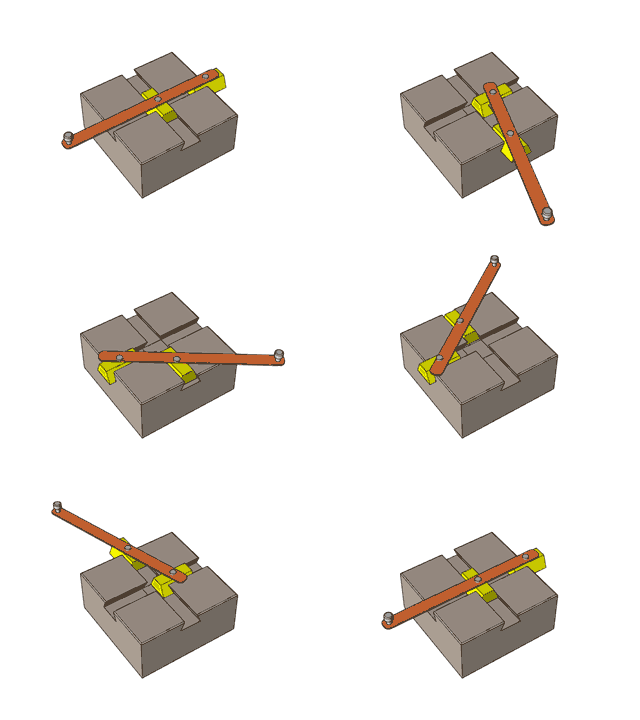
When I was a kid, my mom's parents had a toy they called a bullshit grinder. I just assumed my grandfather made up the name, but it turns out the term "bullshit grinder" is as classic as the toy itself.

If you search Wikipedia for "bullshit grinder," you will be redirected to the much more sanitary and academic "Trammel of Archimedes." The Trammel of Archimedes is noteworthy because its handle traces out an ellipse. Indeed, that appears to be the sole purpose of the Trammel of Archimedes, other than grinding bullshit.

Why do I bring this up? I recently made a petite model of the kitty geek toy. The whole toy fits neatly in the palm of one [human] hand, just like the Trammel of Archimedes, and with a slight flick of the wrist, it's easy to keep the inside ball in motion. The ball traces a circular rather than elliptical path, but the mind-numblingly pleasing yet useless repetitiveness of the non-goal-oriented process echoes the functionality of the bullshit grinder. While I have not tested the grinding efficacy of the Trammel of Archimedes, I have empirical evidence that the petite kitty geek toy is remarkably good at grinding wayward gnats.

All in a day's work, filling gaps the world never knew it had.

Sunday, May 1, 2011

Variations, take 2

My dad recently sent me this photo of the Flentrop manuals at Duke Chapel, in an email with the subject header "reminder." So amidst all the clay geek toys (and extra Holy Week and Easter services), I should report that I've been reasonably diligent about practicing the Dupré Variations. I took them for a test spin in a lesson with David A. on the Aeolian organ at Duke Chapel last week, and they didn't sound anywhere near as maliciously capricious as they did when I first started avoiding them. Indeed, it was amazingly informative and liberating to play them on such an expansive instrument. I'd even go so far as to say quite enjoyable. There's hope for me yet.